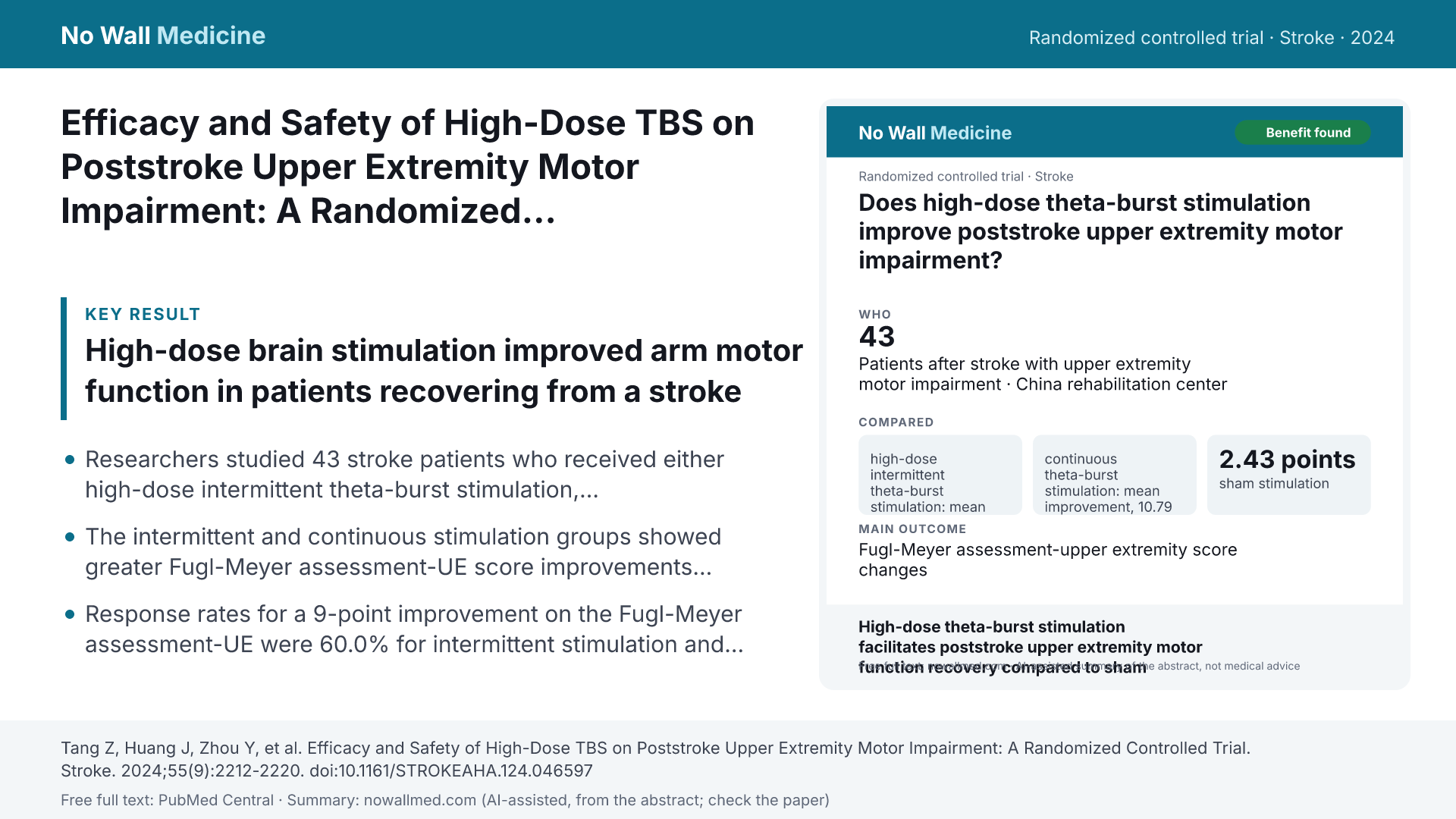
High-dose brain stimulation improved arm motor function in patients recovering from a stroke
Efficacy and Safety of High-Dose TBS on Poststroke Upper Extremity Motor Impairment: A Randomized Controlled Trial
Randomized controlled trialBenefit found
Does high-dose theta-burst stimulation improve poststroke upper extremity motor impairment?
Who
43
Patients after stroke with upper extremity motor impairment · China rehabilitation center
Compared
high-dose intermittent theta-burst stimulation: mean improvement, 10.73 points
continuous theta-burst stimulation: mean improvement, 10.79 points
2.43 pointssham stimulation
Main outcome
Fugl-Meyer assessment-upper extremity score changes
Bottom line: High-dose theta-burst stimulation facilitates poststroke upper extremity motor function recovery compared to sham stimulation.
Stroke · 2024-07-17 · Save PNG
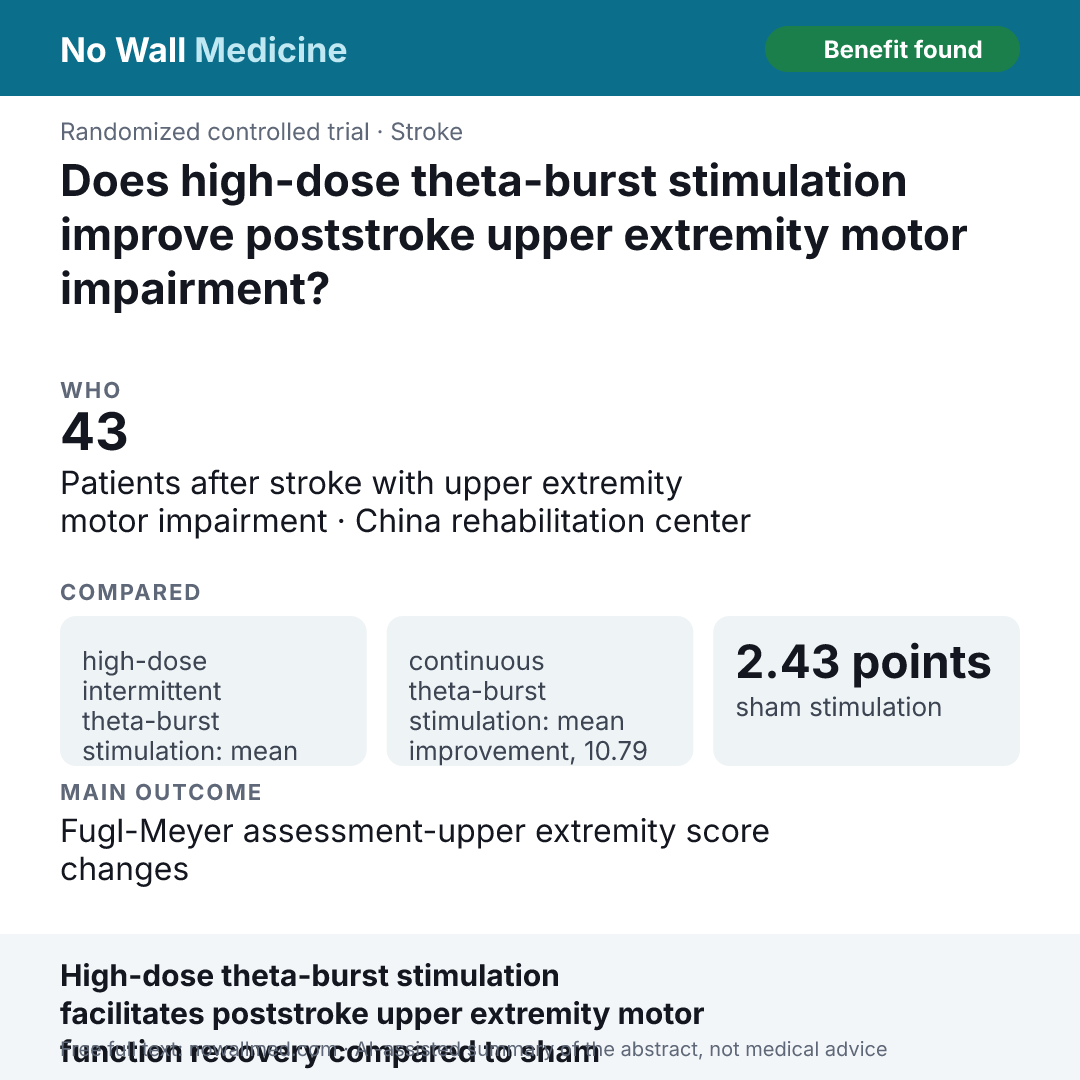
Clinical question: Does high-dose theta-burst stimulation improve poststroke upper extremity motor impairment?
Why it matters: Recovering motor function in the arm remains a challenging task for patients following a stroke.
Key points
- Researchers studied 43 stroke patients who received either high-dose intermittent theta-burst stimulation, continuous theta-burst stimulation, or a sham treatment alongside conventional therapy.
- The intermittent and continuous stimulation groups showed greater Fugl-Meyer assessment-UE score improvements (10.73 points and 10.79 points) compared to the sham group (2.43 points).
- Response rates for a 9-point improvement on the Fugl-Meyer assessment-UE were 60.0% for intermittent stimulation and 64.3% for continuous stimulation, compared to 0.0% for sham.
Headline and key points written with AI from the paper’s abstract, with every number checked against it. Read the paper before relying on them.
Was this summary helpful?
Subject terms
Headline, design, result, key points, caveat and citation as plain text.
Cite this article
Tang Z, Huang J, Zhou Y, et al. Efficacy and Safety of High-Dose TBS on Poststroke Upper Extremity Motor Impairment: A Randomized Controlled Trial. Stroke. 2024;55(9):2212-2220. doi:10.1161/STROKEAHA.124.046597
Spotted a mistake? Suggest a correction