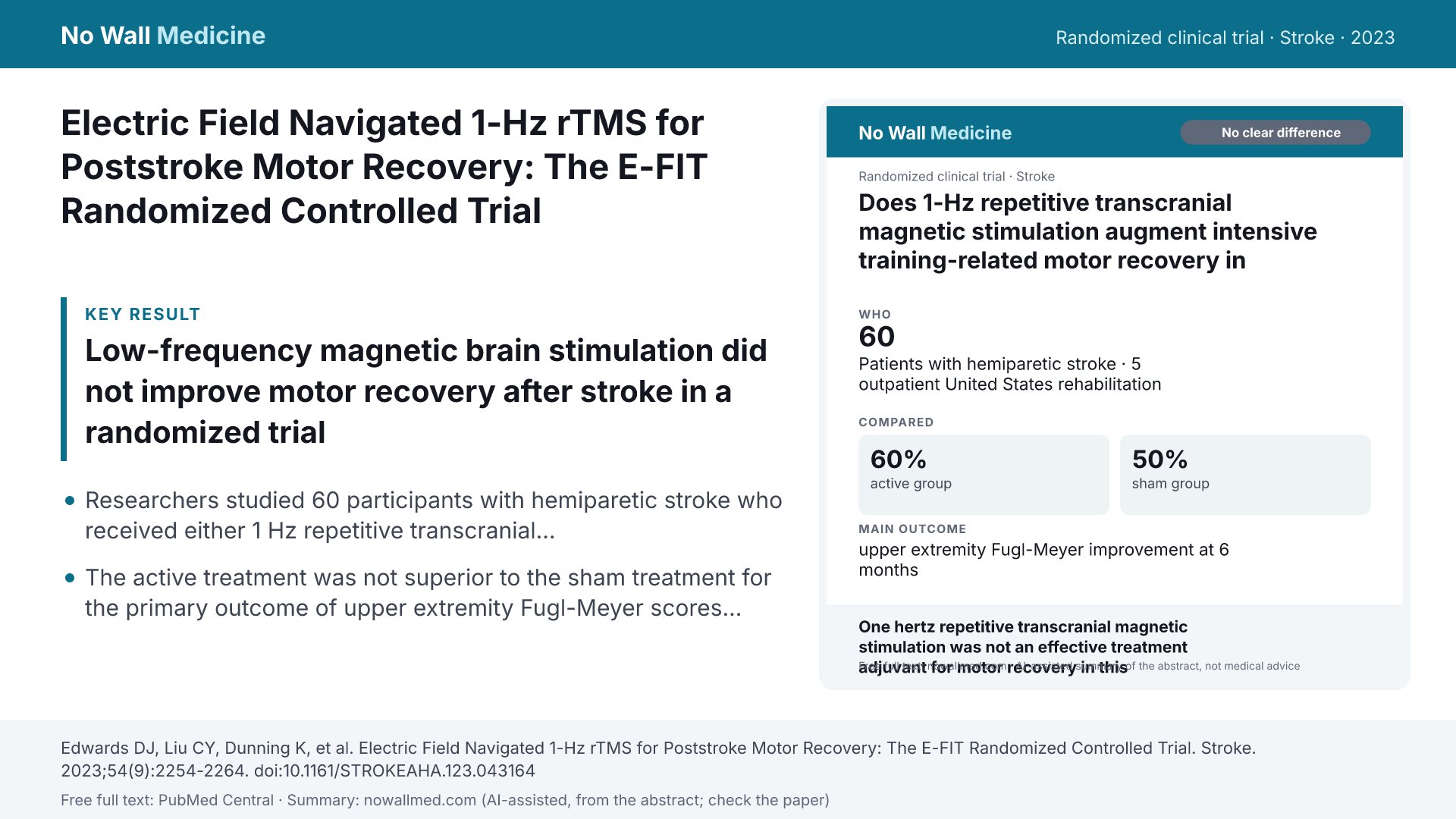
Low-frequency magnetic brain stimulation did not improve motor recovery after stroke in a randomized trial
Electric Field Navigated 1-Hz rTMS for Poststroke Motor Recovery: The E-FIT Randomized Controlled Trial
Randomized clinical trialNo clear difference
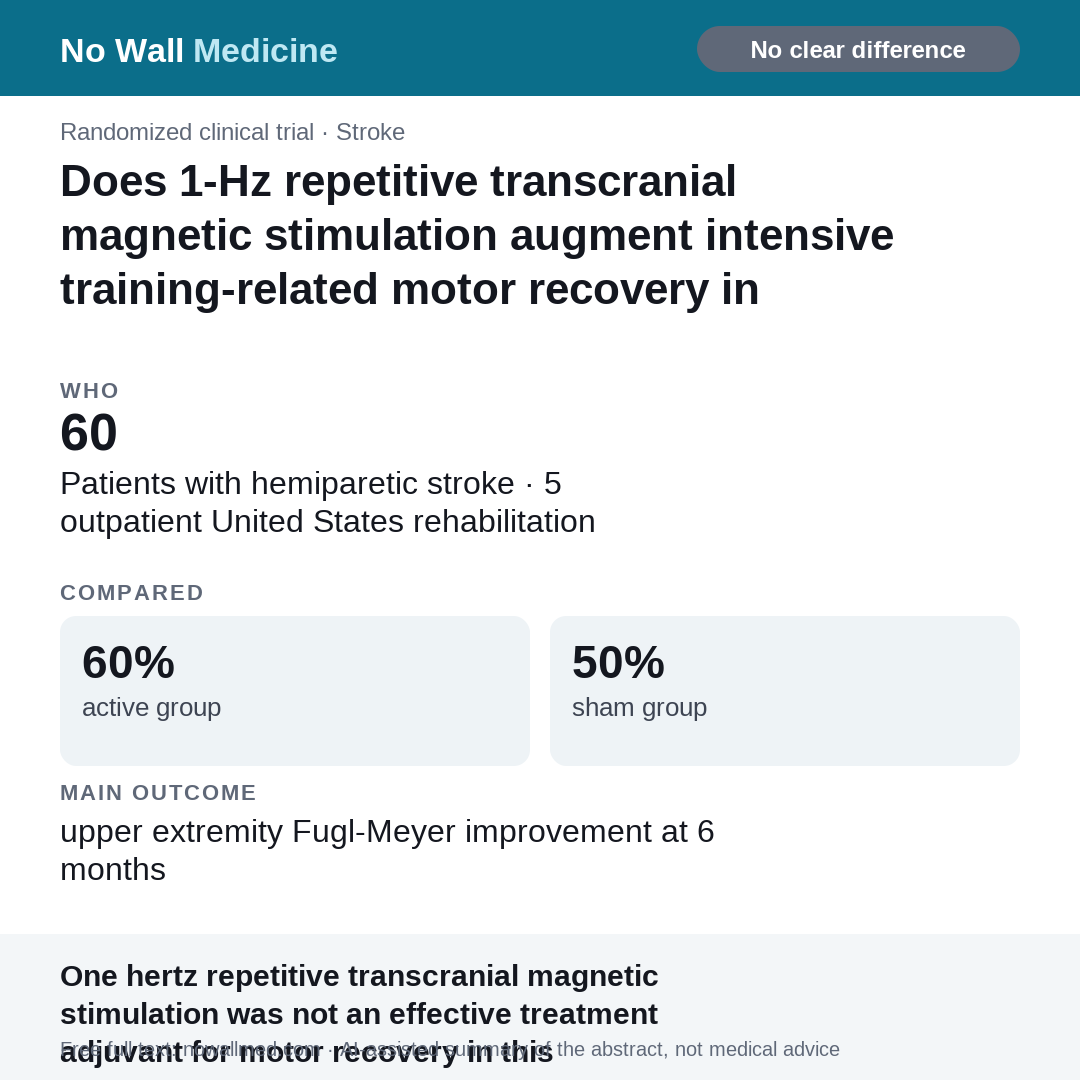
Does 1-Hz repetitive transcranial magnetic stimulation augment intensive training-related motor recovery in hemiparetic stroke?
Who
60
Patients with hemiparetic stroke · 5 outpatient United States rehabilitation centers
Compared
60%active group (18/30)
50%sham group (14/28)
Main outcome
upper extremity Fugl-Meyer improvement at 6 months
Result: posterior mean odds ratio of 1.94 (96% credible interval 0.61-4.80)
Bottom line: One hertz repetitive transcranial magnetic stimulation was not an effective treatment adjuvant for motor recovery in this population.
Limitation: mixed lesion location and extent
Stroke · 2023-08-14Download image
Clinical question: Does 1-Hz repetitive transcranial magnetic stimulation augment intensive training-related motor recovery in hemiparetic stroke?
Key points
- Researchers studied 60 participants with hemiparetic stroke who received either 1 Hz repetitive transcranial magnetic stimulation or a sham treatment before intensive therapy.
- The active treatment was not superior to the sham treatment for the primary outcome of upper extremity Fugl-Meyer scores 6 months after treatment.
- In the intent-to-treat group, upper extremity Fugl-Meyer improvement of 5 points or more occurred in 60% of the active group and 50% of the sham group.
Headline and key points written with AI from the paper’s abstract, with every number checked against it. Read the paper before relying on them.
Was this summary helpful?
Subject terms
Cite this article
Edwards DJ, Liu CY, Dunning K, et al. Electric Field Navigated 1-Hz rTMS for Poststroke Motor Recovery: The E-FIT Randomized Controlled Trial. Stroke. 2023. doi:10.1161/STROKEAHA.123.043164
Spotted a mistake? Suggest a correction