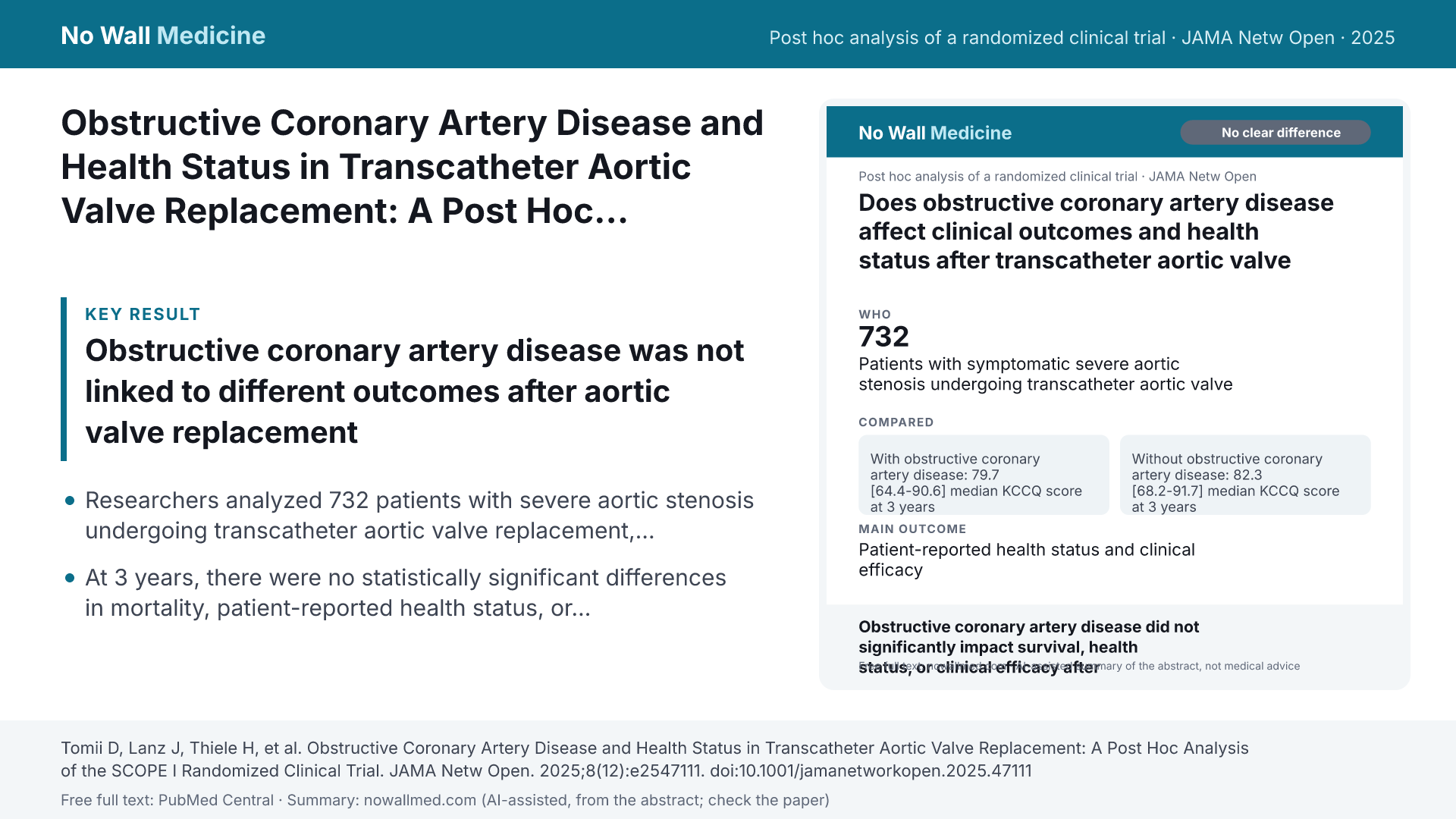
Obstructive coronary artery disease was not linked to different outcomes after aortic valve replacement
Obstructive Coronary Artery Disease and Health Status in Transcatheter Aortic Valve Replacement: A Post Hoc Analysis of the SCOPE I Randomized Clinical Trial
Post hoc analysis of a randomized clinical trialNo clear difference
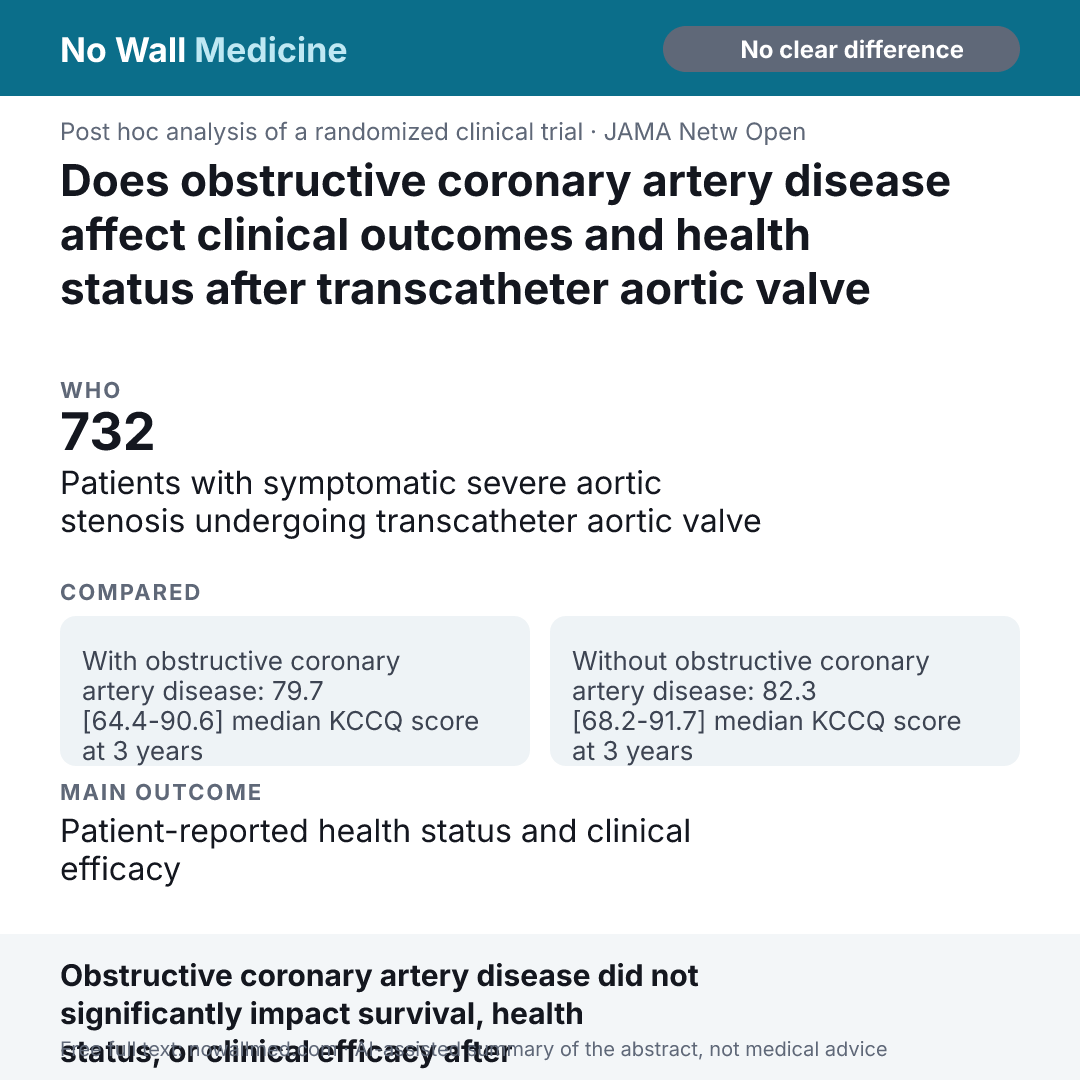
Does obstructive coronary artery disease affect clinical outcomes and health status after transcatheter aortic valve replacement?
Who
732
Patients with symptomatic severe aortic stenosis undergoing transcatheter aortic valve replacement · 20 tertiary heart centers in Europe
Compared
With obstructive coronary artery disease: 79.7 [64.4-90.6] median KCCQ score at 3 years
Without obstructive coronary artery disease: 82.3 [68.2-91.7] median KCCQ score at 3 years
Main outcome
Patient-reported health status and clinical efficacy
Result: adjusted hazard ratio 0.97 (95% CI 0.66 to 1.43) for all-cause death
Bottom line: Obstructive coronary artery disease did not significantly impact survival, health status, or clinical efficacy after transcatheter aortic valve replacement.
JAMA Netw Open · 2025-12-01 · Save PNG
Same trial (NCT03011346)
Papers we list that report this registered trial, oldest first. Read a secondary analysis alongside the main results.
- Secondary analysis No clear difference
This paper JAMA Netw Open 2025-12 - Related report
Sex-Specific Differences in Patient-Centered Outcomes After Transcatheter Aortic Valve Replacement JACC Adv 2026-08
Clinical question: Does obstructive coronary artery disease affect clinical outcomes and health status after transcatheter aortic valve replacement?
Why it matters: It is debated how obstructive coronary artery disease affects clinical outcomes and patient-reported health status in patients undergoing transcatheter aortic valve replacement.
Key points
- Researchers analyzed 732 patients with severe aortic stenosis undergoing transcatheter aortic valve replacement, comparing those with and without obstructive coronary artery disease.
- At 3 years, there were no statistically significant differences in mortality, patient-reported health status, or clinical efficacy between the two groups.
- The presence of obstructive coronary artery disease was associated with a numerically higher, but not statistically significant, risk of heart attack.
Headline and key points written with AI from the paper’s abstract, with every number checked against it. Read the paper before relying on them.
Was this summary helpful?
Subject terms
Headline, design, result, key points, caveat and citation as plain text.
Cite this article
Tomii D, Lanz J, Thiele H, et al. Obstructive Coronary Artery Disease and Health Status in Transcatheter Aortic Valve Replacement: A Post Hoc Analysis of the SCOPE I Randomized Clinical Trial. JAMA Netw Open. 2025;8(12):e2547111. doi:10.1001/jamanetworkopen.2025.47111
Spotted a mistake? Suggest a correction