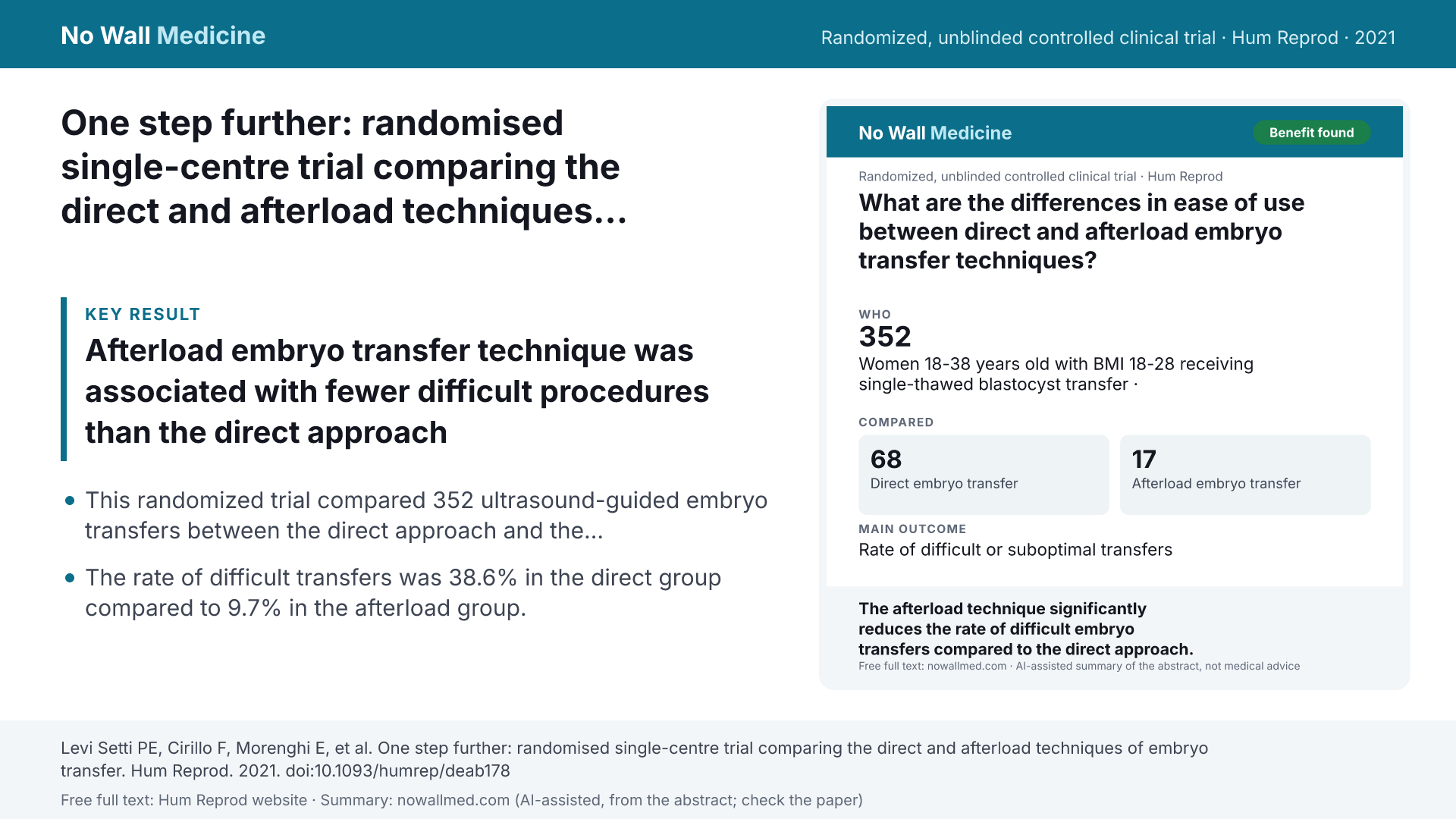
Afterload embryo transfer technique was associated with fewer difficult procedures than the direct approach
One step further: randomised single-centre trial comparing the direct and afterload techniques of embryo transfer
Randomized, unblinded controlled clinical trialBenefit found
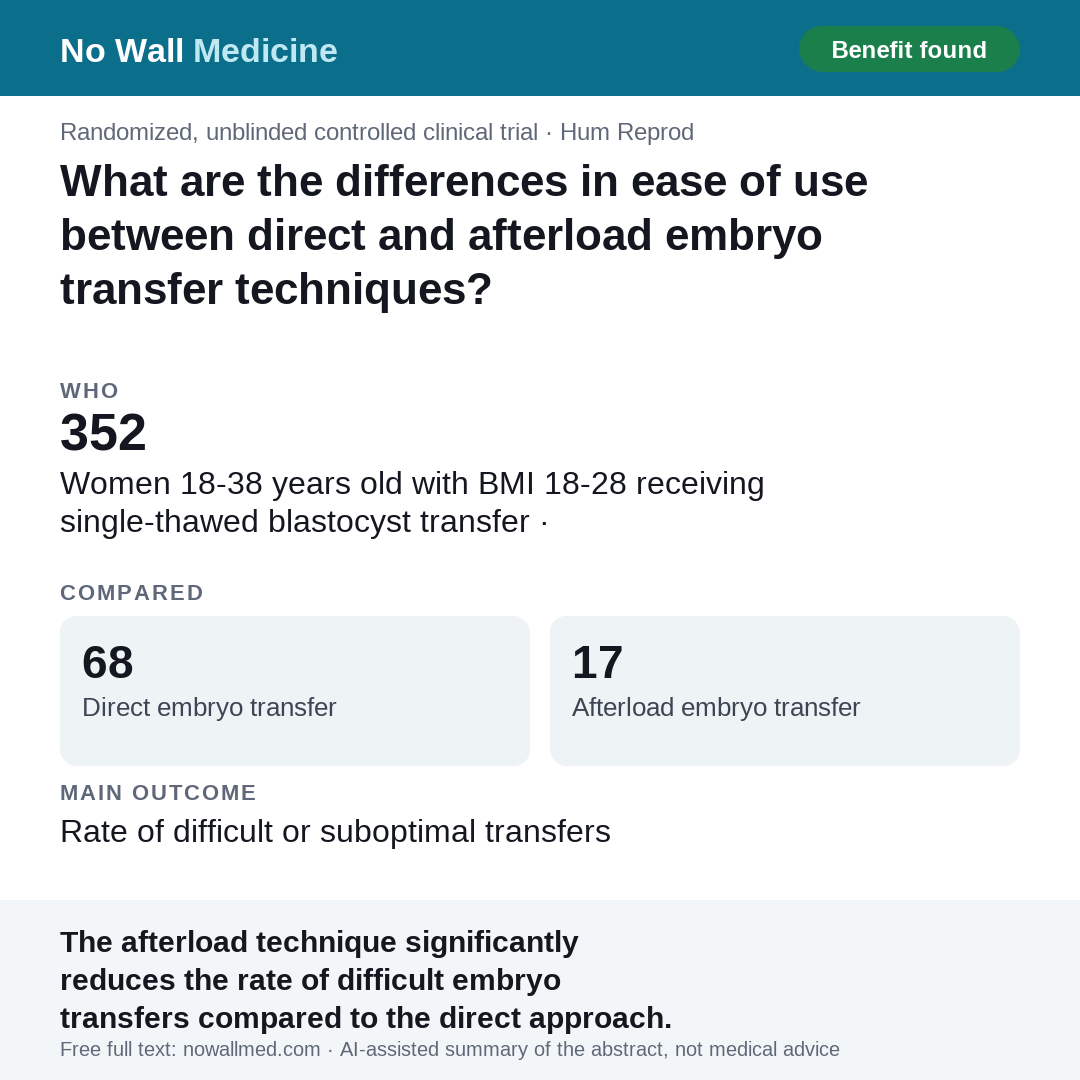
What are the differences in ease of use between direct and afterload embryo transfer techniques?
Who
352
Women 18-38 years old with BMI 18-28 receiving single-thawed blastocyst transfer · Single-centre
Compared
68Direct embryo transfer (38.6%)
17Afterload embryo transfer (9.7%)
Main outcome
Rate of difficult or suboptimal transfers
Result: OR 0.17 (95% CI 0.09-0.30)
Bottom line: The afterload technique significantly reduces the rate of difficult embryo transfers compared to the direct approach.
Limitation: Pregnancy rate conclusions should not be generalised as the difference was not significantly different.
Hum Reprod · 2021-07-30Download image
Clinical question: What are the differences in ease of use between direct and afterload embryo transfer techniques?
Why it matters: It is unknown which technique using soft catheters is preferable to reduce the operator factor during embryo transfer.
Key points
- This randomized trial compared 352 ultrasound-guided embryo transfers between the direct approach and the afterload approach in women aged 18 to 38 years.
- The rate of difficult transfers was 38.6% in the direct group compared to 9.7% in the afterload group.
- Clinical pregnancy rates were 42.0% for the direct group and 48.3% for the afterload group, which was not a statistically significant difference.
Limitation the authors note: The authors state that conclusions about pregnancy rates should not be generalized because the sample analysis was not performed on that outcome and the difference was not statistically significant.
Headline and key points written with AI from the paper’s abstract, with every number checked against it. Read the paper before relying on them.
Was this summary helpful?
Subject terms
Cite this article
Levi Setti PE, Cirillo F, Morenghi E, et al. One step further: randomised single-centre trial comparing the direct and afterload techniques of embryo transfer. Hum Reprod. 2021. doi:10.1093/humrep/deab178
Spotted a mistake? Suggest a correction