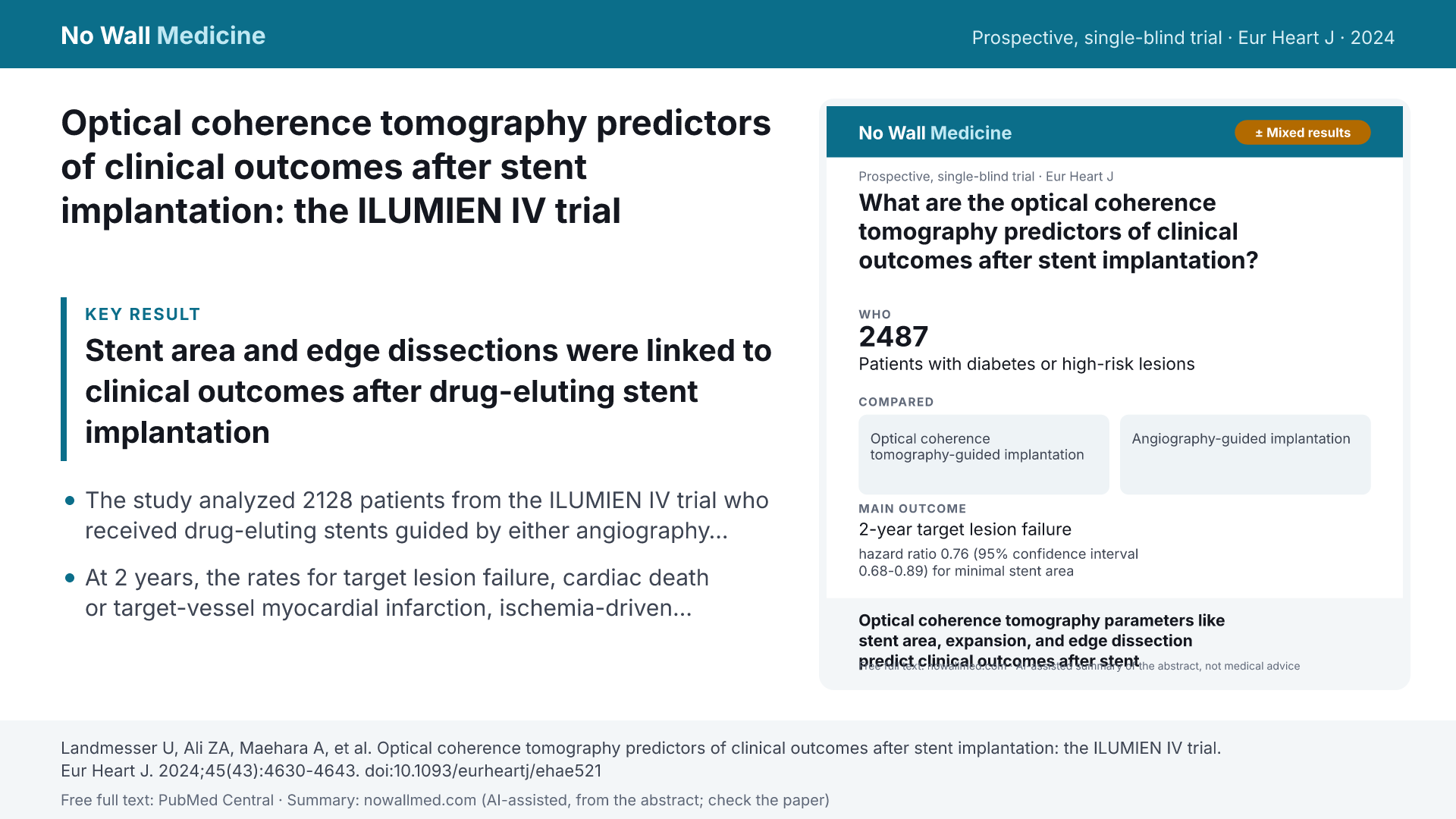
Stent area and edge dissections were linked to clinical outcomes after drug-eluting stent implantation
Optical coherence tomography predictors of clinical outcomes after stent implantation: the ILUMIEN IV trial
Prospective, single-blind trialMixed results
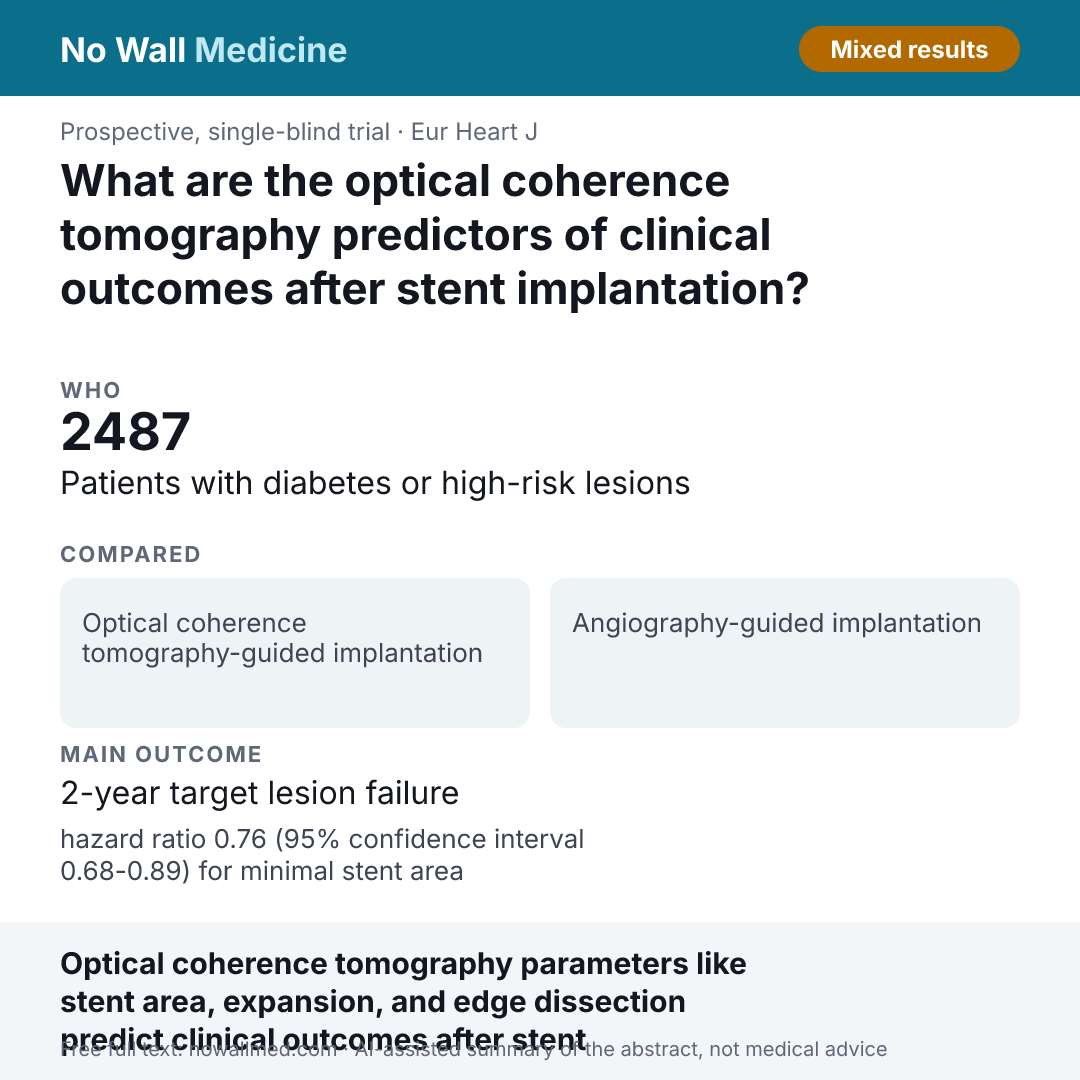
What are the optical coherence tomography predictors of clinical outcomes after stent implantation?
Who
2487
Patients with diabetes or high-risk lesions
Compared
Optical coherence tomography-guided implantation
Angiography-guided implantation
Main outcome
2-year target lesion failure
Result: hazard ratio 0.76 (95% confidence interval 0.68-0.89) for minimal stent area
Bottom line: Optical coherence tomography parameters like stent area, expansion, and edge dissection predict clinical outcomes after stent implantation.
Eur Heart J · 2024-08-29 · Save PNG
Clinical question: What are the optical coherence tomography predictors of clinical outcomes after stent implantation?
Key points
- The study analyzed 2128 patients from the ILUMIEN IV trial who received drug-eluting stents guided by either angiography or optical coherence tomography, a high-resolution imaging technique.
- At 2 years, the rates for target lesion failure, cardiac death or target-vessel myocardial infarction, ischemia-driven target lesion revascularization, and stent thrombosis were 6.3%, 3.3%, 4.3%, and 0.9% respectively.
- Smaller minimal stent area and proximal edge dissection were independent predictors of 2-year target lesion failure.
Headline and key points written with AI from the paper’s abstract, with every number checked against it. Read the paper before relying on them.
Was this summary helpful?
Subject terms
Headline, design, result, key points, caveat and citation as plain text.
Cite this article
Landmesser U, Ali ZA, Maehara A, et al. Optical coherence tomography predictors of clinical outcomes after stent implantation: the ILUMIEN IV trial. Eur Heart J. 2024;45(43):4630-4643. doi:10.1093/eurheartj/ehae521
Spotted a mistake? Suggest a correction