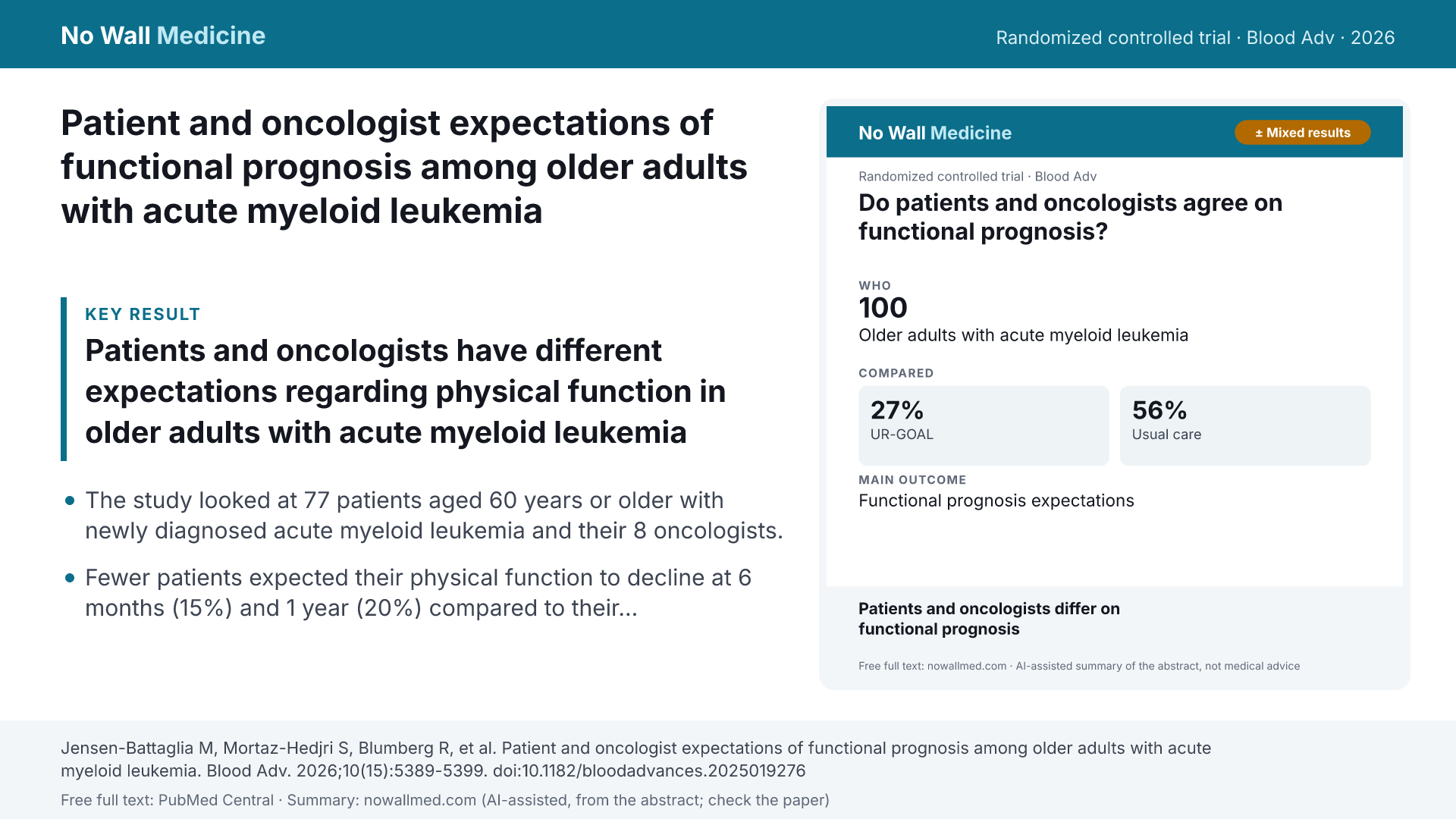
Patients and oncologists have different expectations regarding physical function in older adults with acute myeloid leukemia
Patient and oncologist expectations of functional prognosis among older adults with acute myeloid leukemia
Randomized controlled trialMixed results
Do patients and oncologists agree on functional prognosis?
Who
100
Older adults with acute myeloid leukemia
Compared
27%UR-GOAL
56%Usual care
Main outcome
Functional prognosis expectations
Bottom line: Patients and oncologists differ on functional prognosis
Blood Adv · 2026-06-11 · Save PNG
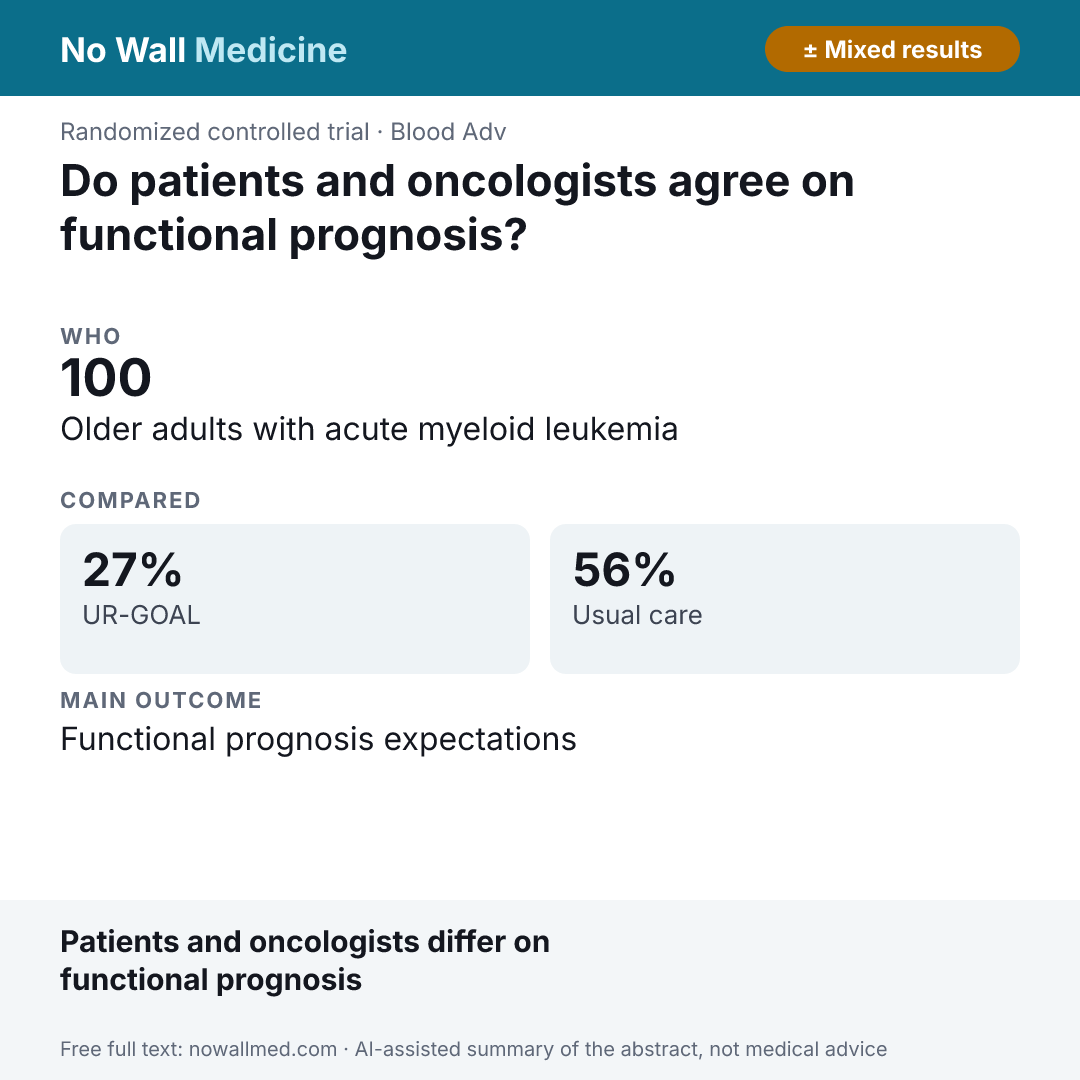
Clinical question: Do patients and oncologists agree on functional prognosis?
Key points
- The study looked at 77 patients aged 60 years or older with newly diagnosed acute myeloid leukemia and their 8 oncologists.
- Fewer patients expected their physical function to decline at 6 months (15%) and 1 year (20%) compared to their oncologists (51% and 54% respectively).
- A decisional support tool called UR-GOAL was associated with less clinically meaningful disagreement regarding physical function compared to usual care.
Headline and key points written with AI from the paper’s abstract, with every number checked against it. Read the paper before relying on them.
Was this summary helpful?
Abstract
Although older adults with cancer often prioritize maintaining physical function when making treatment decisions, whether patients and oncologists have similar expectations of future functioning remains unknown. We explored this among patients with acute myeloid leukemia (AML) and their oncologists in a pilot randomized controlled trial testing a decisional support tool (University of Rochester-Geriatric Oncology Assessment for Acute Myeloid Leukemia [UR-GOAL]). We included adults aged ≥60 years with newly diagnosed AML, randomized 1:1 to UR-GOAL (AML educational video, assessment of aging-related conditions, values, and prognostic awareness) or usual care (UC). After initiating treatment, patients and oncologists reported whether they expected the patient's physical function to decline, improve, or stay the same over the next 6 months and 1 year (functional prognosis). We estimated patient oncologist agreement using weighted κ statistics and evaluated differences by study arm. Of 100 enrolled patients, 77, who received care from 8 oncologists, responded to questions about the patient's functional prognosis. Patients had a mean age of 73 years (standard deviation, 6.8), and 39% were female. Fewer patients (15% at 6 months, 20% at 1 year) anticipated that their function would decline, compared with their oncologists (51% at 6 months, 54% at 1 year). Most patients (68%) had discordant expectations from their oncologist, with κ = 0.10 (6 months) and κ = 0.07 (1 year). However, clinically meaningful discordance (patient: maintain or improve; oncologist: decline) was less common among UR-GOAL patients vs UC (27% vs 56%; P = .010). Older adults with AML have expectations about their future physical function that differ from their oncologists. UR-GOAL may reduce this discordance. This trial was registered at www.ClinicalTrials.gov as NCT05335369.
Abstract reproduced under the article’s CC BY NC ND licence.
Subject terms
Headline, design, result, key points, caveat and citation as plain text.
Cite this article
Jensen-Battaglia M, Mortaz-Hedjri S, Blumberg R, et al. Patient and oncologist expectations of functional prognosis among older adults with acute myeloid leukemia. Blood Adv. 2026;10(15):5389-5399. doi:10.1182/bloodadvances.2025019276
Spotted a mistake? Suggest a correction