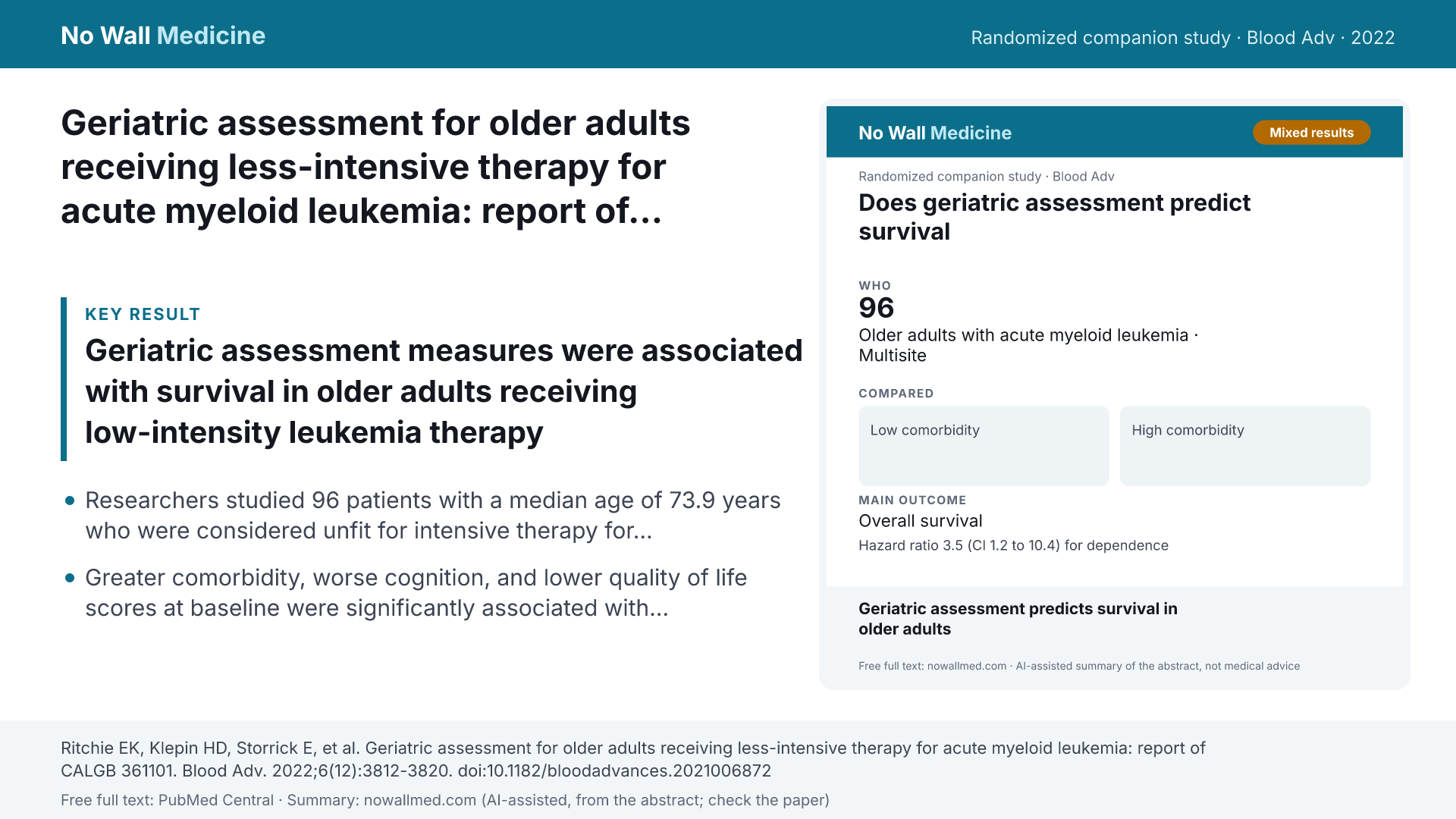
Geriatric assessment measures were associated with survival in older adults receiving low-intensity leukemia therapy
Geriatric assessment for older adults receiving less-intensive therapy for acute myeloid leukemia: report of CALGB 361101
Randomized companion studyMixed results
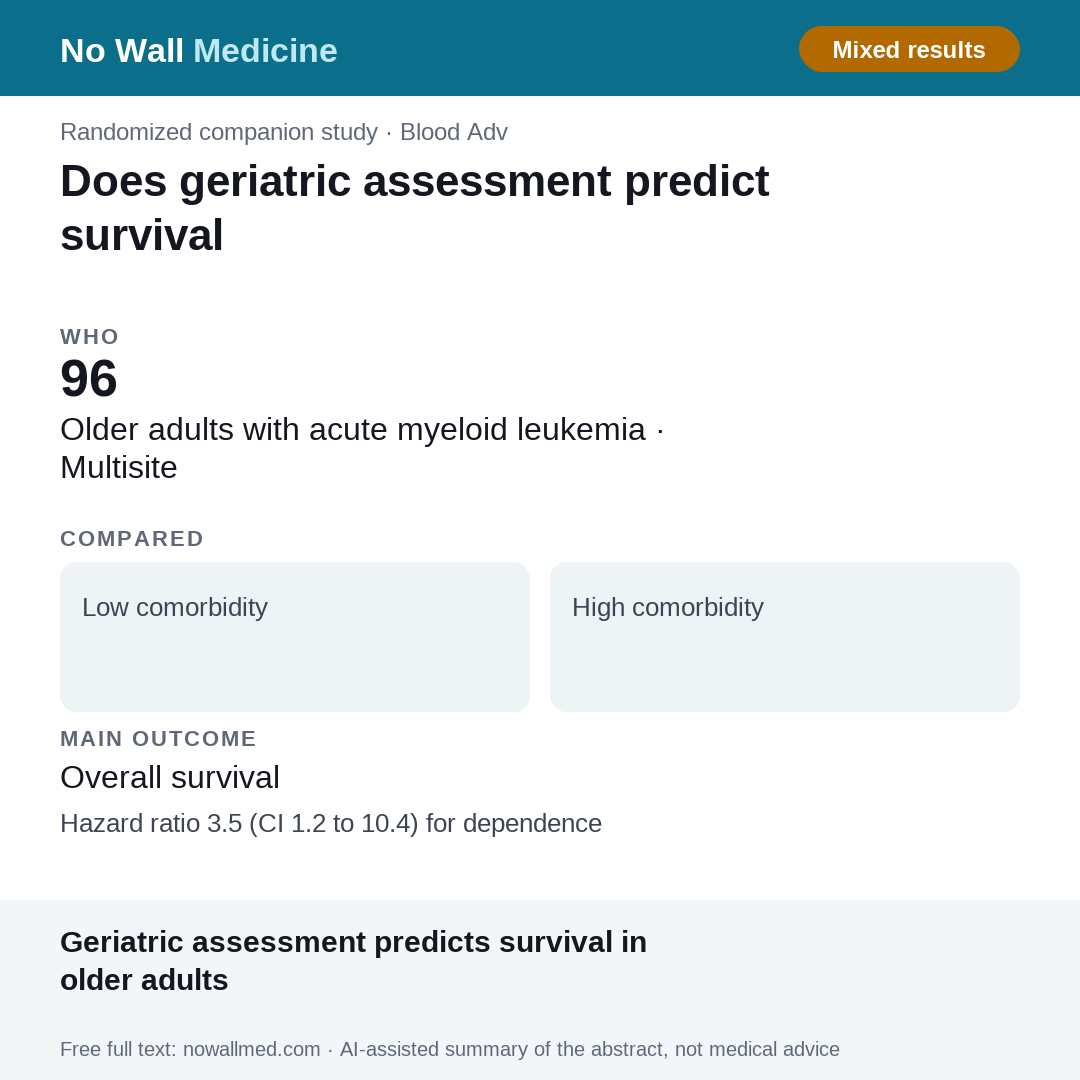
Does geriatric assessment predict survival
Who
96
Older adults with acute myeloid leukemia · Multisite
Compared
Low comorbidity
High comorbidity
Main outcome
Overall survival
Result: Hazard ratio 3.5 (CI 1.2 to 10.4) for dependence
Bottom line: Geriatric assessment predicts survival in older adults
Blood Adv · 2022-04-15Download image
Key points
- Researchers studied 96 patients with a median age of 73.9 years who were considered unfit for intensive therapy for acute myeloid leukemia.
- Greater comorbidity, worse cognition, and lower quality of life scores at baseline were significantly associated with shorter overall survival.
- Dependence in instrumental activities of daily living and cognitive impairment were associated with 6-month mortality with hazard ratios of 3.5 and 3.1, respectively.
Headline and key points written with AI from the paper’s abstract, with every number checked against it. Read the paper before relying on them.
Was this summary helpful?
Abstract
Geriatric assessment (GA) predicts survival among older adults with acute myeloid leukemia (AML) treated intensively. We evaluated the predictive utility of GA among older adults treated with low-intensity therapy on a multisite trial. We conducted a companion study (CALGB 361101) to a randomized phase 2 trial (CALGB 11002) of adults ≥60 years and considered "unfit" for intensive therapy, testing the efficacy of adding bortezomib to decitabine therapy. On 361101, GA and quality of life (QOL) assessment was administered prior to treatment and every other subsequent cycle. Relationships between baseline GA and QOL measures with survival were evaluated using Kaplan-Meier estimation and Cox proportional hazards models. One-hundred sixty-five patients enrolled in CALGB 11002, and 96 (52%) of them also enrolled in 361101 (median age, 73.9 years). Among participants, 85.4% completed ≥1 baseline assessment. In multivariate analyses, greater comorbidity (hematopoietic cell transplantation-specific comorbidity index >3), worse cognition (Blessed Orientation-Memory-Concentration score >4), and lower European Organization for Research and Treatment of Cancer global QOL scores at baseline were significantly associated with shorter overall survival (P < .05 each) after adjustment for Karnofsky Performance Status, age, and treatment arm. Dependence in instrumental activities of daily living and cognitive impairment were associated with 6-month mortality (hazard ratio [HR], 3.5; confidence interval [CI], 1.2-10.4; and HR, 3.1; CI, 1.1-8.6, respectively). GA measures evaluating comorbidity, cognition, and self-reported function were associated with survival and represent candidate measures for screening older adults planned to receive lower-intensity AML therapies. This trial was registered at www.clinicaltrials.gov as #NCT01420926 (CALGB 11002).
Abstract reproduced under the article’s CC BY NC ND licence.
Subject terms
Headline, design, result, key points, caveat and citation as plain text.
Cite this article
Ritchie EK, Klepin HD, Storrick E, et al. Geriatric assessment for older adults receiving less-intensive therapy for acute myeloid leukemia: report of CALGB 361101. Blood Adv. 2022. doi:10.1182/bloodadvances.2021006872
Spotted a mistake? Suggest a correction