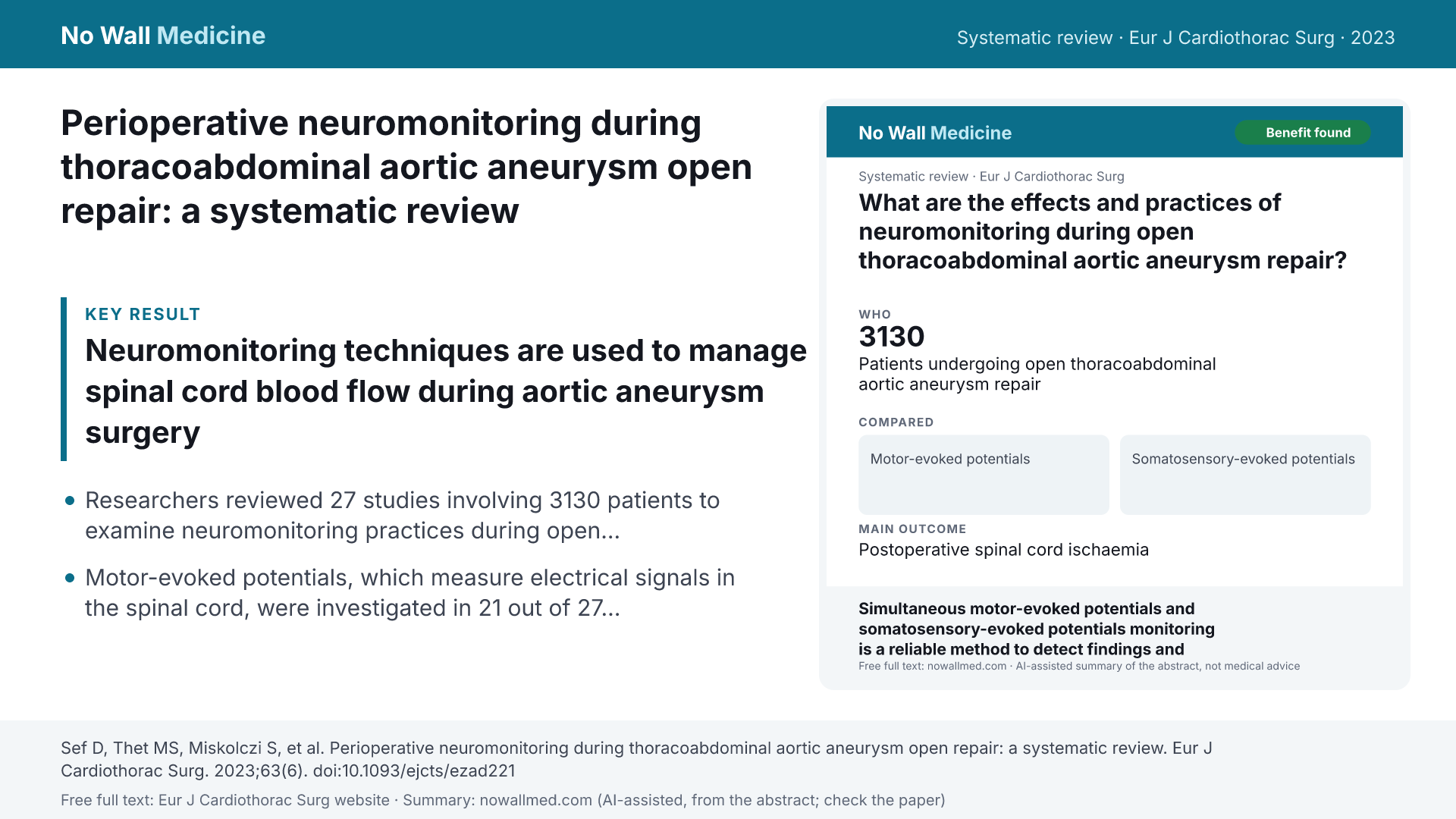
Neuromonitoring techniques are used to manage spinal cord blood flow during aortic aneurysm surgery
Perioperative neuromonitoring during thoracoabdominal aortic aneurysm open repair: a systematic review
Systematic reviewBenefit found
What are the effects and practices of neuromonitoring during open thoracoabdominal aortic aneurysm repair?
Who
3130
Patients undergoing open thoracoabdominal aortic aneurysm repair
Compared
Motor-evoked potentials
Somatosensory-evoked potentials
Main outcome
Postoperative spinal cord ischaemia
Bottom line: Simultaneous motor-evoked potentials and somatosensory-evoked potentials monitoring is a reliable method to detect findings and direct protective manoeuvres.
Eur J Cardiothorac Surg · 2023-05-26Download image
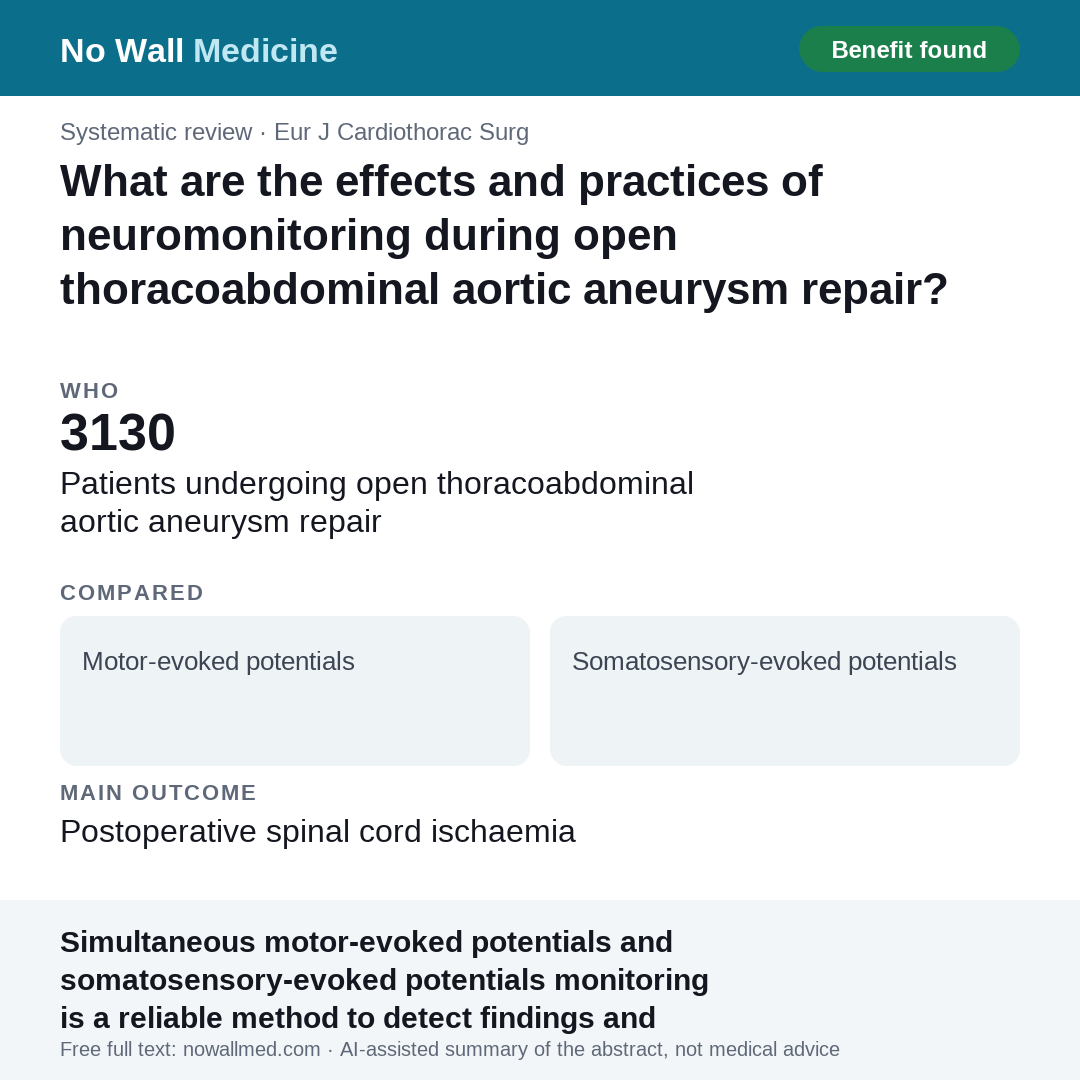
Clinical question: What are the effects and practices of neuromonitoring during open thoracoabdominal aortic aneurysm repair?
Why it matters: There is no consensus regarding which neuromonitoring technique is best for preventing spinal cord ischaemia, which is a lack of blood flow to the spinal cord.
Key points
- Researchers reviewed 27 studies involving 3130 patients to examine neuromonitoring practices during open thoracoabdominal aortic aneurysm repair.
- Motor-evoked potentials, which measure electrical signals in the spinal cord, were investigated in 21 out of 27 studies (78%).
- Somatosensory-evoked potentials, which measure sensory nerve signals, were analyzed in 15 studies.
Headline and key points written with AI from the paper’s abstract, with every number checked against it. Read the paper before relying on them.
Was this summary helpful?
Subject terms
Cite this article
Sef D, Thet MS, Miskolczi S, Velissaris T, De Silva R, Luthra S. Perioperative neuromonitoring during thoracoabdominal aortic aneurysm open repair: a systematic review. Eur J Cardiothorac Surg. 2023. doi:10.1093/ejcts/ezad221
Spotted a mistake? Suggest a correction
Top studies every Monday
The week’s key trials and guidelines in your specialties, plus any topics you follow. By email, free.
Get the weekly digest