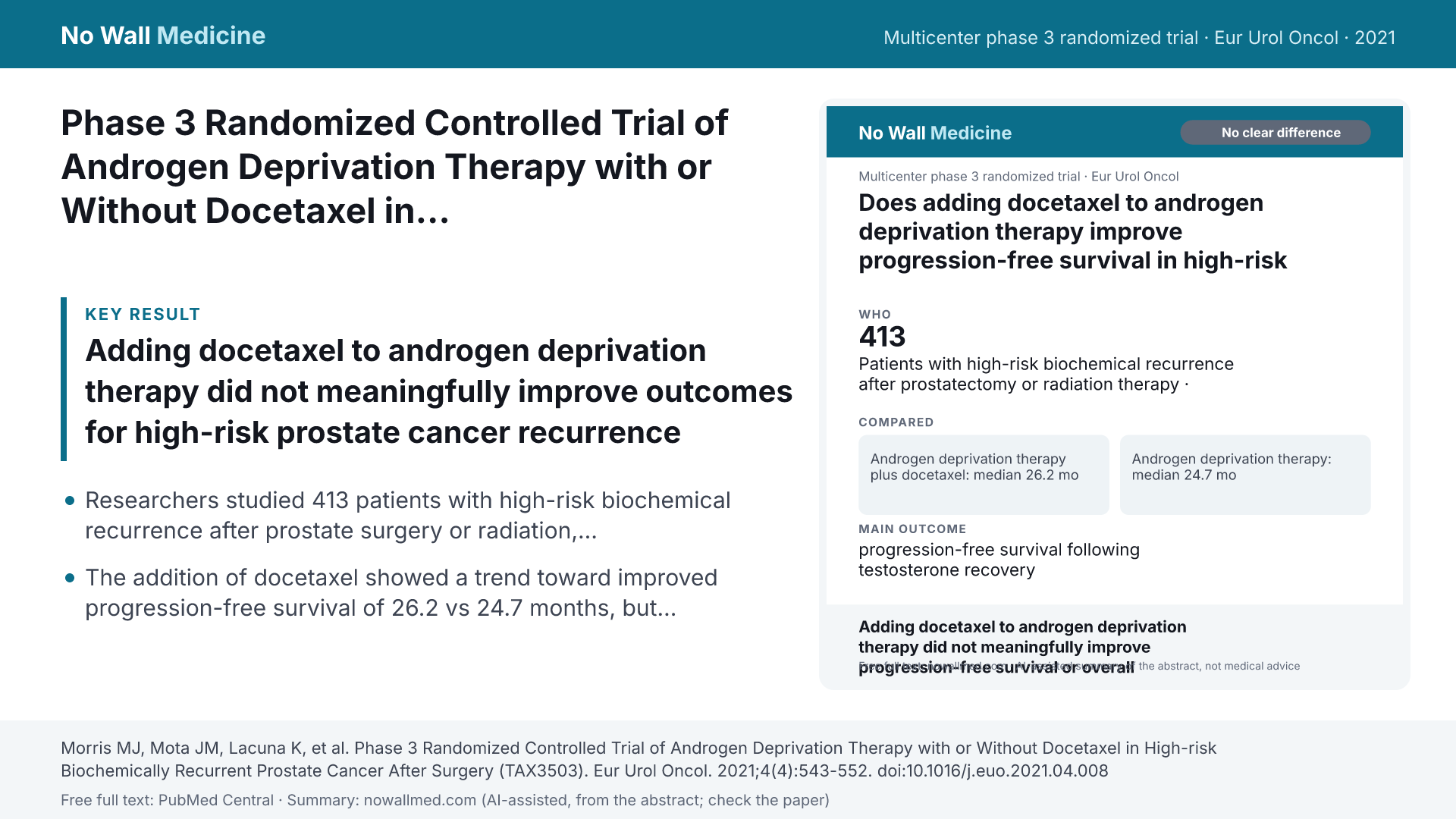
Adding docetaxel to androgen deprivation therapy did not meaningfully improve outcomes for high-risk prostate cancer recurrence
Phase 3 Randomized Controlled Trial of Androgen Deprivation Therapy with or Without Docetaxel in High-risk Biochemically Recurrent Prostate Cancer After Surgery (TAX3503)
Multicenter phase 3 randomized trialNo clear difference
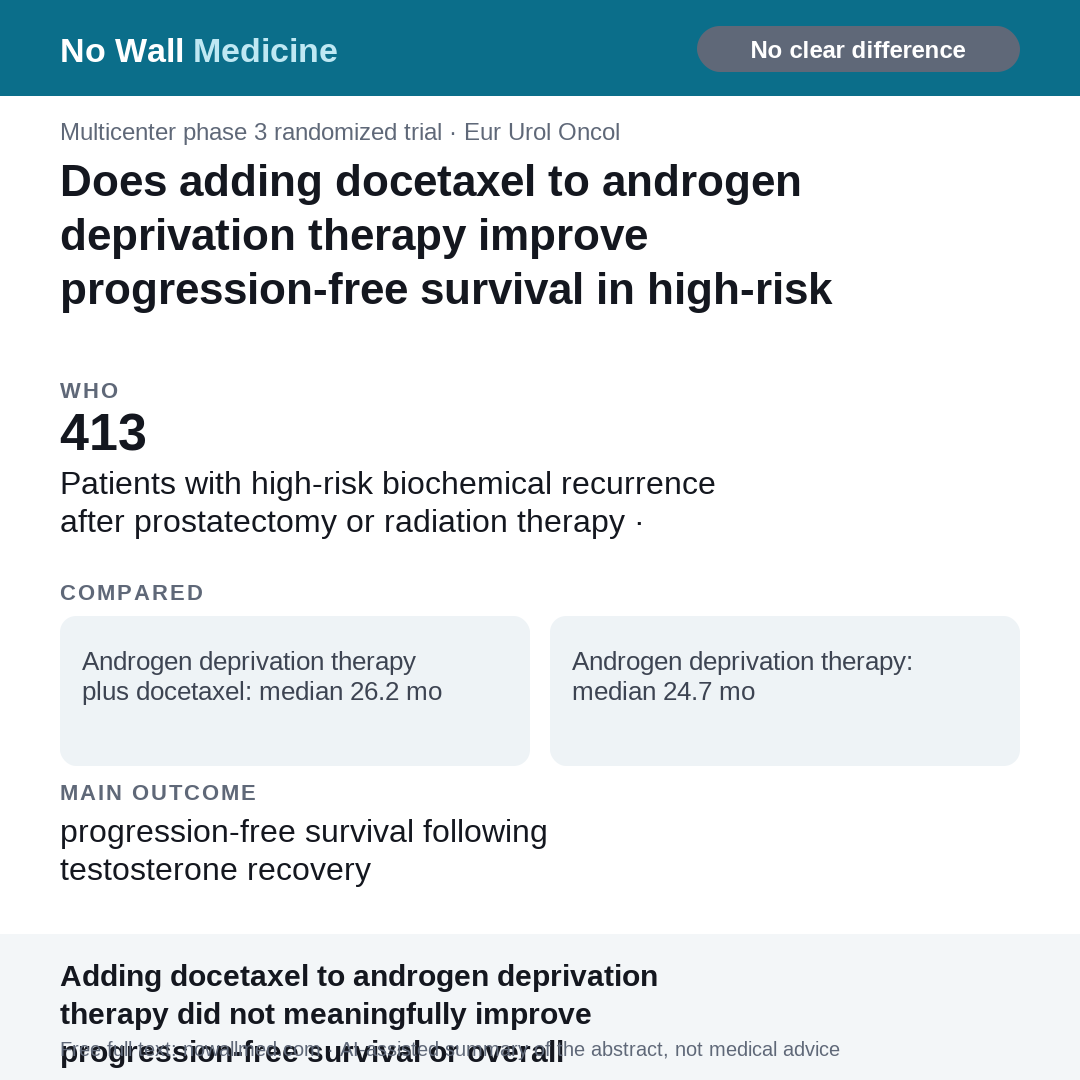
Does adding docetaxel to androgen deprivation therapy improve progression-free survival in high-risk biochemical recurrence?
Who
413
Patients with high-risk biochemical recurrence after prostatectomy or radiation therapy · Multicenter
Compared
Androgen deprivation therapy plus docetaxel: median 26.2 mo
Androgen deprivation therapy: median 24.7 mo
Main outcome
progression-free survival following testosterone recovery
Result: hazard ratio 0.80 (95% CI 0.61-1.04)
Bottom line: Adding docetaxel to androgen deprivation therapy did not meaningfully improve progression-free survival or overall survival in high-risk biochemical recurrence.
Limitation: The sponsor withdrew support of the study in 2012.
Eur Urol Oncol · 2021-05-18Download image
Clinical question: Does adding docetaxel to androgen deprivation therapy improve progression-free survival in high-risk biochemical recurrence?
Why it matters: A standard of care does not exist for patients experiencing high-risk biochemical recurrence, which is the rising of prostate-specific antigen levels, after prostatectomy.
Key points
- Researchers studied 413 patients with high-risk biochemical recurrence after prostate surgery or radiation, comparing androgen deprivation therapy alone to androgen deprivation therapy plus docetaxel chemotherapy.
- The addition of docetaxel showed a trend toward improved progression-free survival of 26.2 vs 24.7 months, but the results were not statistically significant (hazard ratio 0.80, 95% CI 0.61-1.04).
- Severe adverse events of grade 3 or higher were more frequent in the group receiving docetaxel (48.0% vs 10.8%).
Headline and key points written with AI from the paper’s abstract, with every number checked against it. Read the paper before relying on them.
Was this summary helpful?
Subject terms
Cite this article
Morris MJ, Mota JM, Lacuna K, et al. Phase 3 Randomized Controlled Trial of Androgen Deprivation Therapy with or Without Docetaxel in High-risk Biochemically Recurrent Prostate Cancer After Surgery (TAX3503). Eur Urol Oncol. 2021. doi:10.1016/j.euo.2021.04.008
Spotted a mistake? Suggest a correction