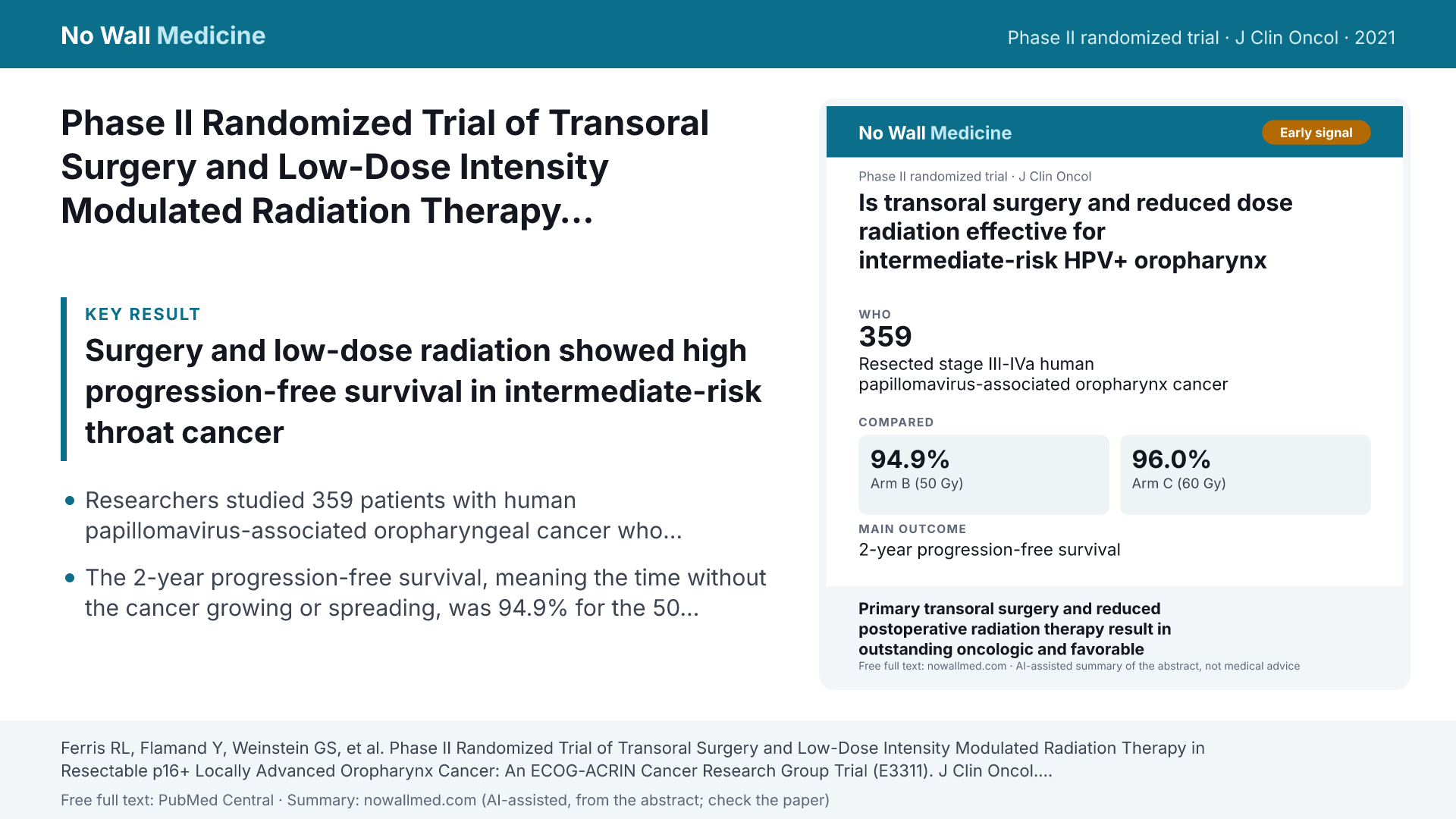
Surgery and low-dose radiation showed high progression-free survival in intermediate-risk throat cancer
Phase II Randomized Trial of Transoral Surgery and Low-Dose Intensity Modulated Radiation Therapy in Resectable p16+ Locally Advanced Oropharynx Cancer: An ECOG-ACRIN Cancer Research Group Trial (E3311)
Phase II randomized trialEarly signal
Is transoral surgery and reduced dose radiation effective for intermediate-risk HPV+ oropharynx cancer?
Who
359
Resected stage III-IVa human papillomavirus-associated oropharynx cancer patients · multi-institutional
Compared
94.9%Arm B (50 Gy) (90% CI, 91.3 to 98.6])
96.0%Arm C (60 Gy) (90% CI, 92.8 to 99.3)
Main outcome
2-year progression-free survival
Bottom line: Primary transoral surgery and reduced postoperative radiation therapy result in outstanding oncologic and favorable functional outcomes.
J Clin Oncol · 2021-10-26Download image
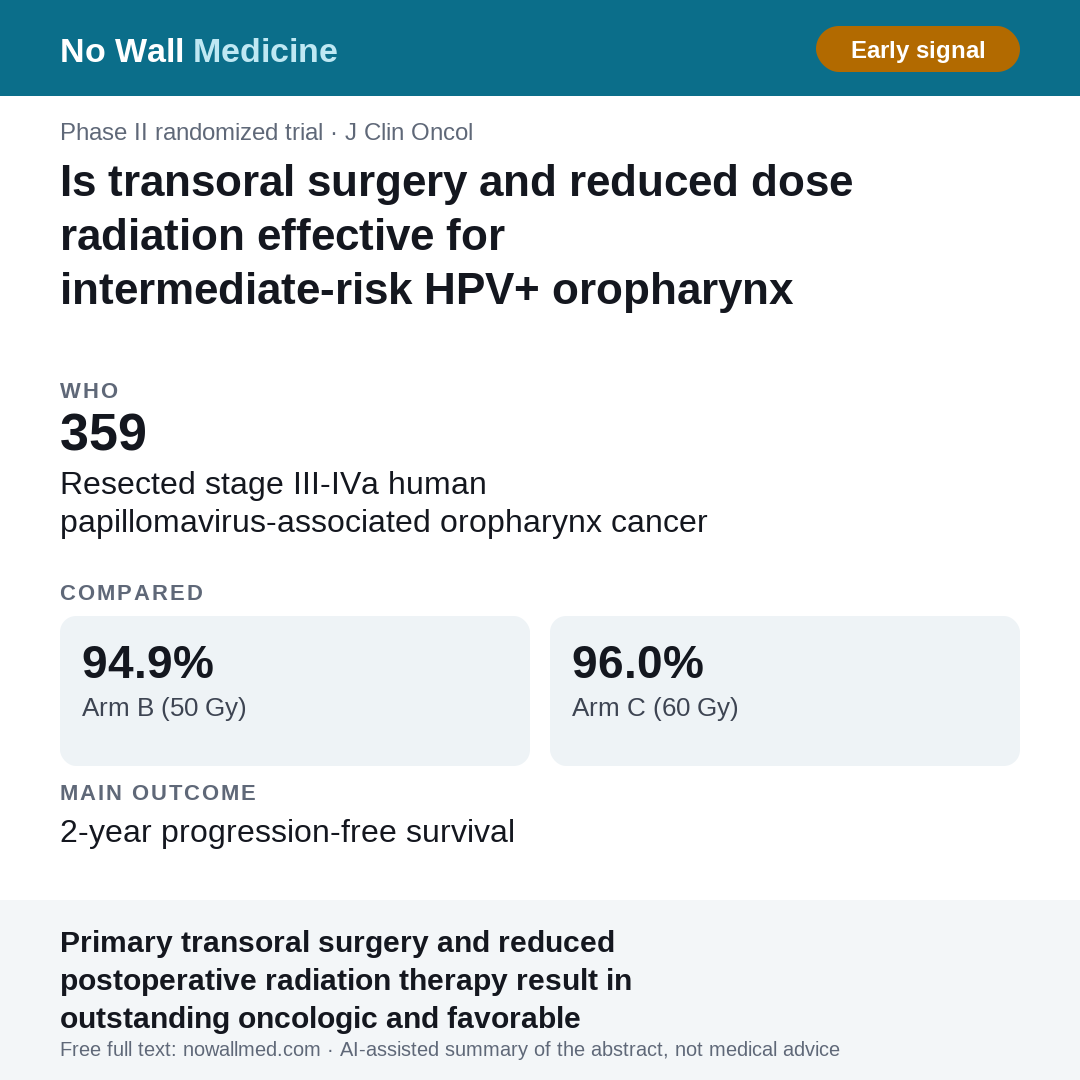
Clinical question: Is transoral surgery and reduced dose radiation effective for intermediate-risk HPV+ oropharynx cancer?
Why it matters: Standard chemoradiation for human papillomavirus-associated oropharyngeal cancer is curative but causes significant toxicity, leaving it unknown if surgery and reduced radiation doses are effective.
Key points
- Researchers studied 359 patients with human papillomavirus-associated oropharyngeal cancer who underwent transoral surgery followed by different radiation doses.
- The 2-year progression-free survival, meaning the time without the cancer growing or spreading, was 94.9% for the 50 Gy radiation group and 96.0% for the 60 Gy group.
- The study also included a low-risk group receiving observation with 96.9% survival and a high-risk group receiving 66 Gy plus weekly cisplatin with 90.7% survival.
Headline and key points written with AI from the paper’s abstract, with every number checked against it. Read the paper before relying on them.
Was this summary helpful?
Subject terms
Cite this article
Ferris RL, Flamand Y, Weinstein GS, et al. Phase II Randomized Trial of Transoral Surgery and Low-Dose Intensity Modulated Radiation Therapy in Resectable p16+ Locally Advanced Oropharynx Cancer: An ECOG-ACRIN Cancer Research Group Trial (E3311). J Clin Oncol. 2021. doi:10.1200/JCO.21.01752
Spotted a mistake? Suggest a correction