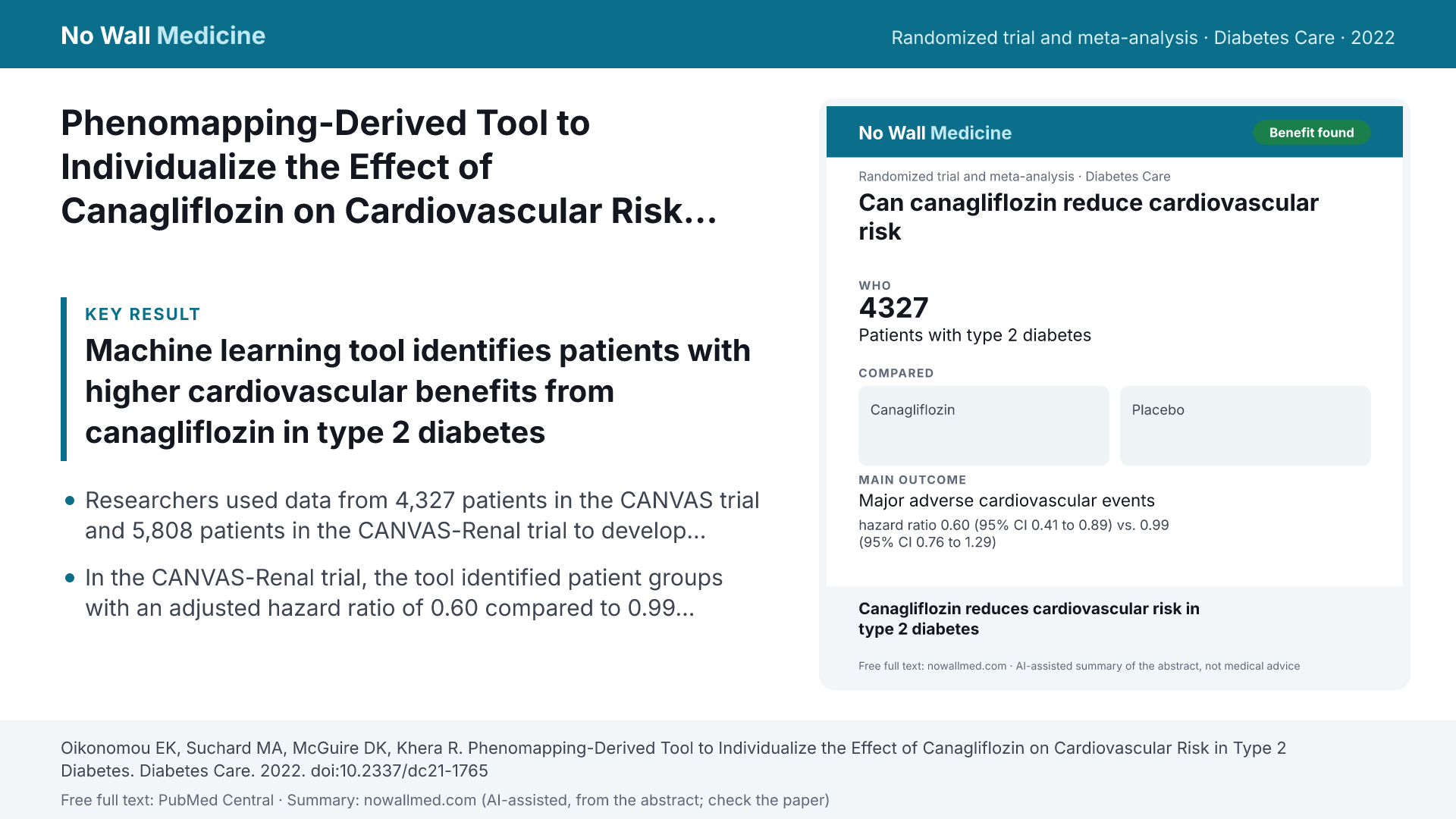
Machine learning tool identifies patients with higher cardiovascular benefits from canagliflozin in type 2 diabetes
Phenomapping-Derived Tool to Individualize the Effect of Canagliflozin on Cardiovascular Risk in Type 2 Diabetes
Randomized trial and meta-analysisBenefit found
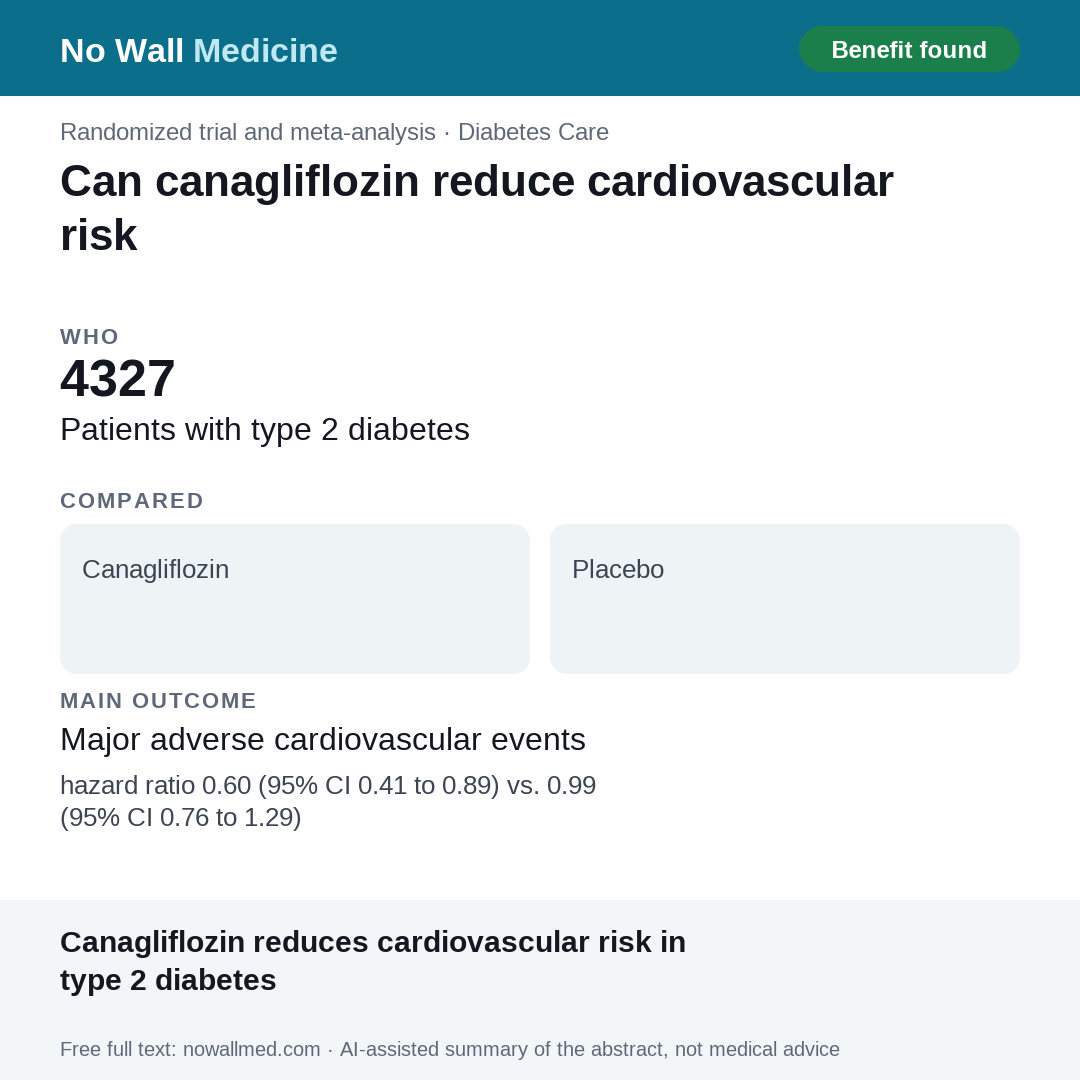
Can canagliflozin reduce cardiovascular risk
Who
4327
Patients with type 2 diabetes
Compared
Canagliflozin
Placebo
Main outcome
Major adverse cardiovascular events
Result: hazard ratio 0.60 (95% CI 0.41 to 0.89) vs. 0.99 (95% CI 0.76 to 1.29)
Bottom line: Canagliflozin reduces cardiovascular risk in type 2 diabetes
Diabetes Care · 2022-02-05Download image
Why it matters: It is unknown how to individualize the cardiovascular benefits of sodium-glucose cotransporter 2 inhibitors for specific patients with type 2 diabetes.
Key points
- Researchers used data from 4,327 patients in the CANVAS trial and 5,808 patients in the CANVAS-Renal trial to develop a personalized prediction tool.
- In the CANVAS-Renal trial, the tool identified patient groups with an adjusted hazard ratio of 0.60 compared to 0.99 for those not identified.
- In the original CANVAS trial, 1,605 patients, or 37.1%, showed a more protective effect than the overall trial estimate of 0.86 for major adverse cardiovascular events.
Headline and key points written with AI from the paper’s abstract, with every number checked against it. Read the paper before relying on them.
Was this summary helpful?
Subject terms
Cite this article
Oikonomou EK, Suchard MA, McGuire DK, Khera R. Phenomapping-Derived Tool to Individualize the Effect of Canagliflozin on Cardiovascular Risk in Type 2 Diabetes. Diabetes Care. 2022. doi:10.2337/dc21-1765
Spotted a mistake? Suggest a correction