Photodynamic Diagnosis-guided Transurethral Resection of Bladder Tumour in Participants with a First Suspected Diagnosis of Intermediate- or High-risk Non-muscle-invasive Bladder Cancer: Cost-effectiveness Analysis Alongside a Randomised Controlled Trial
Randomized trialNo clear difference
Is PDD-TURBT cost effective?
Who
493
Participants with non-muscle-invasive bladder cancer · 22 UK hospitals
Compared
2.087PDD-TURBT
2.094WL-TURBT
Main outcome
Quality-adjusted life years
Bottom line: PDD-TURBT is not more cost effective
Eur Urol Open Sci · 2023-05-31Download image
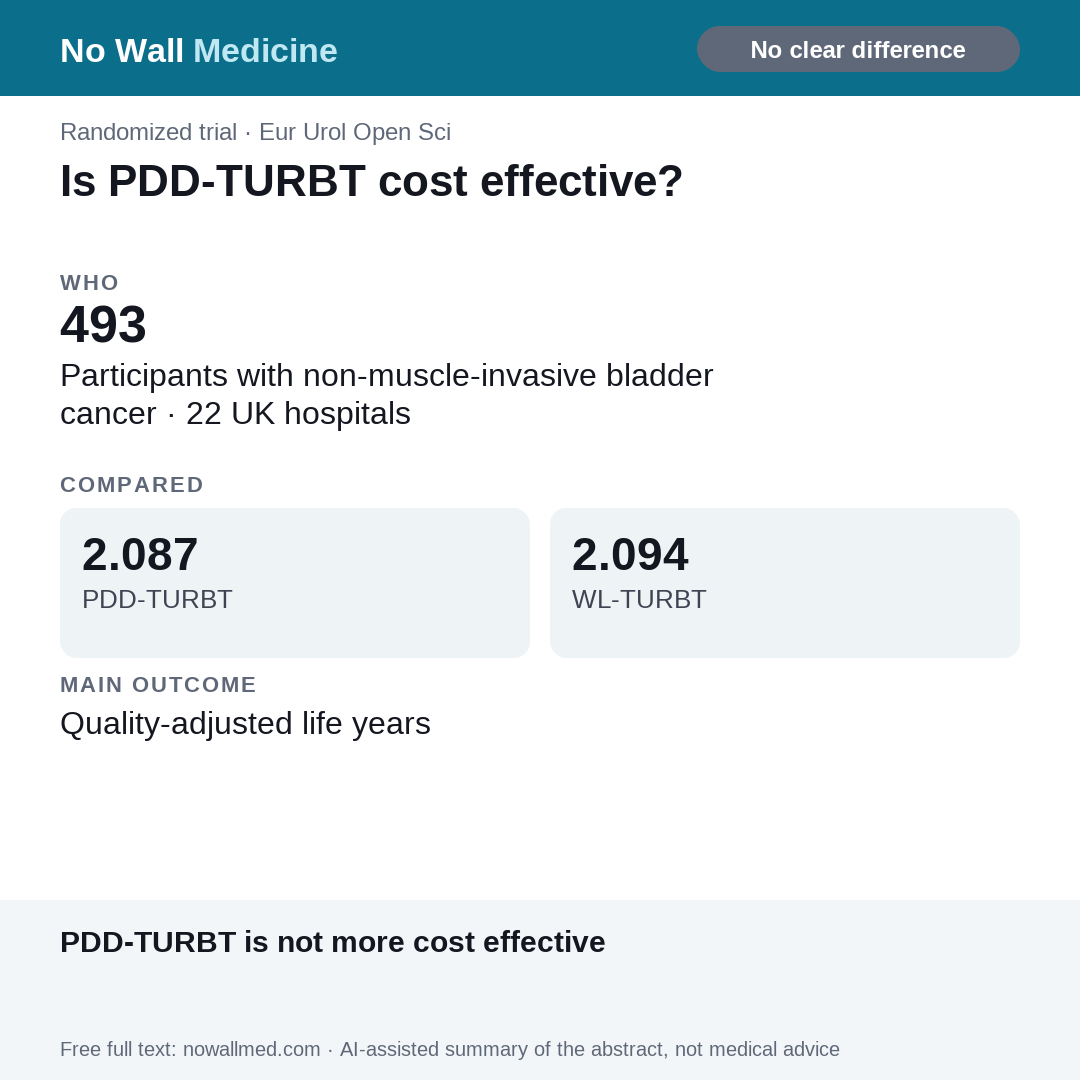
Clinical question: Is PDD-TURBT cost effective?
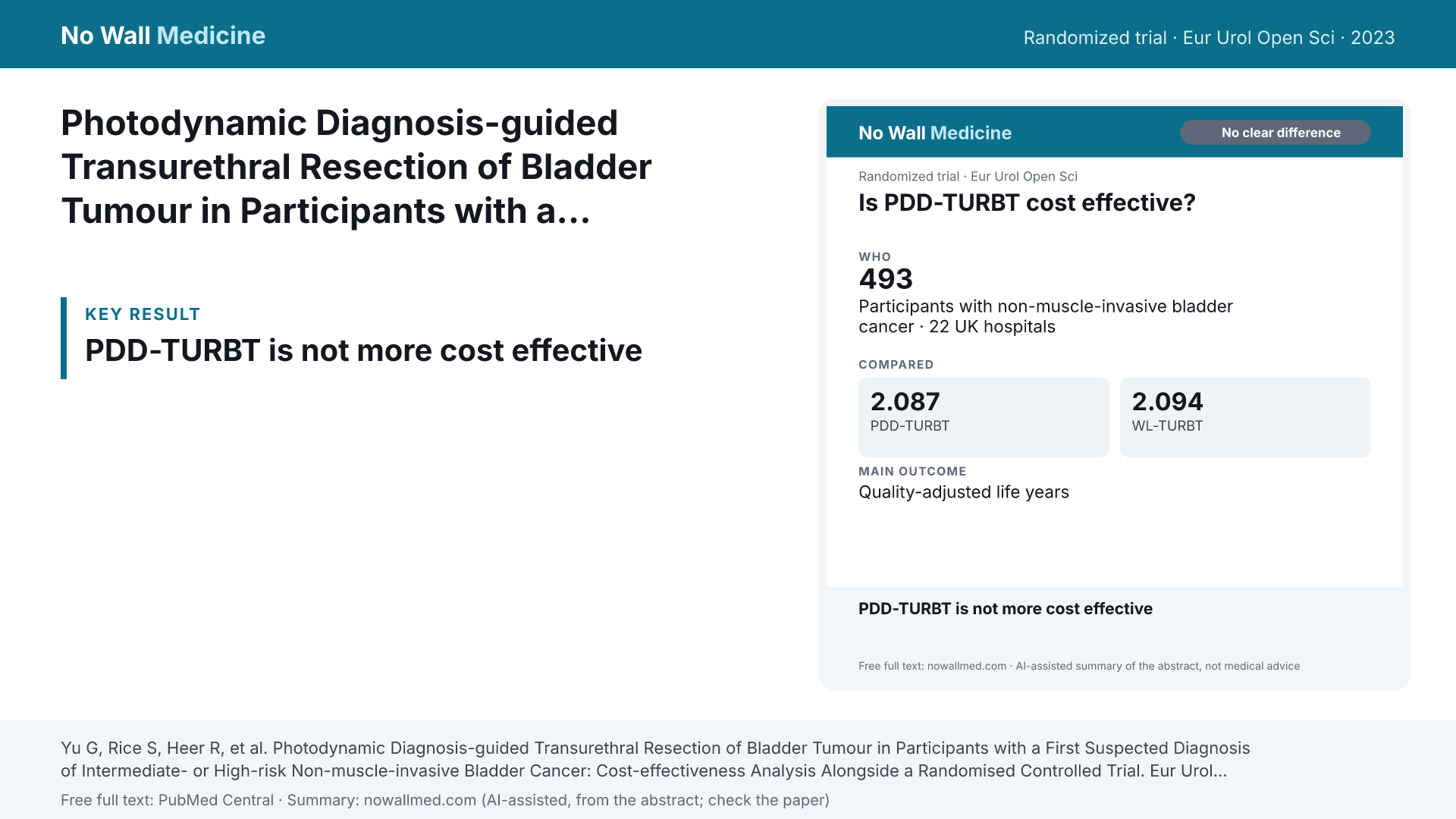
Abstract
Background
Recurrence of non-muscle-invasive bladder cancer (NMIBC) is common after transurethral resection of bladder tumour (TURBT). Photodynamic diagnosis (PDD) may reduce recurrence. PDD uses a photosensitiser in the bladder that causes the tumour to fluoresce to guide resection. PDD provides better diagnostic accuracy and allows more complete tumour resection. Objective
To estimate the economic efficiency of PDD-guided TURBT (PDD-TURBT) in comparison to white light-guided TURNT (WL-TURBT) in individuals with a suspected first diagnosis of NMIBC at intermediate or high risk of recurrence on the basis of routine visual assessment before being scheduled for TURBT. Design setting and participants
This is a health economic evaluation alongside a pragmatic, open-label, parallel-group randomised trial from a societal perspective. A total of 493 participants (aged ≥16 yr) were randomly allocated to PDD-TURBT (n = 244) or WL-TURBT (n = 249) in 22 UK National Health Service hospitals. Outcome measurements and statistical analysis
Cost effectiveness ratios were based on the use of health care resources associated with PDD-TURBT and WL-TURBT and quality-adjusted life years (QALYs) gained within the trial. Uncertainties in key parameters were assessed using sensitivity analyses. Results and limitations
On the basis of the use of resources driven by the trial protocol, the incremental cost effectiveness of PDD-TURBT in comparison to WL-TURBT was not cost saving. At 3 yr, the total cost was £12 881 for PDD-TURBT and £12 005 for WL-TURBT. QALYs at three years were 2.087 for PDD-TURBT and 2.094 for WL-TURBT. The probability that PDD-TURBT is cost effective was never >30% above the range of societal cost-effectiveness thresholds. Conclusions
There was no evidence of a difference in either costs or QALYs over 3-yr follow-up between PDD-TURBT and WL-TURBT in individuals with suspected intermediate- or high-risk NMIBC. PDD-TURBT is not supported for the management of primary intermediate- or high-risk NMIBC. Patient summary
We assessed overall costs for two approaches for removal of bladder tumours in noninvasive cancer and measured quality-adjusted life years gained for each. We found that use of a photosensitiser in the bladder was not more cost effective than use of white light only during tumour removal.
Cite this article
Yu G, Rice S, Heer R, et al. Photodynamic Diagnosis-guided Transurethral Resection of Bladder Tumour in Participants with a First Suspected Diagnosis of Intermediate- or High-risk Non-muscle-invasive Bladder Cancer: Cost-effectiveness Analysis Alongside a Randomised Controlled Trial. Eur Urol Open Sci. 2023. doi:10.1016/j.euros.2023.05.003
Spotted a mistake? Suggest a correction