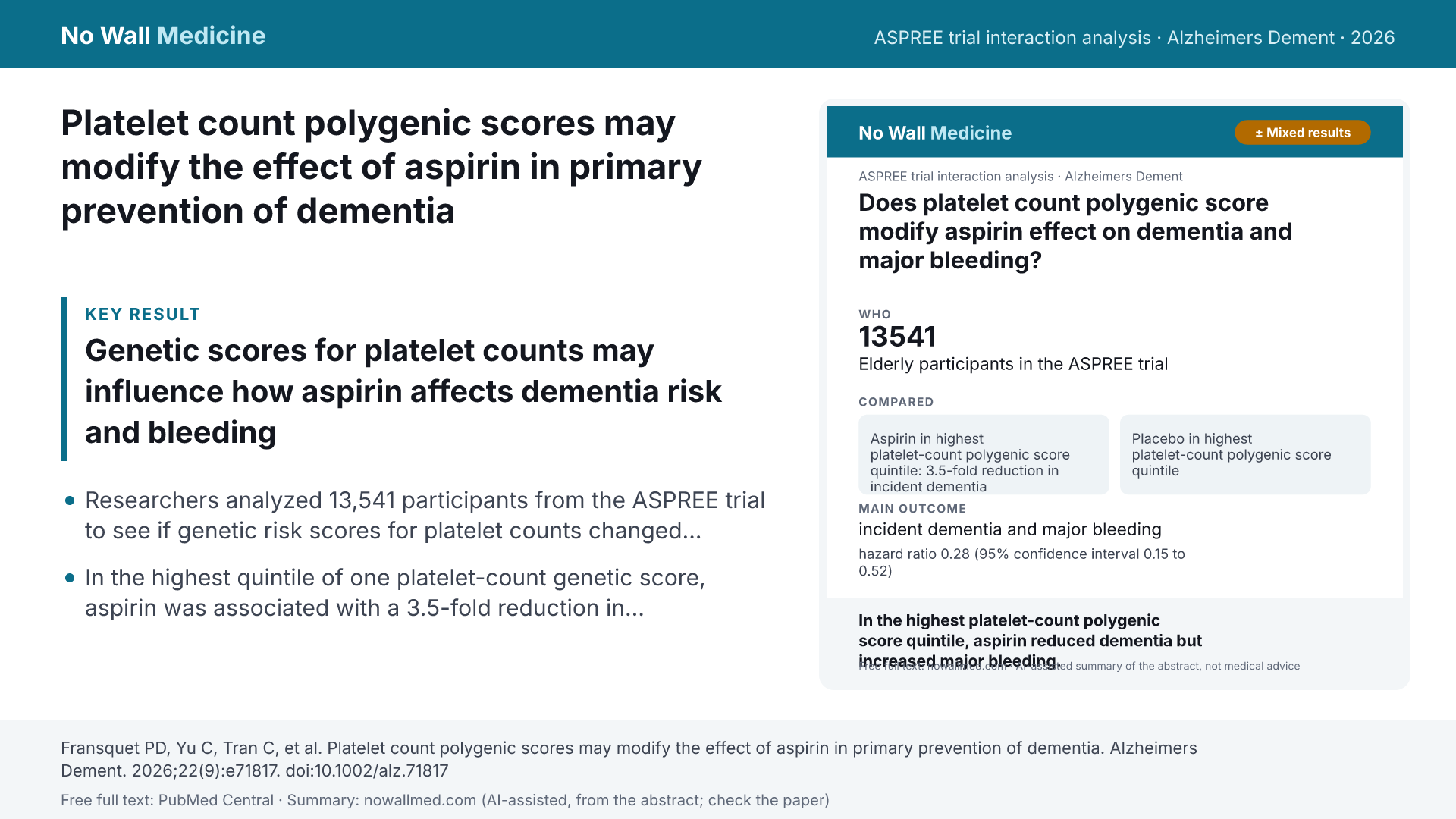
Genetic scores for platelet counts may influence how aspirin affects dementia risk and bleeding
Platelet count polygenic scores may modify the effect of aspirin in primary prevention of dementia
ASPREE trial interaction analysisMixed results
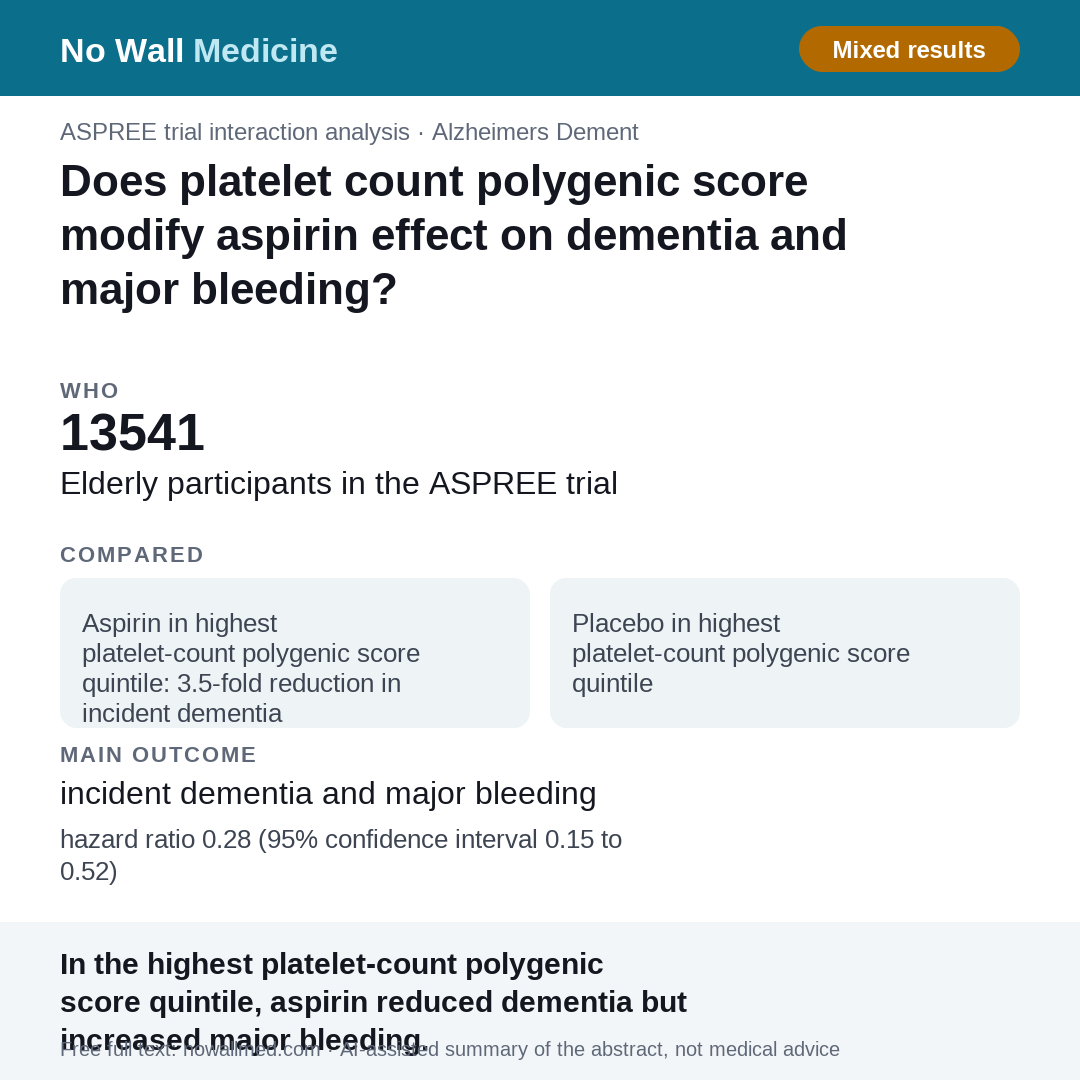
Does platelet count polygenic score modify aspirin effect on dementia and major bleeding?
Who
13541
Elderly participants in the ASPREE trial
Compared
Aspirin in highest platelet-count polygenic score quintile: 3.5-fold reduction in incident dementia
Placebo in highest platelet-count polygenic score quintile
Main outcome
incident dementia and major bleeding
Result: hazard ratio 0.28 (95% confidence interval 0.15 to 0.52)
Bottom line: In the highest platelet-count polygenic score quintile, aspirin reduced dementia but increased major bleeding.
Limitation: These hypothesis-generating findings require validation.
Alzheimers Dement · 2026-09-24Download image
Clinical question: Does platelet count polygenic score modify aspirin effect on dementia and major bleeding?
Why it matters: Aspirin is not currently recommended for preventing dementia because of limited benefits, but researchers wanted to see if specific genetic subgroups might benefit.
Key points
- Researchers analyzed 13,541 participants from the ASPREE trial to see if genetic risk scores for platelet counts changed the effects of aspirin on dementia and bleeding.
- In the highest quintile of one platelet-count genetic score, aspirin was associated with a 3.5-fold reduction in dementia compared to placebo (hazard ratio: 0.28, 95% confidence interval: 0.15 to 0.52).
- The same group taking aspirin also saw an increase in major bleeding (hazard ratio: 2.13, 95% confidence interval: 1.36 to 3.34).
Limitation the authors note: The authors state these findings are hypothesis-generating and require further validation.
Headline and key points written with AI from the paper’s abstract, with every number checked against it. Read the paper before relying on them.
Was this summary helpful?
Subject terms
Headline, design, result, key points, caveat and citation as plain text.
Cite this article
Fransquet PD, Yu C, Tran C, et al. Platelet count polygenic scores may modify the effect of aspirin in primary prevention of dementia. Alzheimers Dement. 2026;22(9):e71817. doi:10.1002/alz.71817
Spotted a mistake? Suggest a correction