Ponesimod showed lower relapse rates and brain volume loss than teriflunomide in multiple sclerosis
Ponesimod Compared With Teriflunomide in Patients With Relapsing Multiple Sclerosis in the Active-Comparator Phase 3 OPTIMUM Study: A Randomized Clinical Trial
Randomized, double-blind trialBenefit found
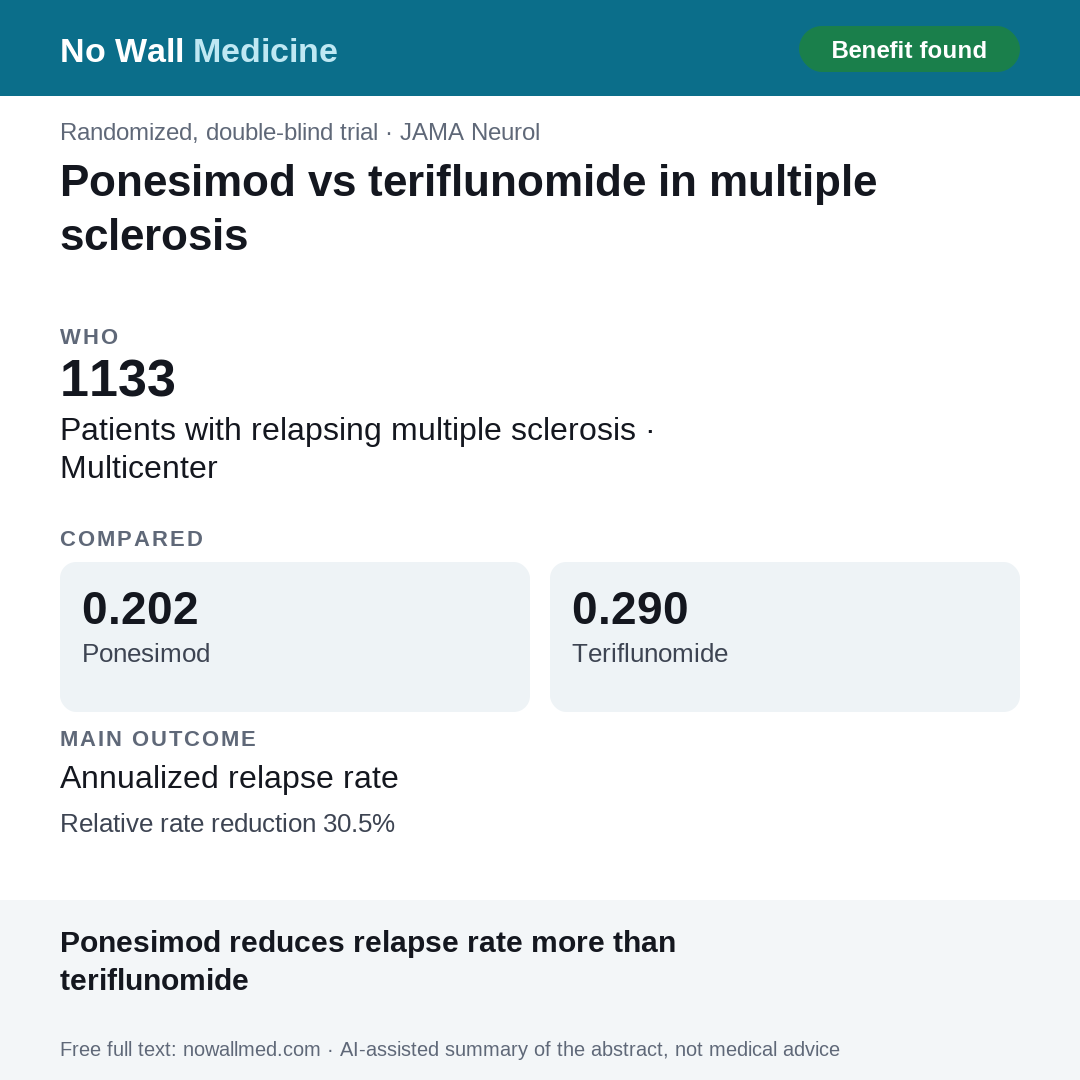
Ponesimod vs teriflunomide in multiple sclerosis
Who
1133
Patients with relapsing multiple sclerosis · Multicenter
Compared
0.202Ponesimod
0.290Teriflunomide
Main outcome
Annualized relapse rate
Result: Relative rate reduction 30.5%
Bottom line: Ponesimod reduces relapse rate more than teriflunomide
JAMA Neurol · 2021-03-30Download image
Why it matters: It was unknown how ponesimod, a sphingosine-1-phosphate receptor 1 modulator, compared to teriflunomide, a pyrimidine synthesis inhibitor, in treating relapsing multiple sclerosis.
Key points
- The trial randomized 1133 patients with relapsing multiple sclerosis to receive either 20 mg of ponesimod or 14 mg of teriflunomide once daily for 108 weeks.
- Ponesimod was associated with a 30.5% relative rate reduction in annualized relapse rate and a 56% relative risk reduction in combined unique active lesions per year.
- While ponesimod showed lower brain volume loss, there was no significant difference in the risk of confirmed disability accumulation at 12 weeks or 24 weeks.
Headline and key points written with AI from the paper’s abstract, with every number checked against it. Read the paper before relying on them.
Was this summary helpful?
Subject terms
Cite this article
Kappos L, Fox RJ, Burcklen M, Freedman MS, Havrdová EK, Hennessy B. Ponesimod Compared With Teriflunomide in Patients With Relapsing Multiple Sclerosis in the Active-Comparator Phase 3 OPTIMUM Study: A Randomized Clinical Trial. JAMA Neurol. 2021. doi:10.1001/jamaneurol.2021.0405
Spotted a mistake? Suggest a correction
Top studies every Monday
The week’s key trials and guidelines in your specialties, plus any topics you follow. By email, free.
Get the weekly digest