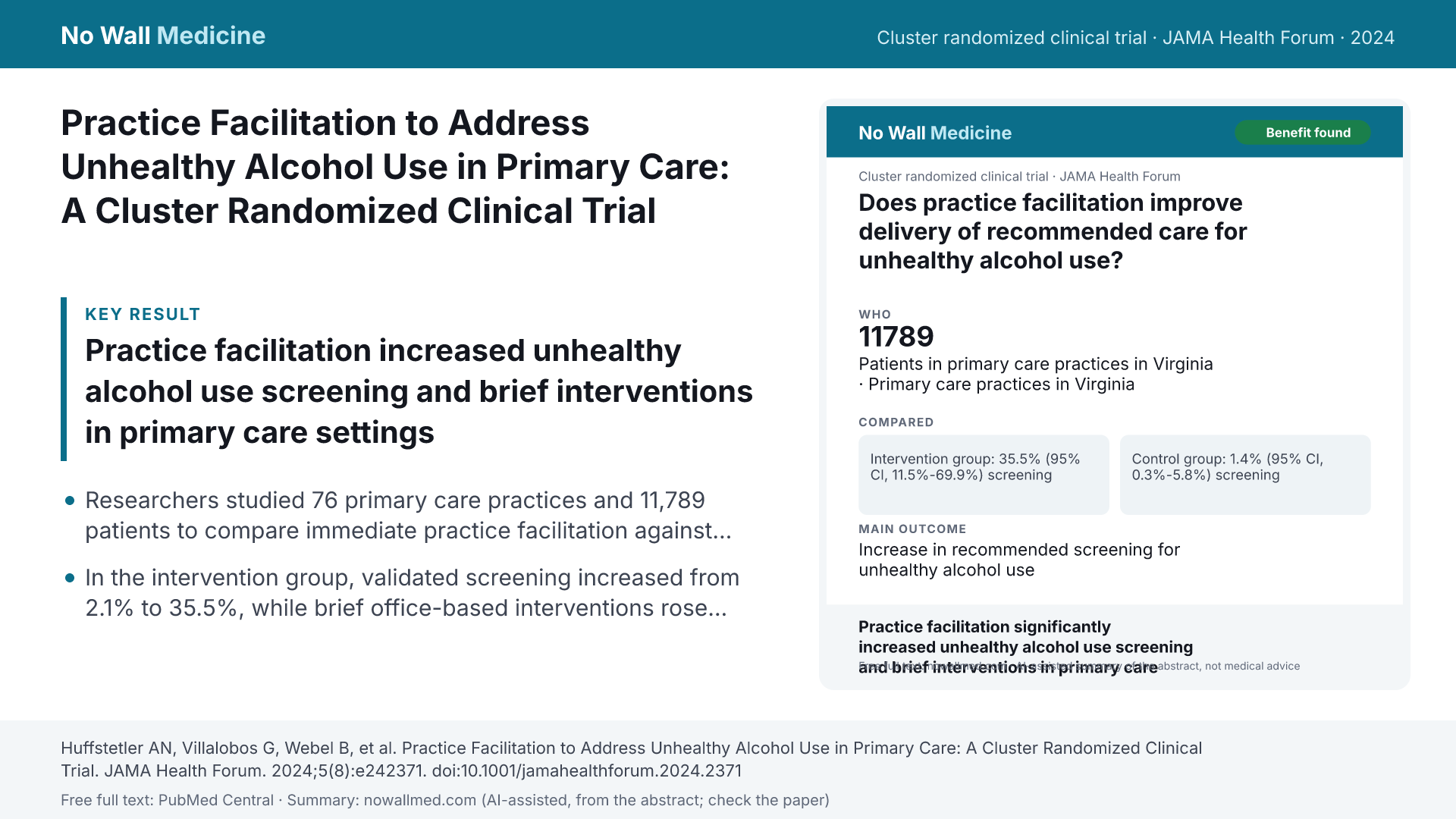
Practice facilitation increased unhealthy alcohol use screening and brief interventions in primary care settings
Practice Facilitation to Address Unhealthy Alcohol Use in Primary Care: A Cluster Randomized Clinical Trial
Cluster randomized clinical trialBenefit found
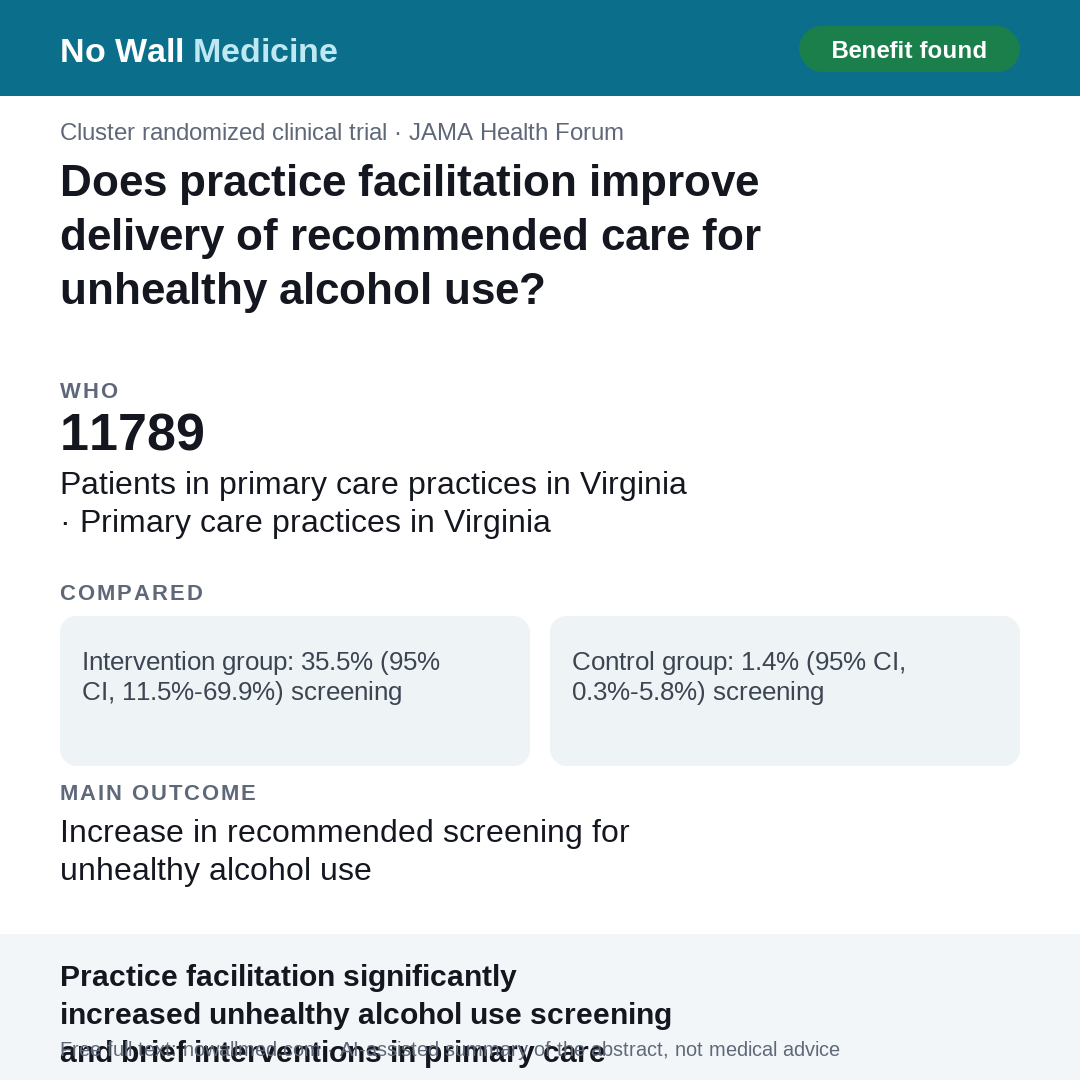
Does practice facilitation improve delivery of recommended care for unhealthy alcohol use?
Who
11789
Patients in primary care practices in Virginia · Primary care practices in Virginia
Compared
Intervention group: 35.5% (95% CI, 11.5%-69.9%) screening
Control group: 1.4% (95% CI, 0.3%-5.8%) screening
Main outcome
Increase in recommended screening for unhealthy alcohol use
Bottom line: Practice facilitation significantly increased unhealthy alcohol use screening and brief interventions in primary care practices.
JAMA Health Forum · 2024-08-02Download image
Clinical question: Does practice facilitation improve delivery of recommended care for unhealthy alcohol use?
Why it matters: Primary care clinicians are recommended to routinely screen adults for unhealthy alcohol use, but this preventive service is currently poorly implemented.
In absolute numbers
Intervention group: 35.5% · Control group: 1.4% → a difference of 34.1 percentage points, so about 3 people would need the treatment for 1 more to benefit (number needed to treat) over the trial’s follow-up.
Worked out by us from the two group results above, not reported by the authors. Check the paper for the exact outcome and timing.
Key points
- Researchers studied 76 primary care practices and 11,789 patients to compare immediate practice facilitation against a delayed control group.
- In the intervention group, validated screening increased from 2.1% to 35.5%, while brief office-based interventions rose from 26.2% to 62.6%.
- The control group saw screening increase from 0.4% to 1.4%, and changes in counseling referrals or medication treatment were similar between both groups.
Headline and key points written with AI from the paper’s abstract, with every number checked against it. Read the paper before relying on them.
Was this summary helpful?
Subject terms
Cite this article
Huffstetler AN, Villalobos G, Webel B, et al. Practice Facilitation to Address Unhealthy Alcohol Use in Primary Care: A Cluster Randomized Clinical Trial. JAMA Health Forum. 2024. doi:10.1001/jamahealthforum.2024.2371
Spotted a mistake? Suggest a correction