Service support model increased verbal alcohol advice but not medication prescription in Australian primary care
Supporting alcohol brief interventions and pharmacotherapy provision in Australian First Nations primary care: exploratory analysis of a cluster randomised trial
Cluster randomised trialMixed results
Does a service support model increase alcohol interventions and pharmacotherapy in Aboriginal health services?
Who
22
22 Aboriginal Community Controlled Health Services · Australia
Compared
Early-support treatment
Waitlist control
Main outcome
Verbal alcohol intervention and relapse prevention pharmacotherapies
Result: odds ratio 7.60 (95% CI 5.54 to 10.42) for verbal intervention
Bottom line: The support model increased verbal alcohol intervention odds but did not significantly increase pharmacotherapy prescription.
Limitation: Data likely underestimates treatment rates due to documentation barriers and different software usage.
BMC Prim Care · 2024-09-28Download image
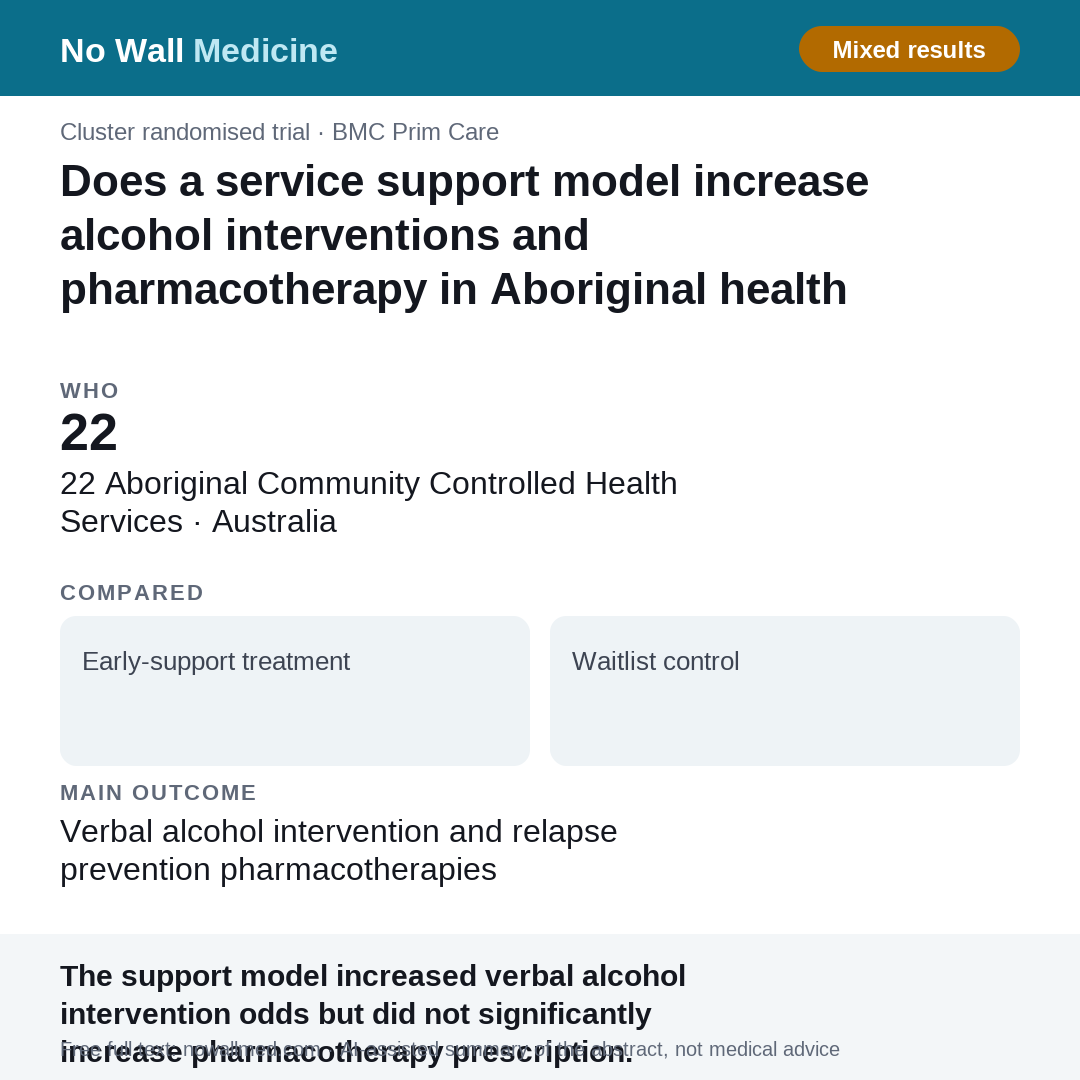
Clinical question: Does a service support model increase alcohol interventions and pharmacotherapy in Aboriginal health services?
Why it matters: It was not clear which specific treatment modalities, such as verbal advice or medication, were increased by a service support model in Aboriginal Community Controlled Health Services.
Key points
- Researchers conducted a cluster randomised trial involving 22 Aboriginal Community Controlled Health Services to test a 24-month service support model.
- The support model was associated with a significant increase in the odds of recorded verbal alcohol interventions (OR = 7.60, 95% CI = 5.54, 10.42, p < 0.001).
- The odds of prescribing relapse prevention pharmacotherapies, which are medications used to prevent a return to alcohol use, did not increase significantly (OR = 1.61, 95% CI = 0.92, 2.80, p = 0.1).
Limitation the authors note: The authors state that data likely underestimates treatment rates due to documentation barriers in practice software and the use of different software by drug and alcohol teams.
Headline and key points written with AI from the paper’s abstract, with every number checked against it. Read the paper before relying on them.
Topics
Cite this article
Dzidowska M, Lee KSK, Conigrave JH, Wilson S, Hayman N, Ivers R. Supporting alcohol brief interventions and pharmacotherapy provision in Australian First Nations primary care: exploratory analysis of a cluster randomised trial. BMC Prim Care. 2024. doi:10.1186/s12875-024-02598-9
Spotted a mistake? Suggest a correction
Top studies every Monday
The week’s key trials and guidelines in your specialties, plus any topics you follow. By email, free.
Get the weekly digest