Preconception sleep timing was associated with pregnancy outcome risks in women with history of loss
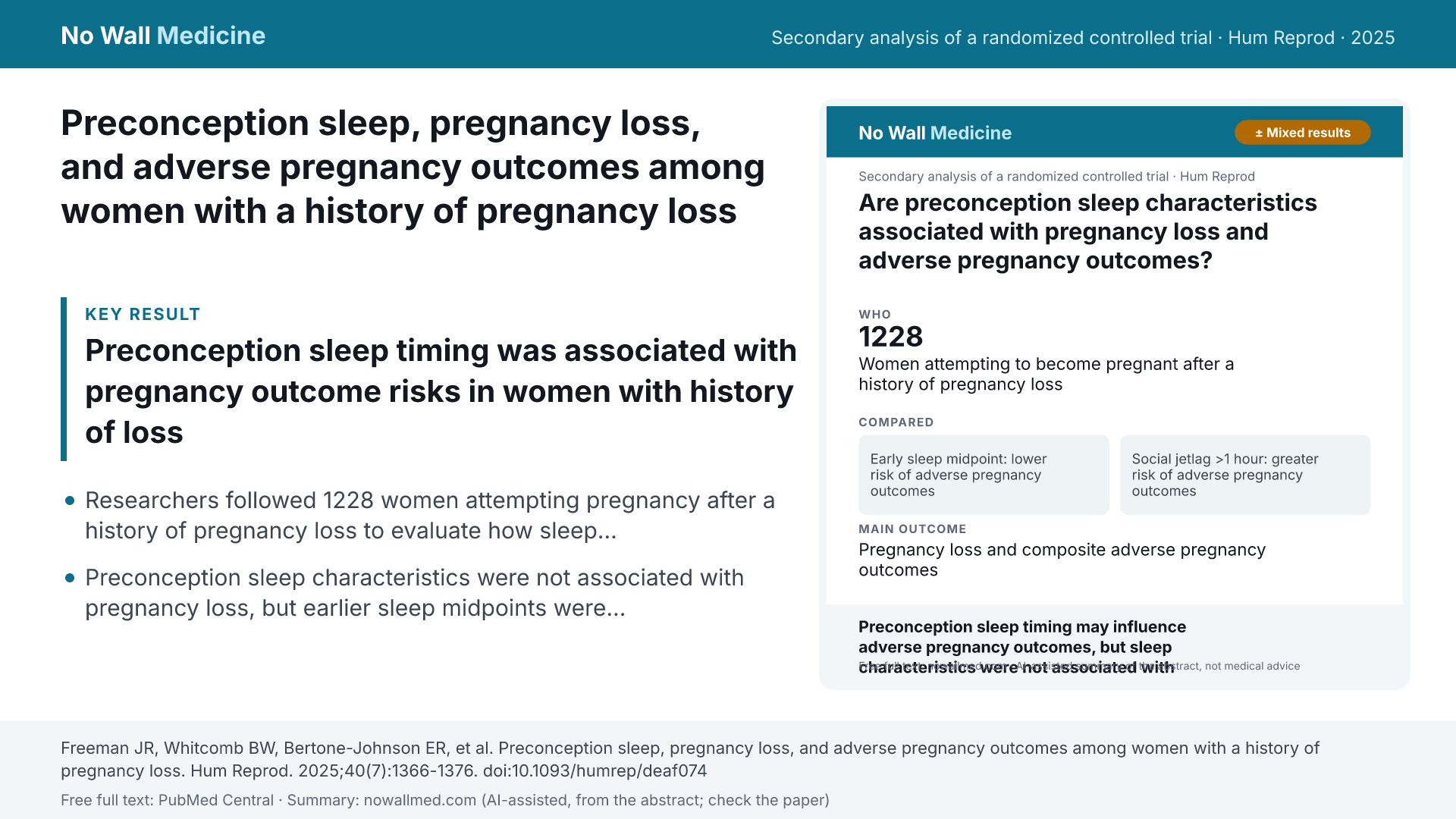
Preconception sleep, pregnancy loss, and adverse pregnancy outcomes among women with a history of pregnancy loss
Secondary analysis of a randomized controlled trialMixed results
Are preconception sleep characteristics associated with pregnancy loss and adverse pregnancy outcomes?
Who
1228
Women attempting to become pregnant after a history of pregnancy loss
Compared
Early sleep midpoint: lower risk of adverse pregnancy outcomes
Social jetlag >1 hour: greater risk of adverse pregnancy outcomes
Main outcome
Pregnancy loss and composite adverse pregnancy outcomes
Result: RR 0.63 (95% CI: 0.40, 0.98) for early midpoint; RR 1.65 (95% CI: 1.11, 2.44) for social jetlag >1h
Bottom line: Preconception sleep timing may influence adverse pregnancy outcomes, but sleep characteristics were not associated with pregnancy loss.
Limitation: Sleep was restricted to baseline self-report and few adverse outcomes limited power.
Funded by: National Cancer Institute and National Institute of Child Health and Human Development
Hum Reprod · 2025-04-23Download image
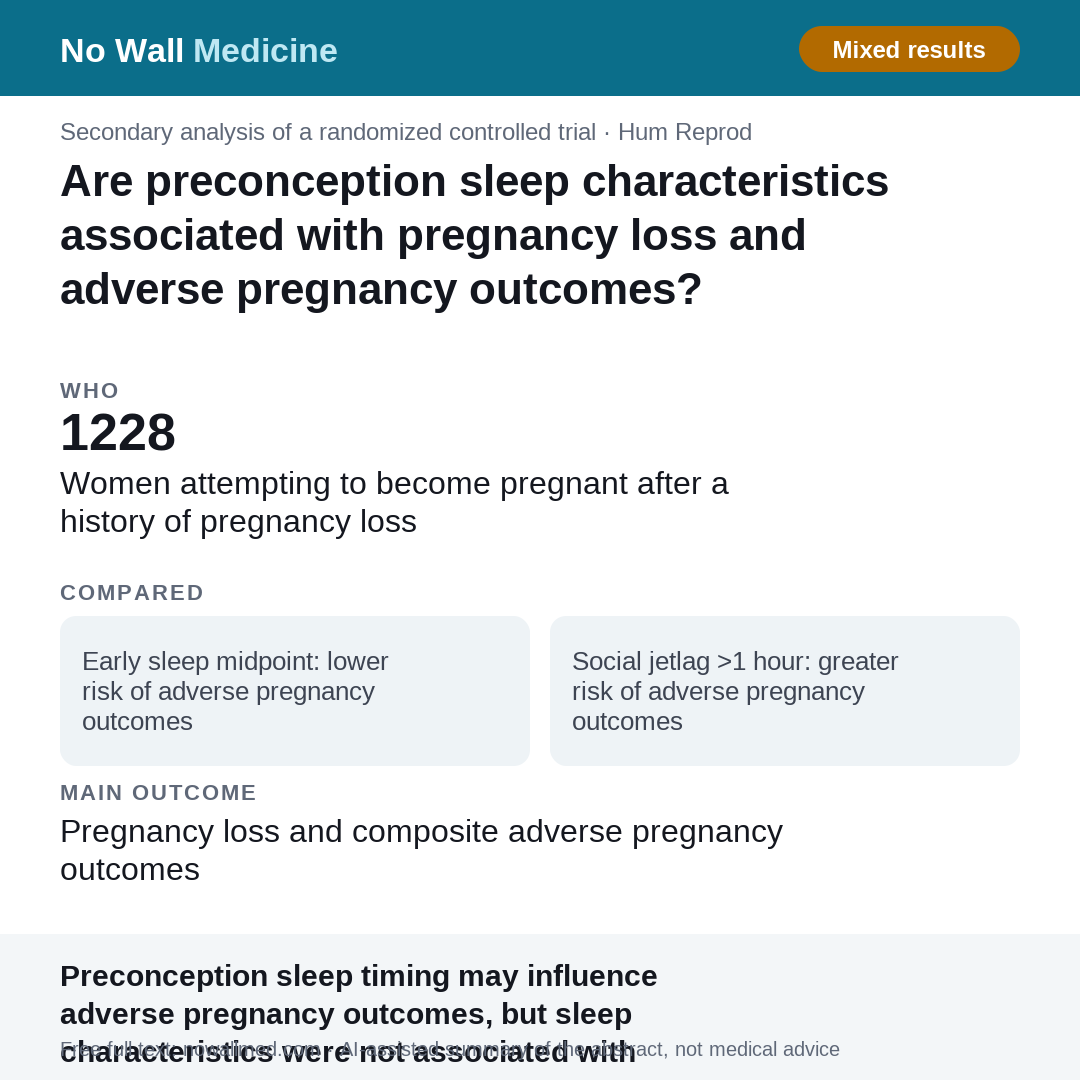
Clinical question: Are preconception sleep characteristics associated with pregnancy loss and adverse pregnancy outcomes?
Why it matters: The relationships between sleep before conception and the risk of pregnancy loss or adverse pregnancy outcomes have not been well characterized.
Key points
- Researchers followed 1228 women attempting pregnancy after a history of pregnancy loss to evaluate how sleep characteristics related to pregnancy loss and adverse outcomes.
- Preconception sleep characteristics were not associated with pregnancy loss, but earlier sleep midpoints were associated with a lower risk of composite adverse pregnancy outcomes (RR 0.63, 95% CI: 0.40, 0.98).
- Social jetlag, or the difference between sleep timing on work days versus free days, greater than 1 hour was associated with a higher risk of composite adverse pregnancy outcomes (RR 1.65, 95% CI: 1.11, 2.44).
Limitation the authors note: The study was limited by baseline self-reported sleep data and a small number of adverse pregnancy outcomes, which may have limited the power to evaluate individual outcomes.
Headline and key points written with AI from the paper’s abstract, with every number checked against it. Read the paper before relying on them.
Was this summary helpful?
Subject terms
Headline, design, result, key points, caveat and citation as plain text.
Cite this article
Freeman JR, Whitcomb BW, Bertone-Johnson ER, et al. Preconception sleep, pregnancy loss, and adverse pregnancy outcomes among women with a history of pregnancy loss. Hum Reprod. 2025. doi:10.1093/humrep/deaf074
Spotted a mistake? Suggest a correction