Advanced artery disease stages were linked to worse limb salvage and higher failure rates
Predictability of the Global Limb Anatomic Staging System (GLASS) for Technical and Limb Related Outcomes: A Systematic Review and Meta-Analysis
Systematic review and meta-analysisBenefit found
Does the Global Limb Anatomic Staging System predict outcomes in chronic limb threatening ischaemia?
Who
2204
Patients with chronic limb threatening ischaemia
Compared
Global Limb Anatomic Staging System 1+2
Global Limb Anatomic Staging System 3
Main outcome
Limb salvage rate, major adverse limb event, and technical outcomes
Result: hazard ratio 0.61 (95% CI 0.47 - 0.80)
Bottom line: Advanced Global Limb Anatomic Staging System stages predict worse limb salvage and major adverse limb events.
Eur J Vasc Endovasc Surg · 2022-04-11Download image
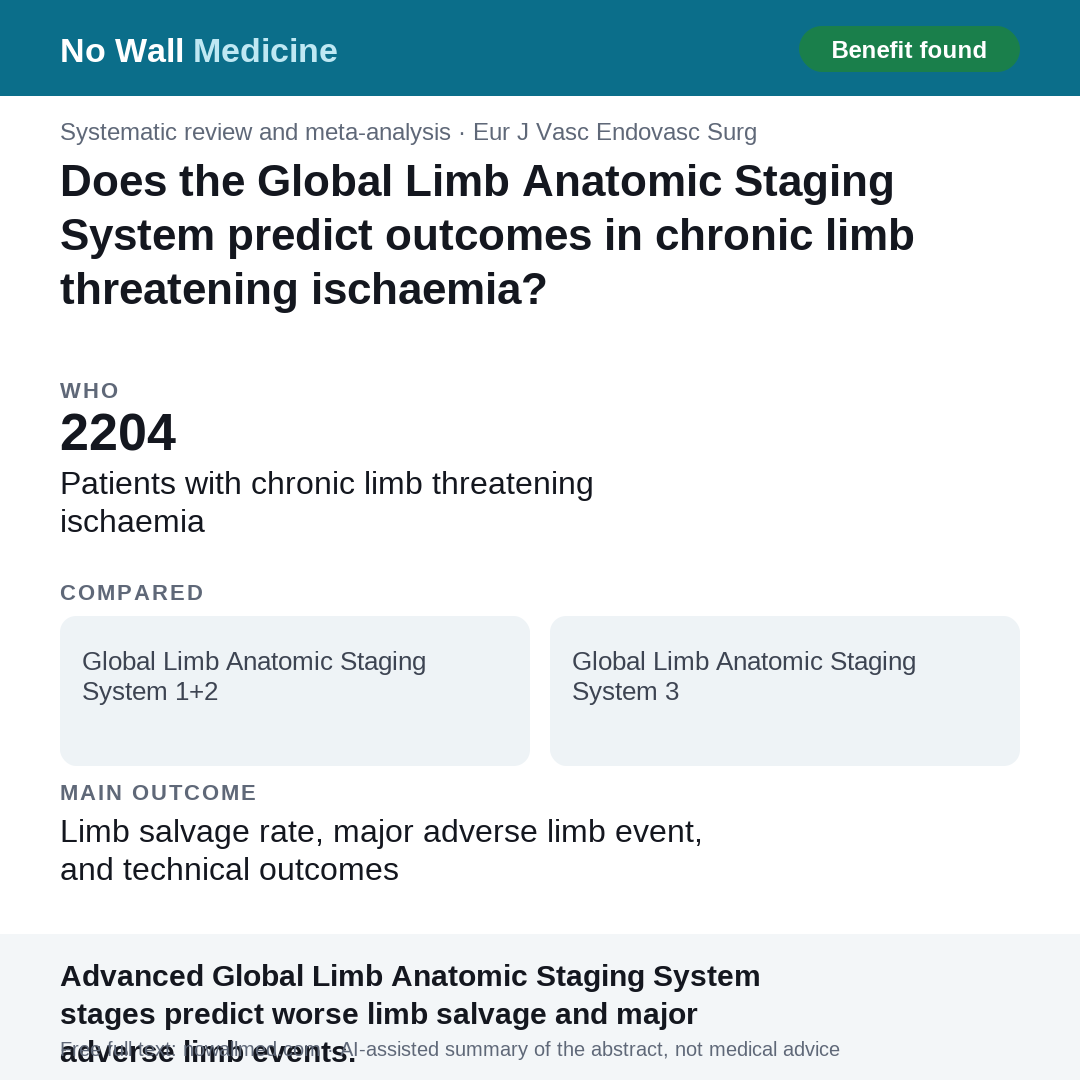
Clinical question: Does the Global Limb Anatomic Staging System predict outcomes in chronic limb threatening ischaemia?
Why it matters: It was unknown if the Global Limb Anatomic Staging System could accurately predict clinical outcomes for patients with chronic limb threatening ischaemia.
Key points
- Researchers analyzed data from seven retrospective cohort studies and one randomized control trial involving 2,204 patients and 2,483 limbs.
- GLASS 3 was associated with lower limb salvage rates (HR 0.61; 95% CI 0.47 - 0.80) and higher major adverse limb events (HR 0.66; 95% CI 0.53 - 0.83) compared to GLASS 1+2.
- After endovascular treatment, immediate technical failure rates were 3.9% for GLASS 1, 5.3% for GLASS 2, and 27.9% for GLASS 3.
Headline and key points written with AI from the paper’s abstract, with every number checked against it. Read the paper before relying on them.
Was this summary helpful?
Subject terms
Cite this article
Shirasu T, Takagi H, Gregg A, Kuno T, Yasuhara J, Kent KC. Predictability of the Global Limb Anatomic Staging System (GLASS) for Technical and Limb Related Outcomes: A Systematic Review and Meta-Analysis. Eur J Vasc Endovasc Surg. 2022. doi:10.1016/j.ejvs.2022.03.044
Spotted a mistake? Suggest a correction
Top studies every Monday
The week’s key trials and guidelines in your specialties, plus any topics you follow. By email, free.
Get the weekly digest