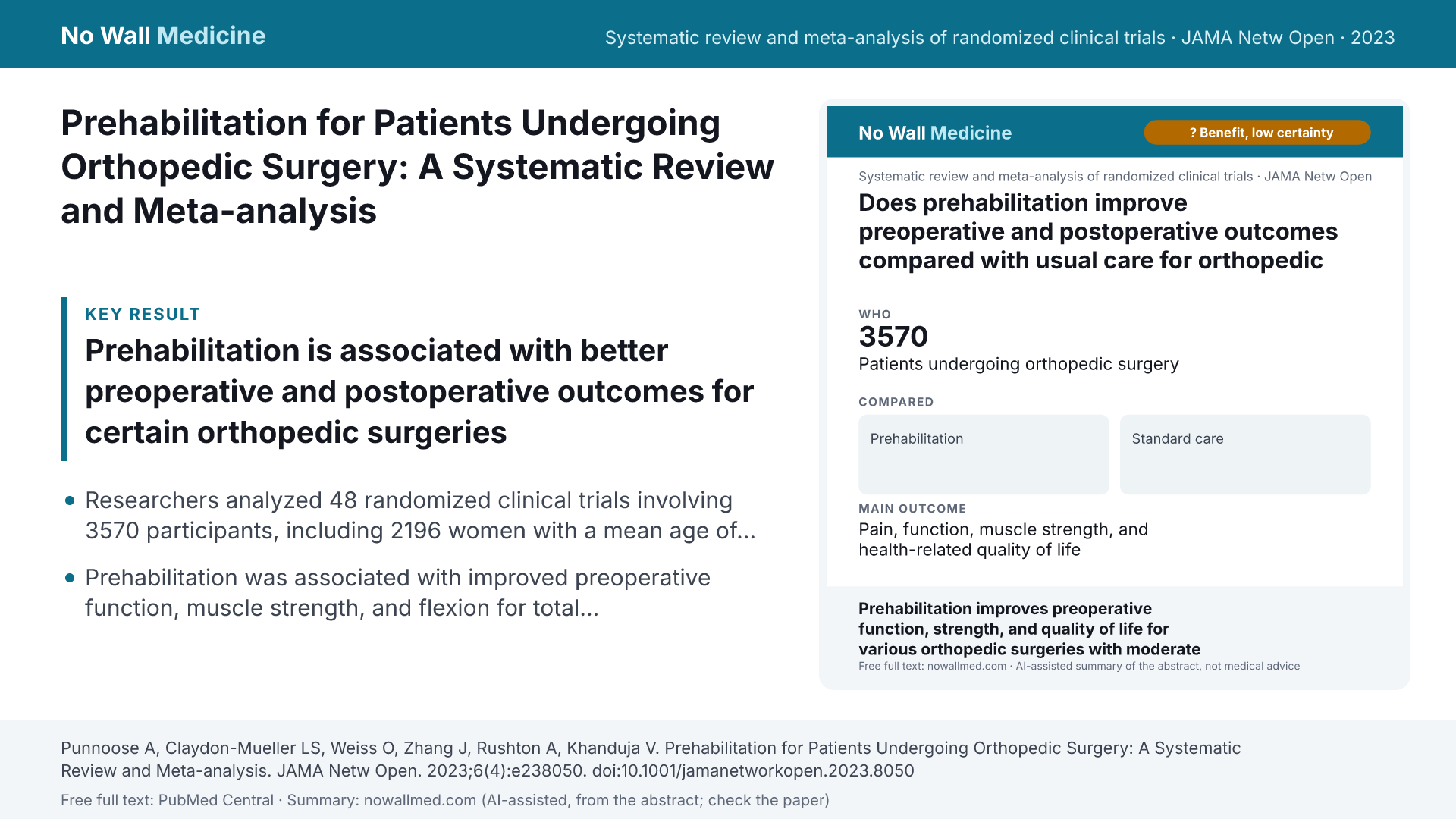
Prehabilitation is associated with better preoperative and postoperative outcomes for certain orthopedic surgeries
Prehabilitation for Patients Undergoing Orthopedic Surgery: A Systematic Review and Meta-analysis
Systematic review and meta-analysis of randomized clinical trialsBenefit found
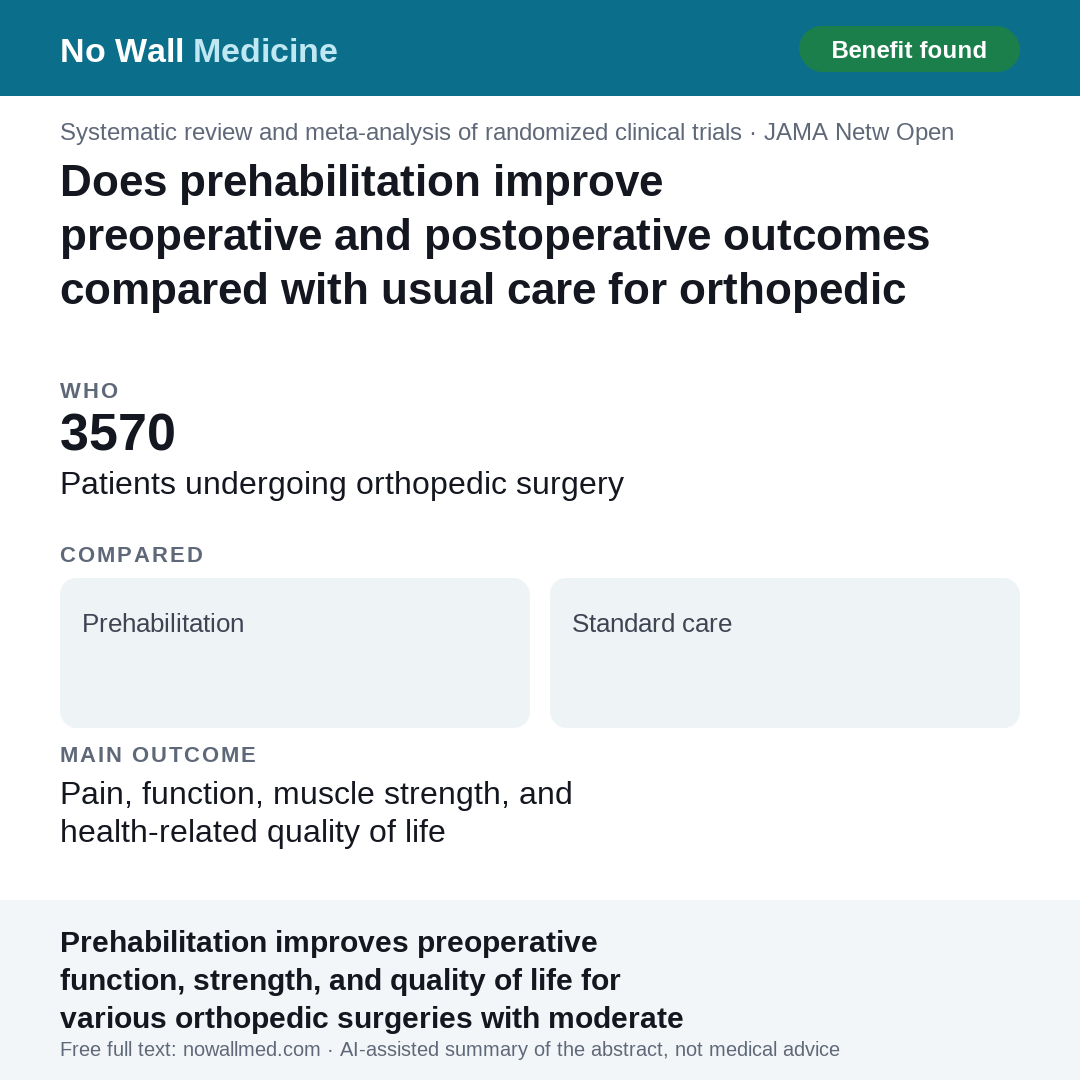
Does prehabilitation improve preoperative and postoperative outcomes compared with usual care for orthopedic surgery patients?
Who
3570
Patients undergoing orthopedic surgery
Compared
Prehabilitation
Standard care
Main outcome
Pain, function, muscle strength, and health-related quality of life
Bottom line: Prehabilitation improves preoperative function, strength, and quality of life for various orthopedic surgeries with moderate to high certainty.
Limitation: High risk of bias and heterogeneity affected overall quality of evidence for some outcomes.
JAMA Netw Open · 2023-04-03Download image
Clinical question: Does prehabilitation improve preoperative and postoperative outcomes compared with usual care for orthopedic surgery patients?
Why it matters: Current literature has produced varying results regarding whether prehabilitation programs improve preoperative and postoperative outcomes for patients undergoing orthopedic surgery.
Key points
- Researchers analyzed 48 randomized clinical trials involving 3570 participants, including 2196 women with a mean age of 64.1 years.
- Prehabilitation was associated with improved preoperative function, muscle strength, and flexion for total knee replacement, and improved health-related quality of life and muscle strength for total hip replacement.
- For lumbar surgery, prehabilitation was associated with reduced back pain and improved health-related quality of life preoperatively, and improved function 6 months after surgery.
Limitation the authors note: High risk of bias and heterogeneity affected the overall quality of evidence for other outcomes.
Headline and key points written with AI from the paper’s abstract, with every number checked against it. Read the paper before relying on them.
Was this summary helpful?
Subject terms
Cite this article
Punnoose A, Claydon-Mueller LS, Weiss O, Zhang J, Rushton A, Khanduja V. Prehabilitation for Patients Undergoing Orthopedic Surgery: A Systematic Review and Meta-analysis. JAMA Netw Open. 2023. doi:10.1001/jamanetworkopen.2023.8050
Spotted a mistake? Suggest a correction
Top studies every Monday
The week’s key trials and guidelines in your specialties, plus any topics you follow. By email, free.
Get the weekly digest