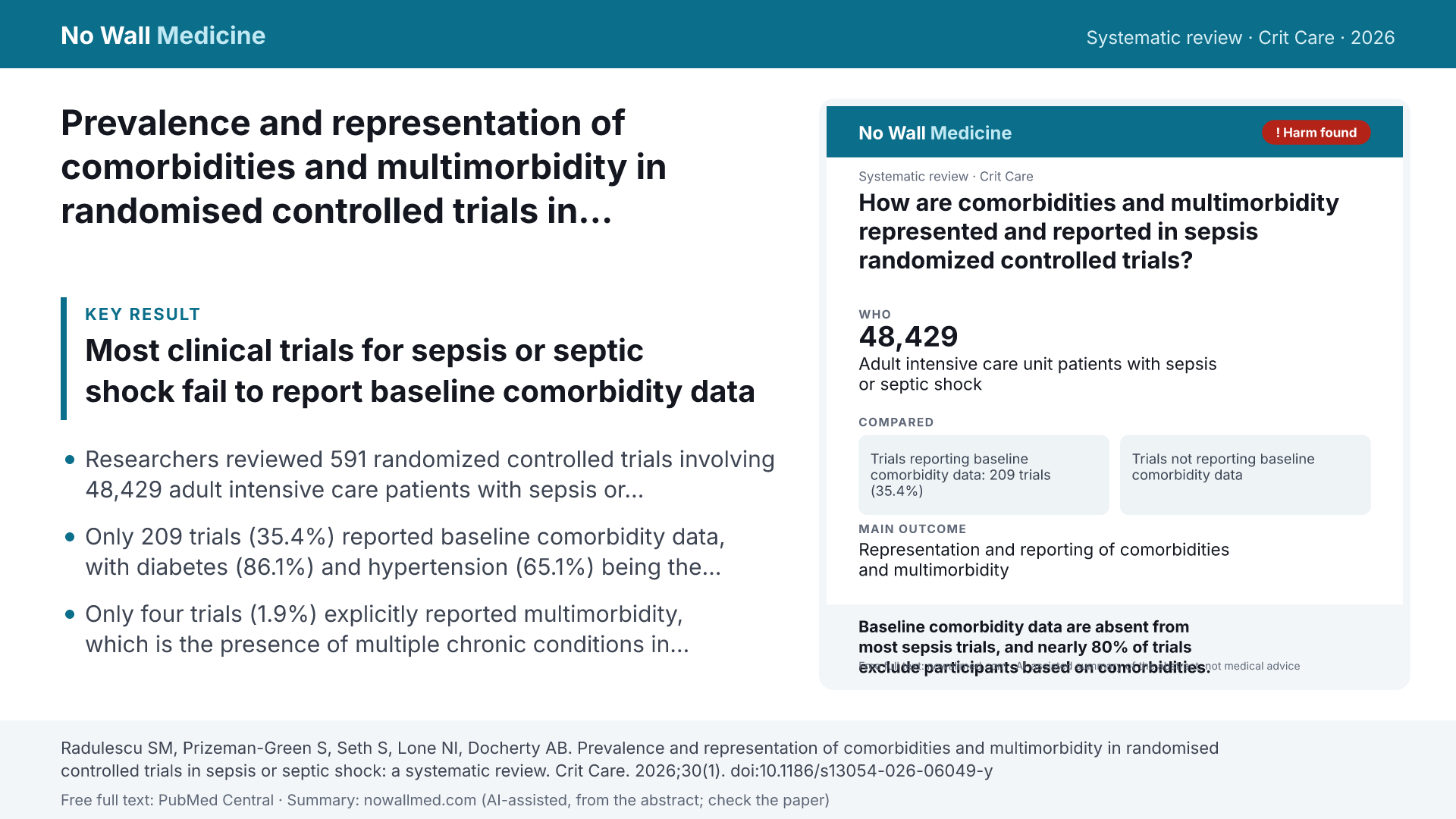
Most clinical trials for sepsis or septic shock fail to report baseline comorbidity data
Prevalence and representation of comorbidities and multimorbidity in randomised controlled trials in sepsis or septic shock: a systematic review
Systematic reviewHarm found
How are comorbidities and multimorbidity represented and reported in sepsis randomized controlled trials?
Who
48,429
Adult intensive care unit patients with sepsis or septic shock
Compared
Trials reporting baseline comorbidity data: 209 trials (35.4%)
Trials not reporting baseline comorbidity data
Main outcome
Representation and reporting of comorbidities and multimorbidity
Result: OR 1.08, 95% CI 1.06-1.11
Bottom line: Baseline comorbidity data are absent from most sepsis trials, and nearly 80% of trials exclude participants based on comorbidities.
Crit Care · 2026-05-06 · Save PNG
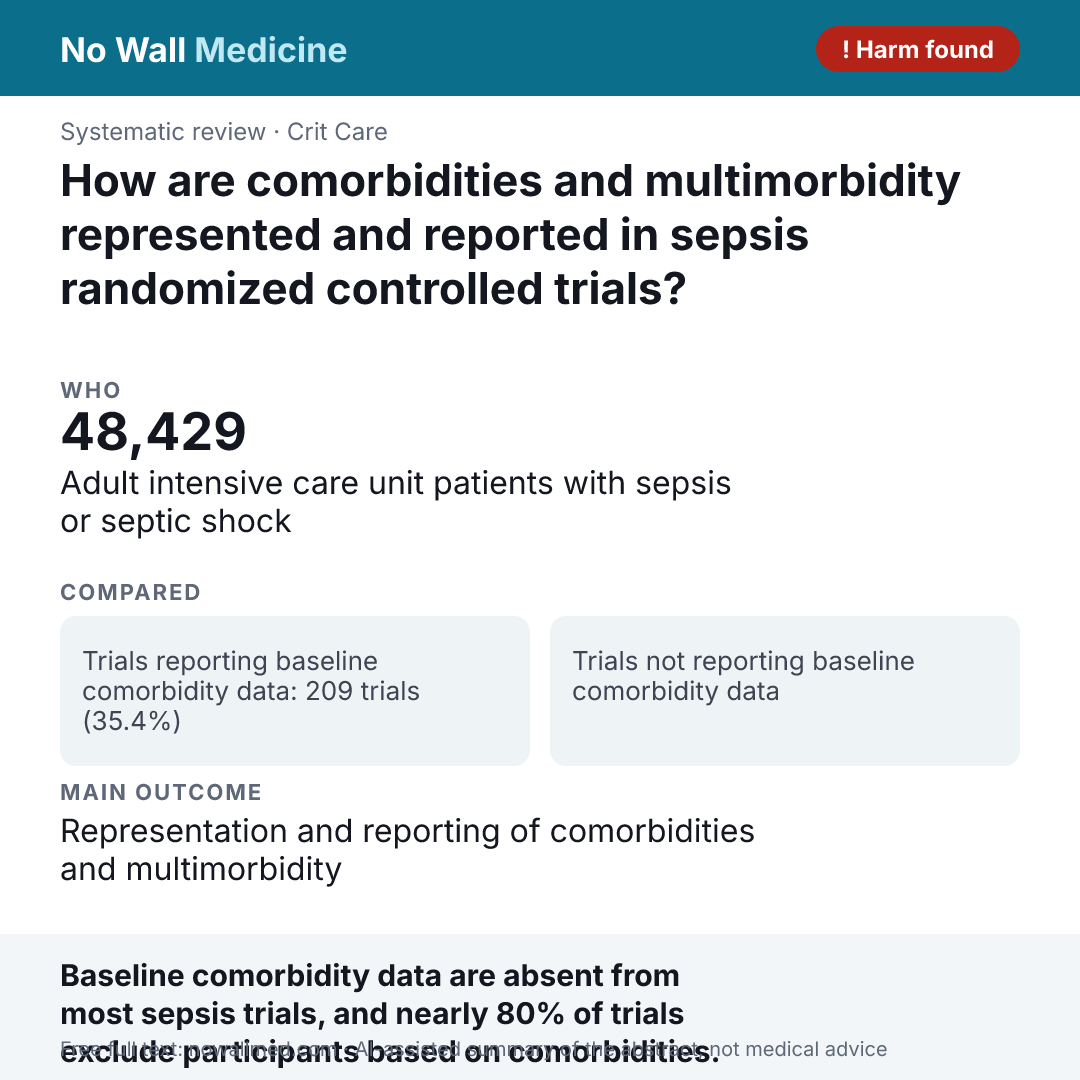
Clinical question: How are comorbidities and multimorbidity represented and reported in sepsis randomized controlled trials?
Why it matters: Inadequate reporting of chronic disease burden in sepsis trials limits the ability to understand if these conditions change how treatments work.
Key points
- Researchers reviewed 591 randomized controlled trials involving 48,429 adult intensive care patients with sepsis or septic shock.
- Only 209 trials (35.4%) reported baseline comorbidity data, with diabetes (86.1%) and hypertension (65.1%) being the most frequently reported conditions.
- Only four trials (1.9%) explicitly reported multimorbidity, which is the presence of multiple chronic conditions in one person.
Headline and key points written with AI from the paper’s abstract, with every number checked against it. Read the paper before relying on them.
Was this summary helpful?
Subject terms
Headline, design, result, key points, caveat and citation as plain text.
Cite this article
Radulescu SM, Prizeman-Green S, Seth S, Lone NI, Docherty AB. Prevalence and representation of comorbidities and multimorbidity in randomised controlled trials in sepsis or septic shock: a systematic review. Crit Care. 2026;30(1). doi:10.1186/s13054-026-06049-y
Spotted a mistake? Suggest a correction