Preventive coronary stenting was associated with fewer clinical events in patients with vulnerable plaques
Preventive percutaneous coronary intervention for non-flow-limiting vulnerable atherosclerotic coronary plaques in diabetes: the PREVENT trial
Randomized clinical trialBenefit found
Does preventive percutaneous coronary intervention reduce clinical events in patients with non-flow-limiting vulnerable plaques?
Who
1606
Patients with non-flow-limiting vulnerable coronary plaques
Compared
Preventive percutaneous coronary intervention plus optimal medical therapy: 0% in diabetic and 0.5% in non-diabetic
Optimal medical therapy alone: 3.7% in diabetic and 3.2% in non-diabetic
Main outcome
Composite of cardiac death, myocardial infarction, revascularisation, or angina hospitalization
Result: hazard ratio 0.16 (95% confidence interval 0.05-0.55)
Bottom line: Preventive percutaneous coronary intervention reduced the primary endpoint at 2 years regardless of diabetes status.
Eur Heart J · 2025-05-29Download image
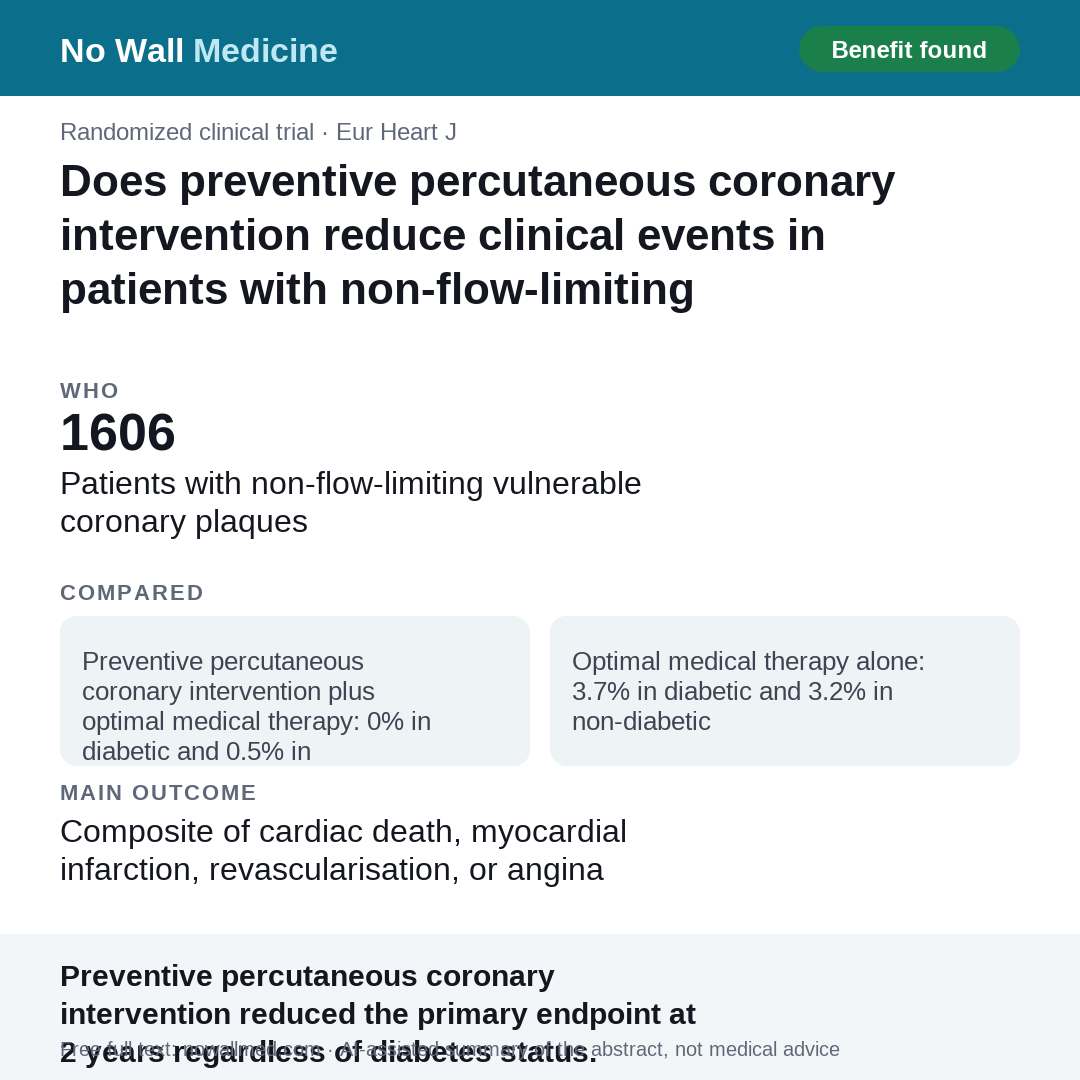
Clinical question: Does preventive percutaneous coronary intervention reduce clinical events in patients with non-flow-limiting vulnerable plaques?
Why it matters: The efficacy and safety of preventive percutaneous coronary intervention for treating vulnerable plaques in patients with diabetes remain unclear.
Key points
- The trial studied 1606 patients with non-flow-limiting vulnerable plaques, comparing preventive percutaneous coronary intervention (stenting) plus medical therapy to medical therapy alone.
- At 2 years, the primary endpoint occurred in 0% of diabetic patients and 0.5% of non-diabetic patients receiving stenting, compared to 3.7% and 3.2% in the medical therapy groups.
- There were no significant differences in the primary endpoint incidence between diabetic and non-diabetic patients, which was 1.8% versus 1.9%.
Headline and key points written with AI from the paper’s abstract, with every number checked against it. Read the paper before relying on them.
Topics
Cite this article
Kim MC, Park SJ, Park DW, Ahn JM, Kang DY, Kim WJ. Preventive percutaneous coronary intervention for non-flow-limiting vulnerable atherosclerotic coronary plaques in diabetes: the PREVENT trial. Eur Heart J. 2025. doi:10.1093/eurheartj/ehaf273
Spotted a mistake? Suggest a correction