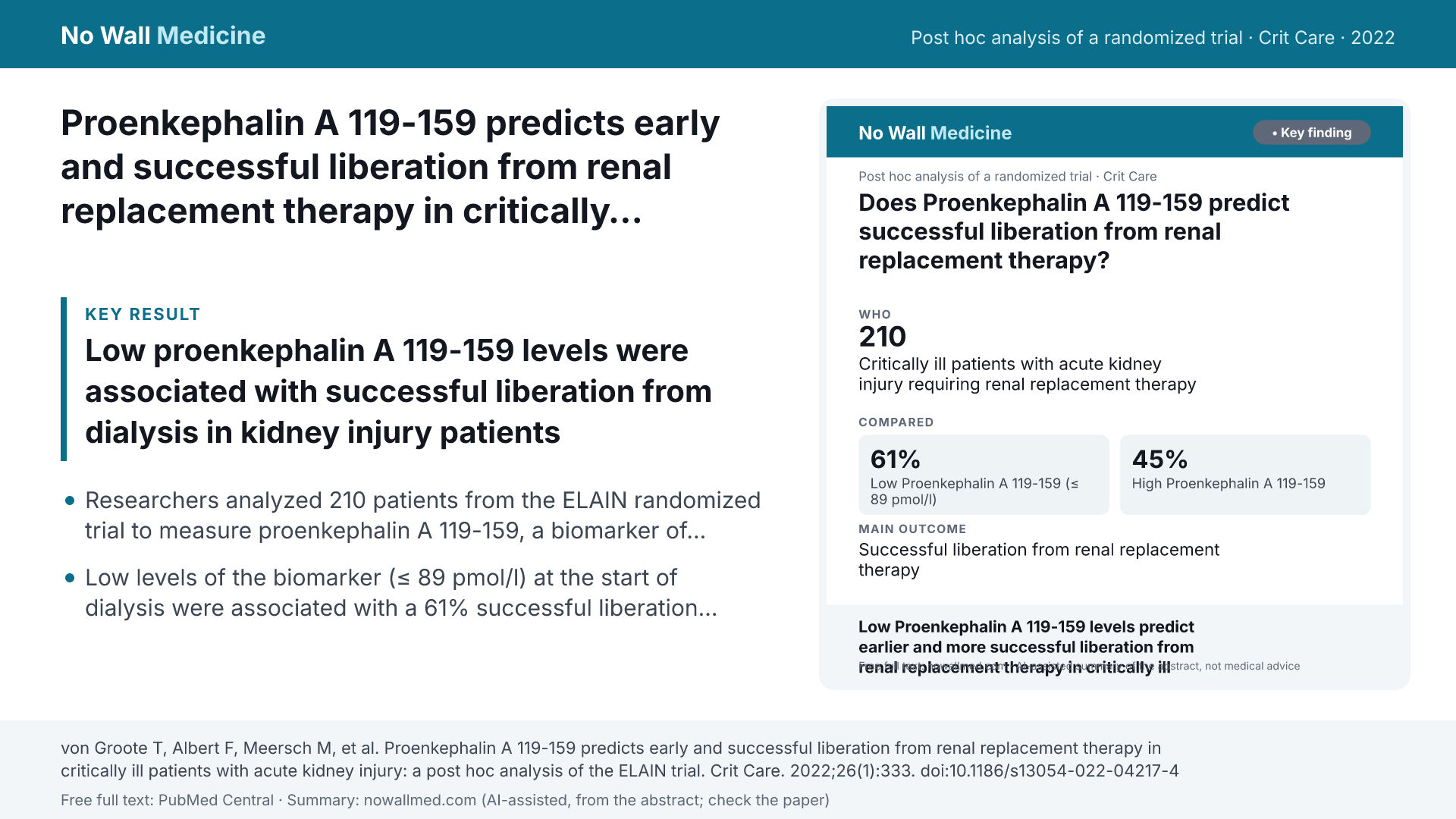
Low proenkephalin A 119-159 levels were associated with successful liberation from dialysis in kidney injury patients
Proenkephalin A 119-159 predicts early and successful liberation from renal replacement therapy in critically ill patients with acute kidney injury: a post hoc analysis of the ELAIN trial
Post hoc analysis of a randomized trialBenefit found
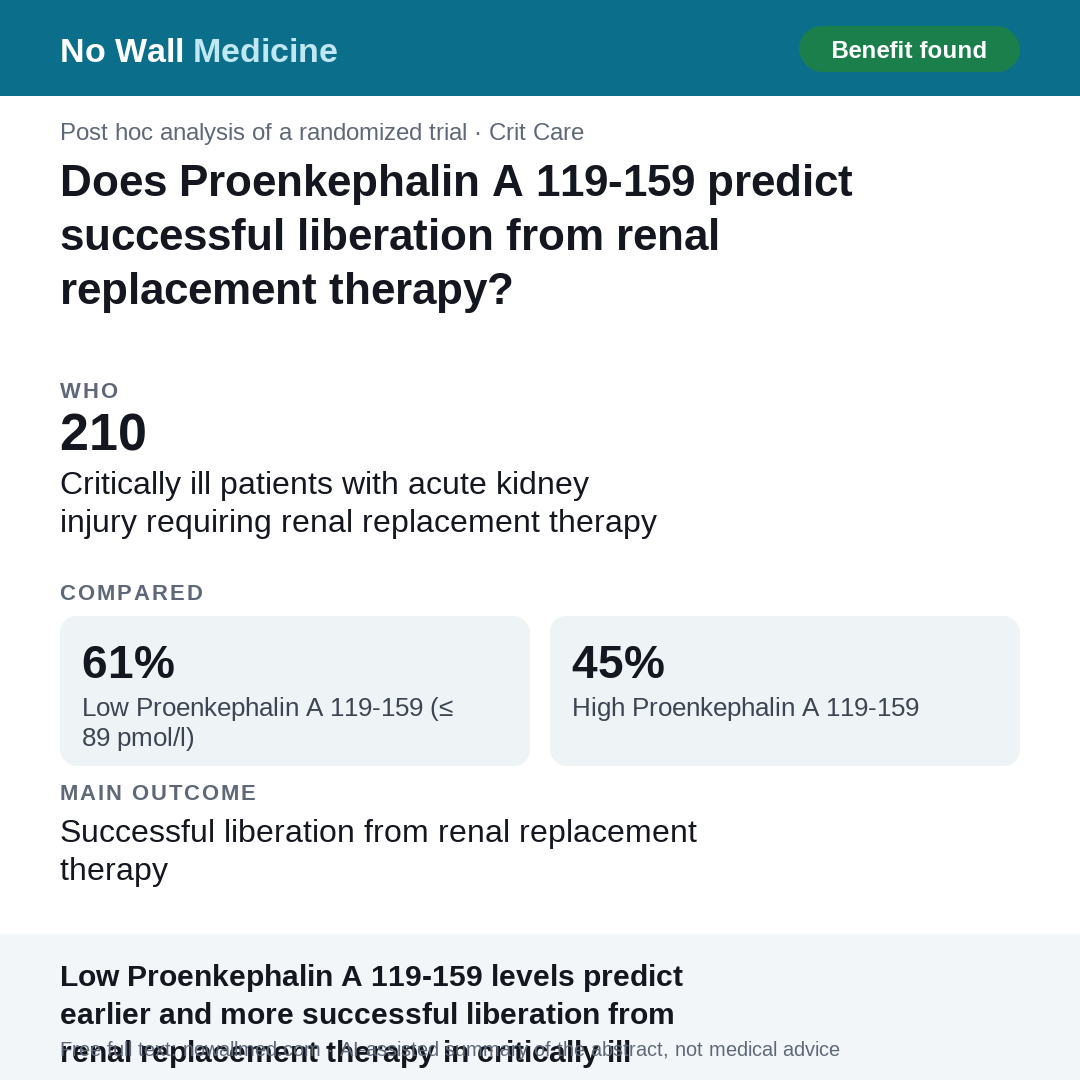
Does Proenkephalin A 119-159 predict successful liberation from renal replacement therapy?
Who
210
Critically ill patients with acute kidney injury requiring renal replacement therapy
Compared
61%Low Proenkephalin A 119-159 (≤ 89 pmol/l) (28d-CIF of successful liberation)
45%High Proenkephalin A 119-159 (28d-CIF of successful liberation)
Main outcome
Successful liberation from renal replacement therapy
Result: subdistribution hazard ratio 1.83 (95%CI 1.26-2.67)
Bottom line: Low Proenkephalin A 119-159 levels predict earlier and more successful liberation from renal replacement therapy in critically ill patients.
Limitation: This was a post hoc analysis of the ELAIN trial
Crit Care · 2022-10-31Download image
Clinical question: Does Proenkephalin A 119-159 predict successful liberation from renal replacement therapy?
Why it matters: There are currently no tools available to predict whether critically ill patients with acute kidney injury will successfully stop using renal replacement therapy.
Key points
- Researchers analyzed 210 patients from the ELAIN randomized trial to measure proenkephalin A 119-159, a biomarker of kidney function, during renal replacement therapy (dialysis).
- Low levels of the biomarker (≤ 89 pmol/l) at the start of dialysis were associated with a 61% successful liberation rate compared to 45% for high levels.
- At the day 3 landmark analysis, low levels were associated with a 67% successful liberation rate compared to 47% for high levels.
Headline and key points written with AI from the paper’s abstract, with every number checked against it. Read the paper before relying on them.
Was this summary helpful?
Subject terms
Cite this article
von Groote T, Albert F, Meersch M, Koch R, Porschen C, Hartmann O. Proenkephalin A 119-159 predicts early and successful liberation from renal replacement therapy in critically ill patients with acute kidney injury: a post hoc analysis of the ELAIN trial. Crit Care. 2022. doi:10.1186/s13054-022-04217-4
Spotted a mistake? Suggest a correction