Prostate-specific membrane antigen imaging did not change progression-free survival compared to sodium fluoride imaging
Progression-free Survival Following Primary Staging with [18F]PSMA-1007-PET/ceCT Versus Na[18F]F-PET/ceCT in Prostate Cancer: Results from the PRISMA-PET Randomized Controlled Trial
Multicenter, randomized controlled trialNo clear difference
Does [18F]PSMA-1007-PET/ceCT compare to Na[18F]F-PET/ceCT for progression-free survival in newly diagnosed prostate cancer?
Who
385
Patients with newly diagnosed prostate cancer · Multicenter
Compared
34[18F]PSMA-1007-PET/ceCT (18%)
43Na[18F]F-PET/ceCT (23%)
Main outcome
progression-free survival
Result: hazard ratio 0.74 (95% CI 0.47-1.16)
Bottom line: In newly diagnosed prostate cancer, [18F]PSMA-1007-PET/ceCT did not significantly differ from Na[18F]F-PET/ceCT regarding progression-free survival.
Limitation: The main limitation was the variation in types of progression-free survival events between the two groups.
Eur Urol Open Sci · 2026-05-27Download image
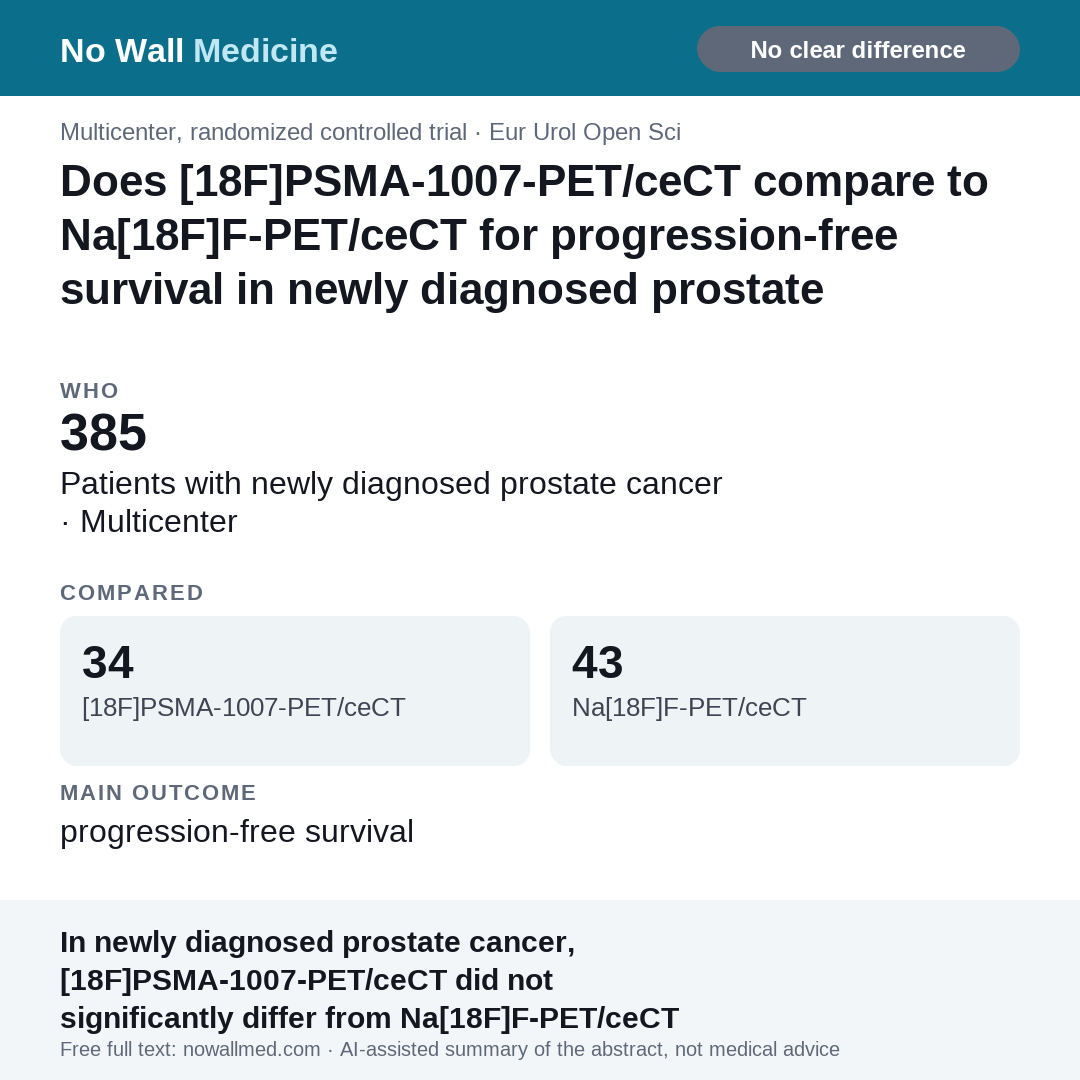
Clinical question: Does [18F]PSMA-1007-PET/ceCT compare to Na[18F]F-PET/ceCT for progression-free survival in newly diagnosed prostate cancer?
Why it matters: It is unclear how different imaging methods used for initial staging affect progression-free survival in patients with newly diagnosed prostate cancer.
Key points
- Researchers studied 385 patients with newly diagnosed prostate cancer who were randomized to receive either prostate-specific membrane antigen 1007 positron emission tomography or sodium fluoride positron emission tomography.
- Progression-free survival did not differ significantly between the two groups, with 34 patients (18%) in the prostate-specific membrane antigen group versus 43 patients (23%) in the sodium fluoride group.
- Fewer patients were classified as having nonmetastatic disease when staged with prostate-specific membrane antigen 1007 imaging compared to sodium fluoride imaging.
Limitation the authors note: The main limitation was the variation in types of progression-free survival events between the two groups.
Headline and key points written with AI from the paper’s abstract, with every number checked against it. Read the paper before relying on them.
Was this summary helpful?
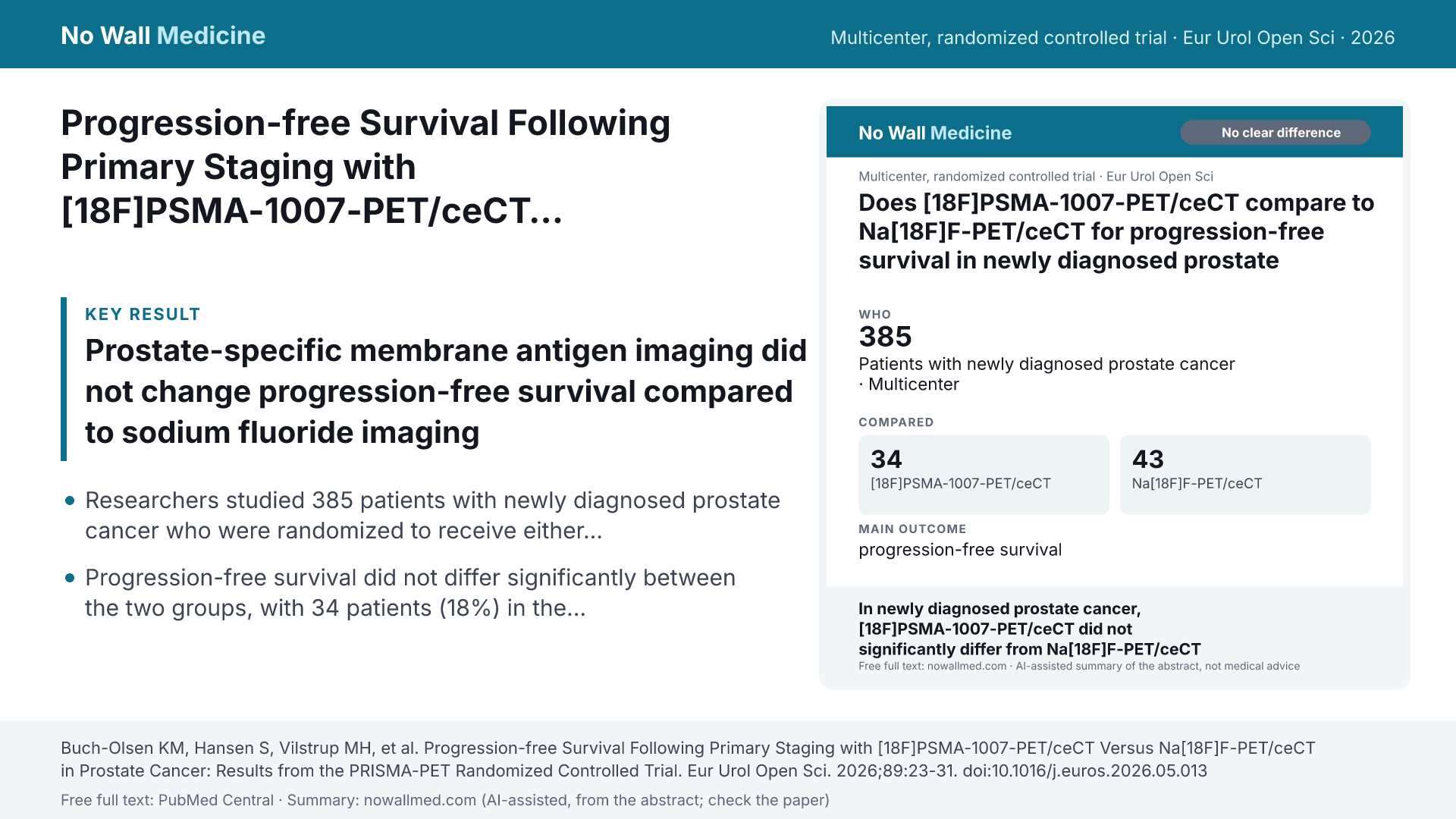
Cite this article
Buch-Olsen KM, Hansen S, Vilstrup MH, et al. Progression-free Survival Following Primary Staging with [18F]PSMA-1007-PET/ceCT Versus Na[18F]F-PET/ceCT in Prostate Cancer: Results from the PRISMA-PET Randomized Controlled Trial. Eur Urol Open Sci. 2026. doi:10.1016/j.euros.2026.05.013
Spotted a mistake? Suggest a correction