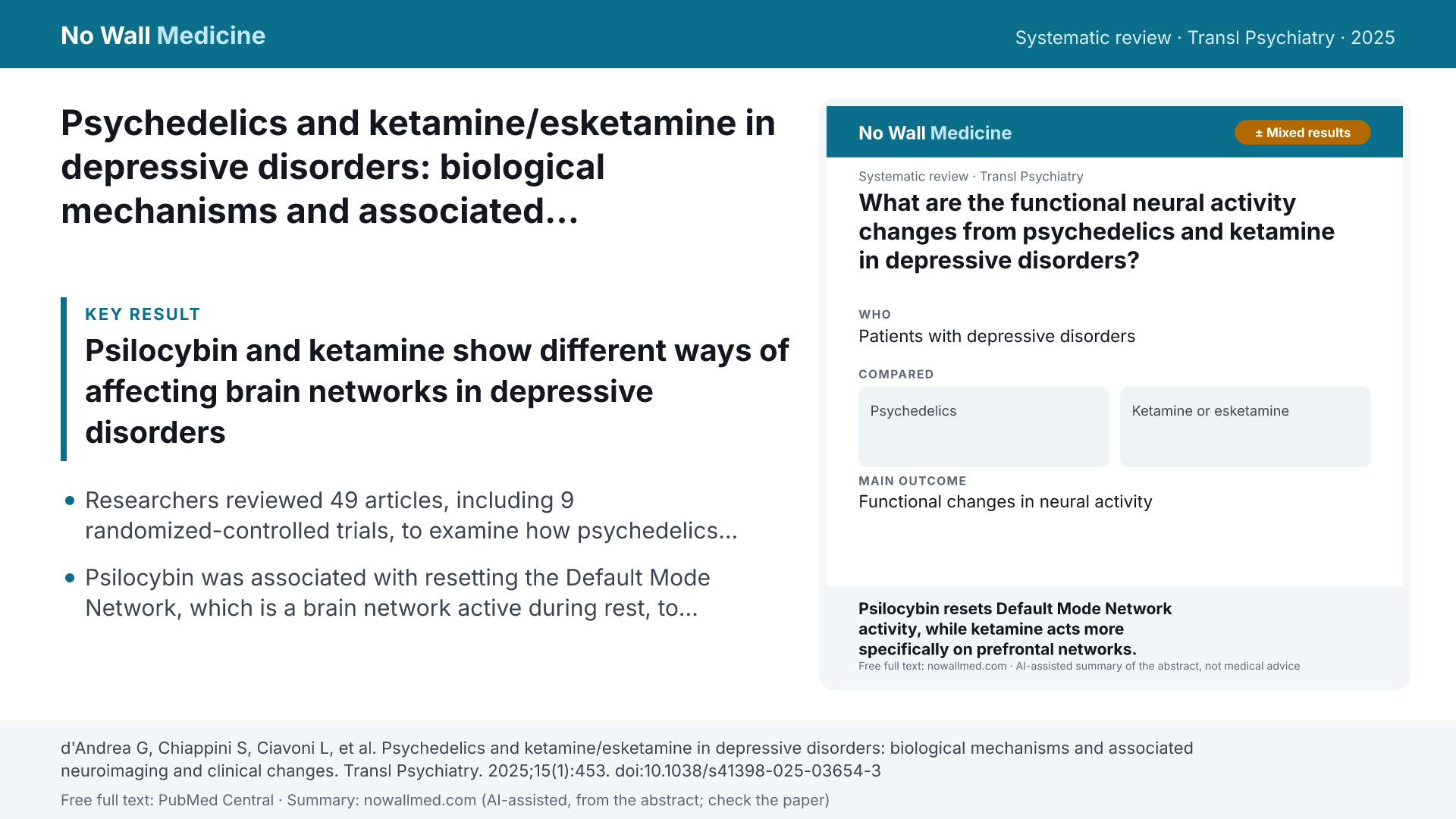
Psilocybin and ketamine show different ways of affecting brain networks in depressive disorders
Psychedelics and ketamine/esketamine in depressive disorders: biological mechanisms and associated neuroimaging and clinical changes
Systematic reviewMixed results
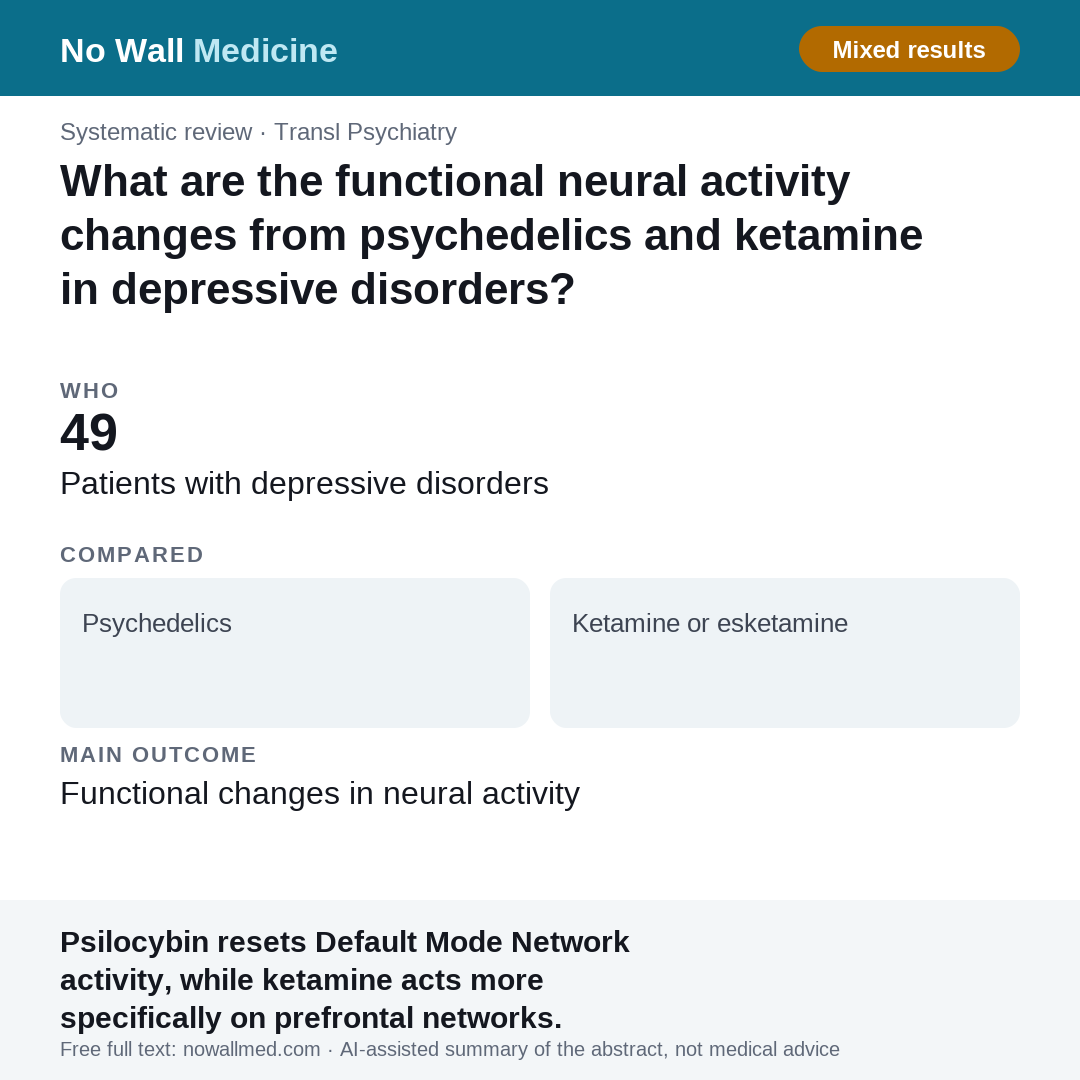
What are the functional neural activity changes from psychedelics and ketamine in depressive disorders?
Who
49
Patients with depressive disorders
Compared
Psychedelics
Ketamine or esketamine
Main outcome
Functional changes in neural activity
Bottom line: Psilocybin resets Default Mode Network activity, while ketamine acts more specifically on prefrontal networks.
Transl Psychiatry · 2025-10-31Download image
Clinical question: What are the functional neural activity changes from psychedelics and ketamine in depressive disorders?
Why it matters: The biological mechanisms and specific changes in neural activity caused by psychedelic compounds and ketamine in depressive disorders remain largely unexplored.
Key points
- Researchers reviewed 49 articles, including 9 randomized-controlled trials, to examine how psychedelics and ketamine affect brain activity in depression.
- Psilocybin was associated with resetting the Default Mode Network, which is a brain network active during rest, to help reduce depressive symptoms.
- Ketamine was associated with more specific actions on brain networks involving prefrontal areas that act indirectly on the Default Mode Network.
Headline and key points written with AI from the paper’s abstract, with every number checked against it. Read the paper before relying on them.
Was this summary helpful?
Subject terms
Cite this article
d'Andrea G, Chiappini S, Ciavoni L, Tucci R, Martino F, Semeraro FM. Psychedelics and ketamine/esketamine in depressive disorders: biological mechanisms and associated neuroimaging and clinical changes. Transl Psychiatry. 2025. doi:10.1038/s41398-025-03654-3
Spotted a mistake? Suggest a correction