Lung transplant recipients maintained respiratory patterns despite nerve damage during early postoperative ventilation
Pulmonary volume-feedback and ventilatory pattern after bilateral lung transplantation using neurally adjusted ventilatory assist ventilation
Prospective randomized trialBenefit found
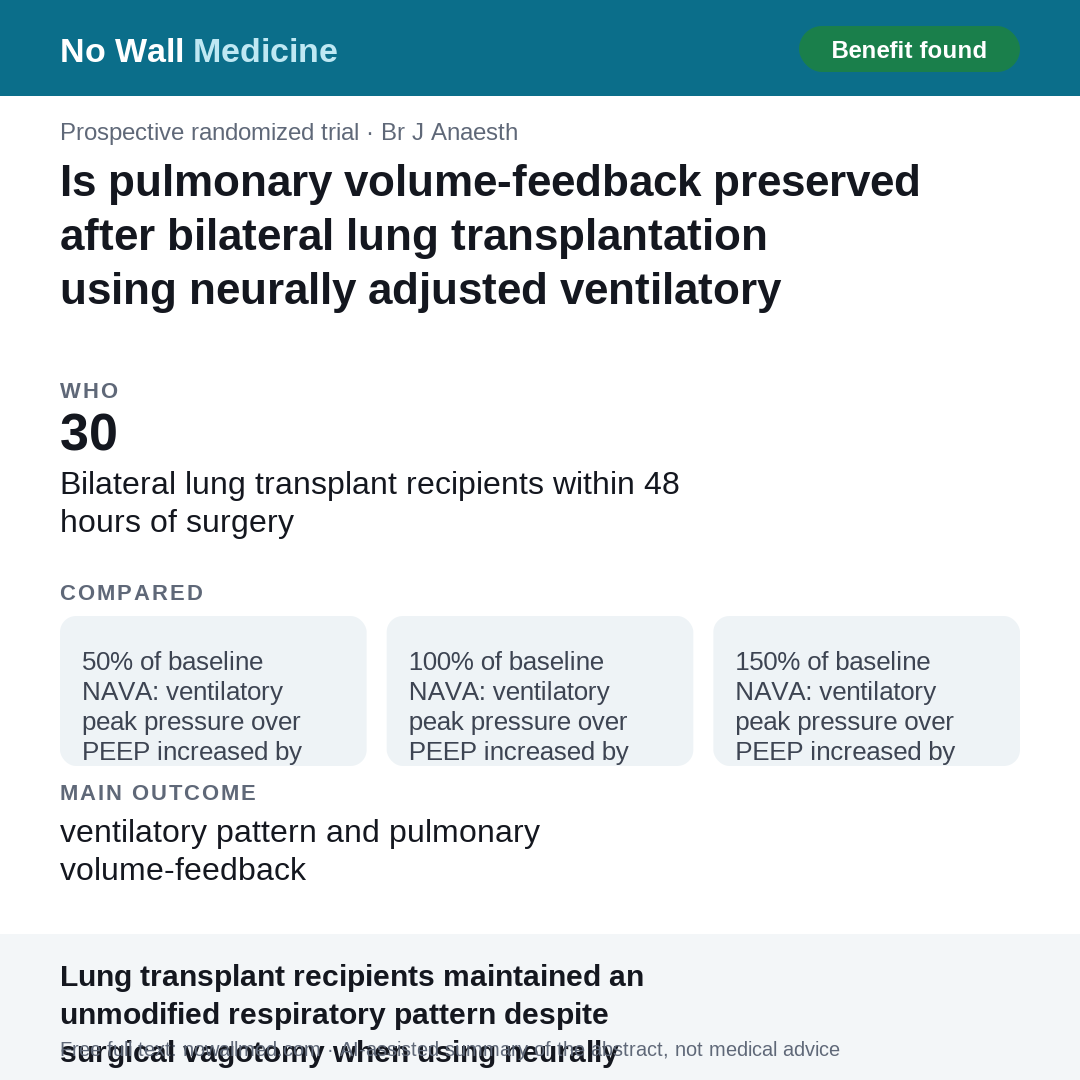
Is pulmonary volume-feedback preserved after bilateral lung transplantation using neurally adjusted ventilatory assist ventilation?
Who
30
Bilateral lung transplant recipients within 48 hours of surgery
Compared
50% of baseline NAVA: ventilatory peak pressure over PEEP increased by 6.3 (1.8) cm H2O
100% of baseline NAVA: ventilatory peak pressure over PEEP increased by 7.6 (2.4) cm H2O
150% of baseline NAVA: ventilatory peak pressure over PEEP increased by 8.7 (3.2) cm H2O
Main outcome
ventilatory pattern and pulmonary volume-feedback
Bottom line: Lung transplant recipients maintained an unmodified respiratory pattern despite surgical vagotomy when using neurally adjusted ventilatory assist ventilation.
Br J Anaesth · 2021-04-21Download image
Clinical question: Is pulmonary volume-feedback preserved after bilateral lung transplantation using neurally adjusted ventilatory assist ventilation?
Why it matters: It was unknown if the loss of pulmonary vagal nerves during bilateral lung transplantation alters respiratory drive and volume-feedback in the early postoperative period.
Key points
- Researchers studied 30 bilateral lung transplant recipients within 48 hours of surgery using Neurally Adjusted Ventilatory Assist, a mode driven by diaphragm electrical activity.
- Increasing the level of ventilatory assistance to 150% of baseline was associated with a peak diaphragm electrical activity decrease of 8.8 (8.7) μV.
- Doubling the positive end-expiratory pressure, or the pressure maintained in the lungs to keep airways open, did not affect tidal volume.
Headline and key points written with AI from the paper’s abstract, with every number checked against it. Read the paper before relying on them.
Was this summary helpful?
Subject terms
Cite this article
Grasselli G, Castagna L, Abbruzzese C, Corcione N, Bottino N, Guzzardella A. Pulmonary volume-feedback and ventilatory pattern after bilateral lung transplantation using neurally adjusted ventilatory assist ventilation. Br J Anaesth. 2021. doi:10.1016/j.bja.2021.03.010
Spotted a mistake? Suggest a correction
Top studies every Monday
The week’s key trials and guidelines in your specialties, plus any topics you follow. By email, free.
Get the weekly digest