Degarelix and hormone agonists showed similar PSA responses in high-risk prostate cancer patients
Radiotherapy plus Long-term Adjuvant Androgen Deprivation with a Luteinizing Hormone-releasing Hormone Antagonist Versus Agonist in Patients with Very High-risk Localized or Locally Advanced Prostate Cancer: The EORTC GUCG-1414 Phase 3 Randomized Trial
Randomized phase 3 trialNo clear difference
Does degarelix or an LHRH agonist improve PSA nadir response in high-risk prostate cancer?
Who
379
Patients with very high-risk localized or locally advanced prostate cancer
Compared
52%degarelix
60%LHRH agonist
Main outcome
PSA nadir response less than 0.1 ng/ml within 6 months
Result: odds ratio 0.73 (95% CI 0.43-1.22)
Bottom line: Degarelix did not improve PSA nadir response compared to LHRH agonists in high-risk prostate cancer patients.
Limitation: Early closure and insufficient power to assess progression-free survival.
Eur Urol Oncol · 2025-11-07Download image
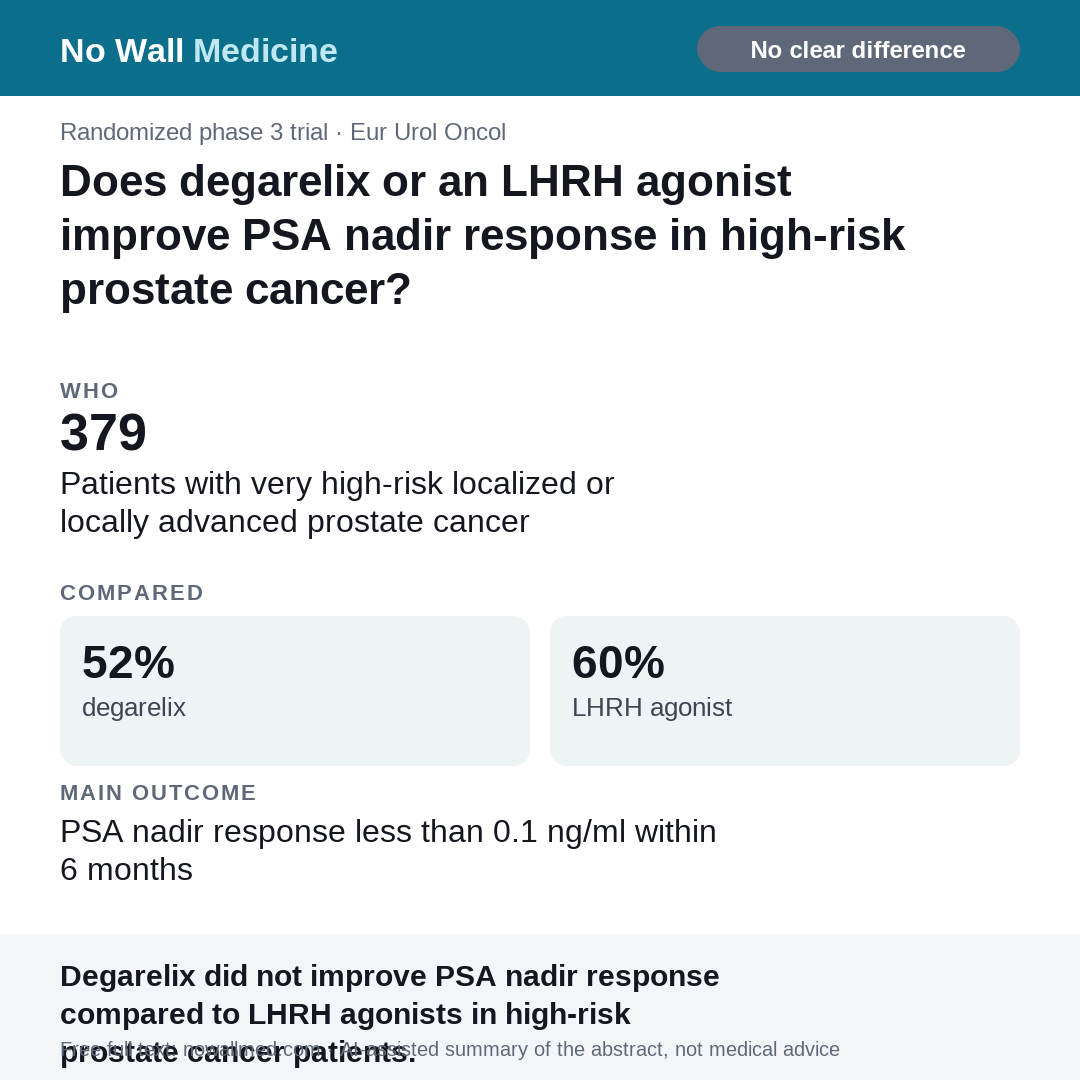
Clinical question: Does degarelix or an LHRH agonist improve PSA nadir response in high-risk prostate cancer?
Why it matters: It is unclear whether using a luteinizing hormone-releasing hormone antagonist like degarelix provides better outcomes than an agonist when combined with radiation for high-risk prostate cancer.
Key points
- Researchers studied 379 patients with high-risk prostate cancer randomized to receive pelvic radiation plus either degarelix or a luteinizing hormone-releasing hormone agonist for 18, 24, or 36 months.
- A PSA nadir, or lowest prostate-specific antigen level, of <0.1 ng/ml was achieved by 60% of patients using an agonist and 52% using degarelix.
- Two-year progression-free survival was 88% in both treatment groups, and degarelix was associated with a lower incidence of cardiovascular events in patients with pre-existing cardiovascular disease.
Headline and key points written with AI from the paper’s abstract, with every number checked against it. Read the paper before relying on them.
Topics
Cite this article
Zilli T, Böhmer D, Roeder A, Lauffer D, Villafranca Iturre AE, Jové-Teixidó JJ. Radiotherapy plus Long-term Adjuvant Androgen Deprivation with a Luteinizing Hormone-releasing Hormone Antagonist Versus Agonist in Patients with Very High-risk Localized or Locally Advanced Prostate Cancer: The EORTC GUCG-1414 Phase 3 Randomized Trial. Eur Urol Oncol. 2025. doi:10.1016/j.euo.2025.10.009
Spotted a mistake? Suggest a correction