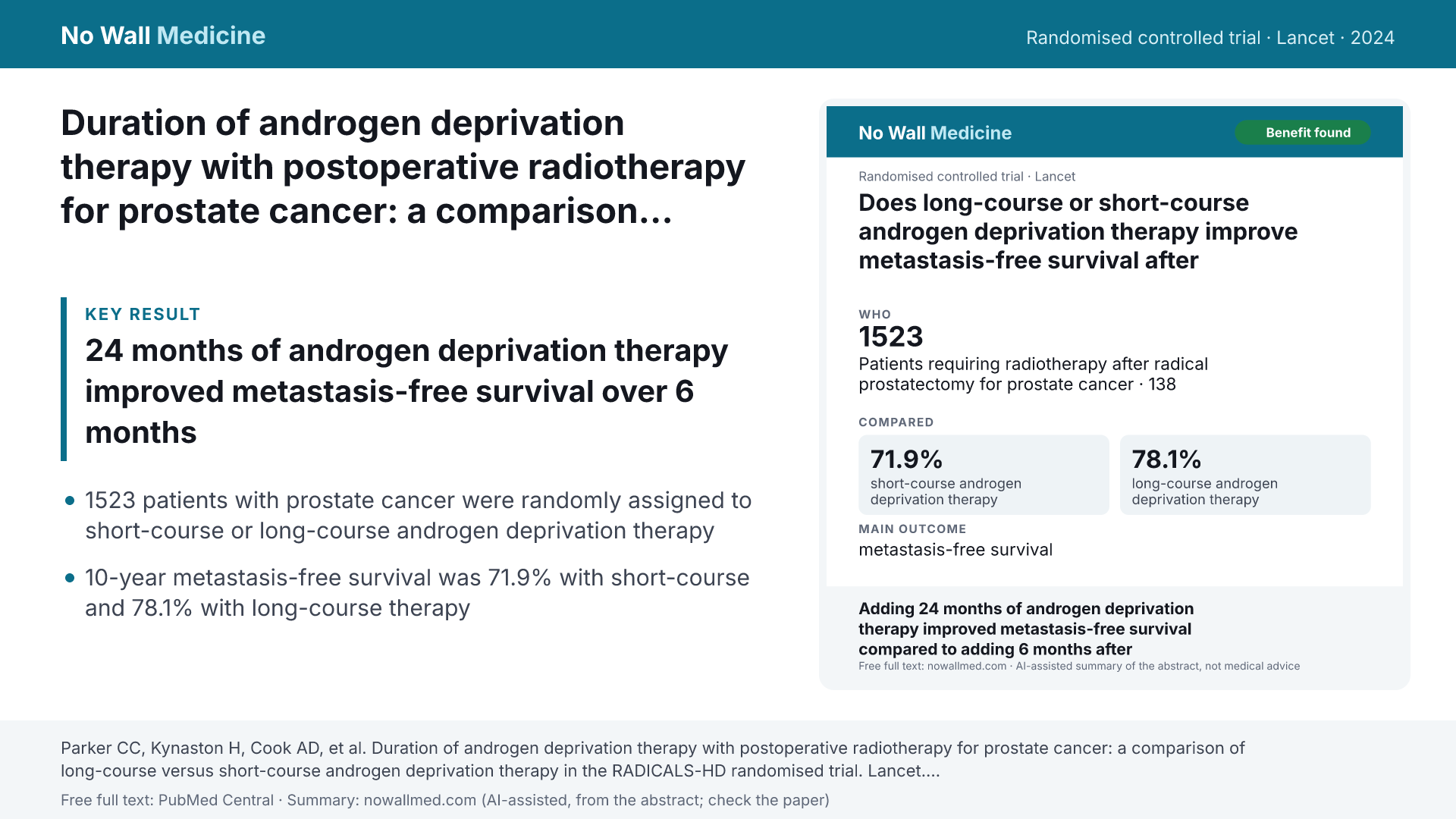
24 months of androgen deprivation therapy improved metastasis-free survival over 6 months
Duration of androgen deprivation therapy with postoperative radiotherapy for prostate cancer: a comparison of long-course versus short-course androgen deprivation therapy in the RADICALS-HD randomised trial
Randomised controlled trialBenefit found
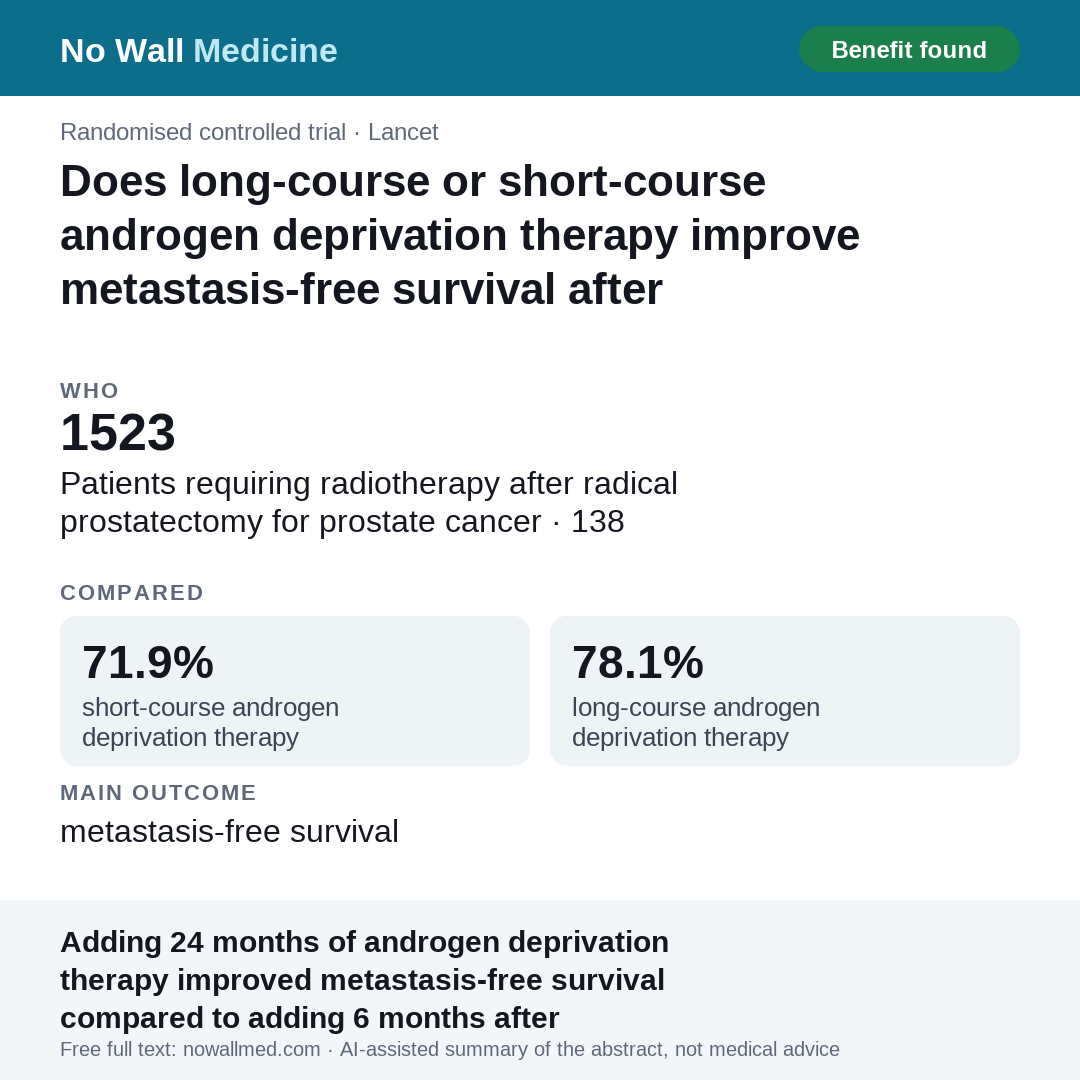
Does long-course or short-course androgen deprivation therapy improve metastasis-free survival after postoperative radiotherapy?
Who
1523
Patients requiring radiotherapy after radical prostatectomy for prostate cancer · 138 centres in Canada, Denmark, Ireland, and the UK
Compared
71.9%short-course androgen deprivation therapy (95% CI 67.6-75.7)
78.1%long-course androgen deprivation therapy (74.2-81.5)
Main outcome
metastasis-free survival
Result: hazard ratio 0.773 (95% CI 0.612-0.975)
Bottom line: Adding 24 months of androgen deprivation therapy improved metastasis-free survival compared to adding 6 months after postoperative radiotherapy.
Limitation: The allocated treatment was not masked.
Funded by: Cancer Research UK, UK Research and Innovation, Canadian Cancer Society
Lancet · 2024-05-16Download image
Clinical question: Does long-course or short-course androgen deprivation therapy improve metastasis-free survival after postoperative radiotherapy?
Why it matters: Optimal duration of androgen deprivation therapy with postoperative radiotherapy for prostate cancer was uncertain
Key points
- 1523 patients with prostate cancer were randomly assigned to short-course or long-course androgen deprivation therapy.
- 10-year metastasis-free survival was 71.9% with short-course and 78.1% with long-course therapy.
- Toxicity of grade 3 or higher was reported in 14% of short-course and 19% of long-course therapy participants.
Limitation the authors note: The trial had an open-label design, as the allocated treatment was not masked
Headline and key points written with AI from the paper’s abstract, with every number checked against it. Read the paper before relying on them.
Was this summary helpful?
Abstract
Background
Previous evidence supports androgen deprivation therapy (ADT) with primary radiotherapy as initial treatment for intermediate-risk and high-risk localised prostate cancer. However, the use and optimal duration of ADT with postoperative radiotherapy after radical prostatectomy remains uncertain. Methods
RADICALS-HD was a randomised controlled trial of ADT duration within the RADICALS protocol. Here, we report on the comparison of short-course versus long-course ADT. Key eligibility criteria were indication for radiotherapy after previous radical prostatectomy for prostate cancer, prostate-specific antigen less than 5 ng/mL, absence of metastatic disease, and written consent. Participants were randomly assigned (1:1) to add 6 months of ADT (short-course ADT) or 24 months of ADT (long-course ADT) to radiotherapy, using subcutaneous gonadotrophin-releasing hormone analogue (monthly in the short-course ADT group and 3-monthly in the long-course ADT group), daily oral bicalutamide monotherapy 150 mg, or monthly subcutaneous degarelix. Randomisation was done centrally through minimisation with a random element, stratified by Gleason score, positive margins, radiotherapy timing, planned radiotherapy schedule, and planned type of ADT, in a computerised system. The allocated treatment was not masked. The primary outcome measure was metastasis-free survival, defined as metastasis arising from prostate cancer or death from any cause. The comparison had more than 80% power with two-sided α of 5% to detect an absolute increase in 10-year metastasis-free survival from 75% to 81% (hazard ratio [HR] 0·72). Standard time-to-event analyses were used. Analyses followed intention-to-treat principle. The trial is registered with the ISRCTN registry, ISRCTN40814031, and ClinicalTrials.gov, NCT00541047. Findings
Between Jan 30, 2008, and July 7, 2015, 1523 patients (median age 65 years, IQR 60-69) were randomly assigned to receive short-course ADT (n=761) or long-course ADT (n=762) in addition to postoperative radiotherapy at 138 centres in Canada, Denmark, Ireland, and the UK. With a median follow-up of 8·9 years (7·0-10·0), 313 metastasis-free survival events were reported overall (174 in the short-course ADT group and 139 in the long-course ADT group; HR 0·773 [95% CI 0·612-0·975]; p=0·029). 10-year metastasis-free survival was 71·9% (95% CI 67·6-75·7) in the short-course ADT group and 78·1% (74·2-81·5) in the long-course ADT group. Toxicity of grade 3 or higher was reported for 105 (14%) of 753 participants in the short-course ADT group and 142 (19%) of 757 participants in the long-course ADT group (p=0·025), with no treatment-related deaths. Interpretation
Compared with adding 6 months of ADT, adding 24 months of ADT improved metastasis-free survival in people receiving postoperative radiotherapy. For individuals who can accept the additional duration of adverse effects, long-course ADT should be offered with postoperative radiotherapy. Funding
Cancer Research UK, UK Research and Innovation (formerly Medical Research Council), and Canadian Cancer Society.
Abstract reproduced under the article’s CC BY licence.
Subject terms
Cite this article
Parker CC, Kynaston H, Cook AD, et al. Duration of androgen deprivation therapy with postoperative radiotherapy for prostate cancer: a comparison of long-course versus short-course androgen deprivation therapy in the RADICALS-HD randomised trial. Lancet. 2024. doi:10.1016/S0140-6736(24)00549-X
Spotted a mistake? Suggest a correction