Prostate-specific antigen levels at three and seven months were associated with overall survival
Three- and Seven-month Prostate-specific Antigen Levels as Prognostic Markers for Overall Survival in Metastatic Hormone-sensitive Prostate Cancer: Results from SWOG S1216, a Phase 3 Randomized Trial of Androgen Deprivation Plus Orteronel or Bicalutamide
Phase 3 randomized trialBenefit found
Do prostate-specific antigen levels at 3 and 7 months predict overall survival?
Who
1251
Patients with metastatic hormone-sensitive prostate cancer · SWOG S1216 trial
Compared
PSA-7mo complete response: improved overall survival
PSA-7mo no response
PSA-3mo complete response: similar association to no response
PSA-3mo no response
Main outcome
overall survival
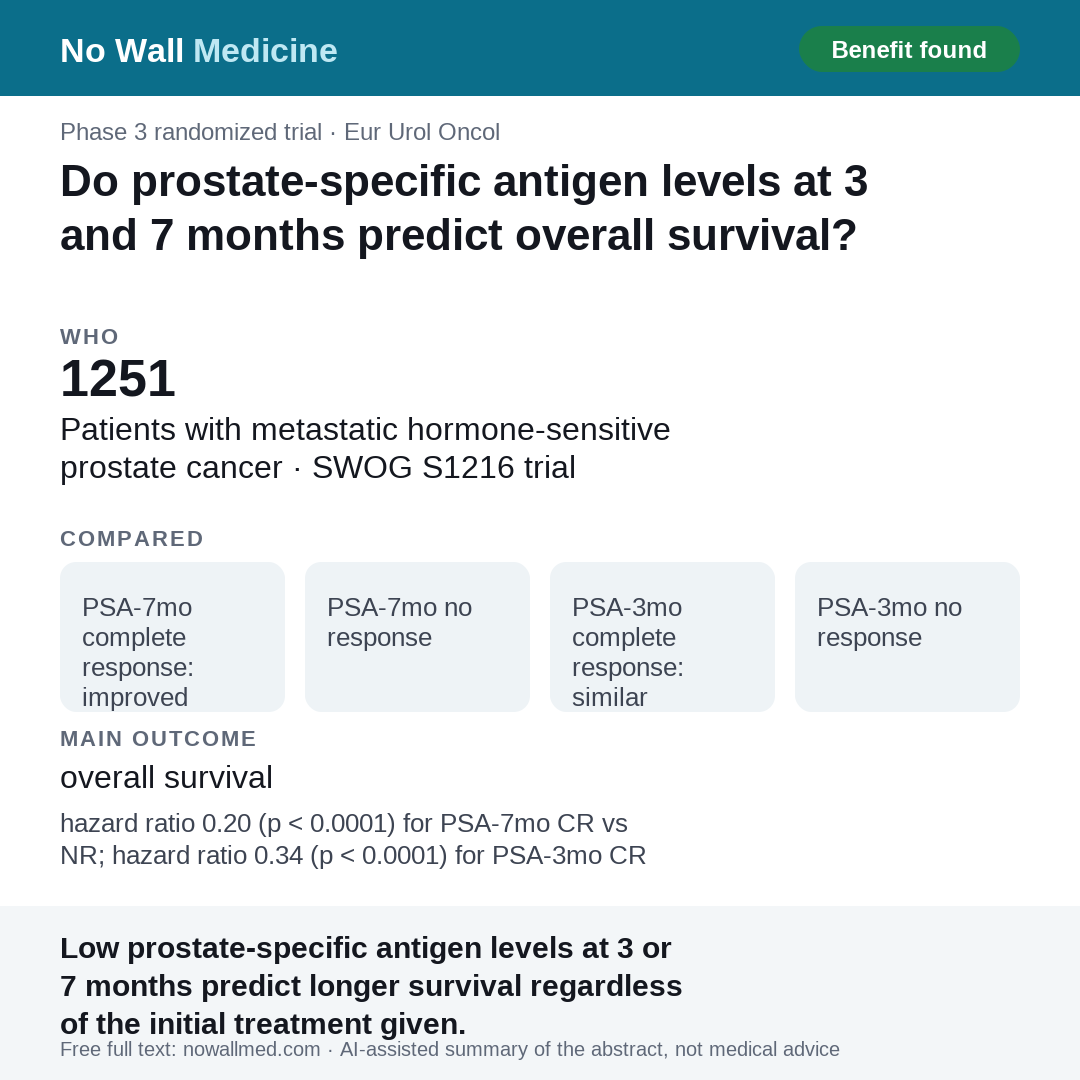
Result: hazard ratio 0.20 (p < 0.0001) for PSA-7mo CR vs NR; hazard ratio 0.34 (p < 0.0001) for PSA-3mo CR vs NR
Bottom line: Low prostate-specific antigen levels at 3 or 7 months predict longer survival regardless of the initial treatment given.
Eur Urol Oncol · 2024-03-23Download image
Clinical question: Do prostate-specific antigen levels at 3 and 7 months predict overall survival?
Why it matters: It was unknown if prostate-specific antigen levels at three and seven months remain valid prognostic markers as treatments for metastatic hormone-sensitive prostate cancer evolve.
Key points
- Researchers analyzed 1251 patients for three-month prostate-specific antigen levels and 1231 patients for seven-month levels in a phase 3 clinical trial.
- A complete response at seven months was associated with improved overall survival compared to no response (HR: 0.20; p < 0.0001).
- A complete response at three months was also associated with improved overall survival compared to no response (HR: 0.34; p < 0.0001).
Headline and key points written with AI from the paper’s abstract, with every number checked against it. Read the paper before relying on them.
Was this summary helpful?
Subject terms
Cite this article
Parikh M, Tangen C, Hussain MHA, Gupta S, Callis S, Jo Y. Three- and Seven-month Prostate-specific Antigen Levels as Prognostic Markers for Overall Survival in Metastatic Hormone-sensitive Prostate Cancer: Results from SWOG S1216, a Phase 3 Randomized Trial of Androgen Deprivation Plus Orteronel or Bicalutamide. Eur Urol Oncol. 2024. doi:10.1016/j.euo.2024.03.001
Spotted a mistake? Suggest a correction
Top studies every Monday
The week’s key trials and guidelines in your specialties, plus any topics you follow. By email, free.
Get the weekly digest