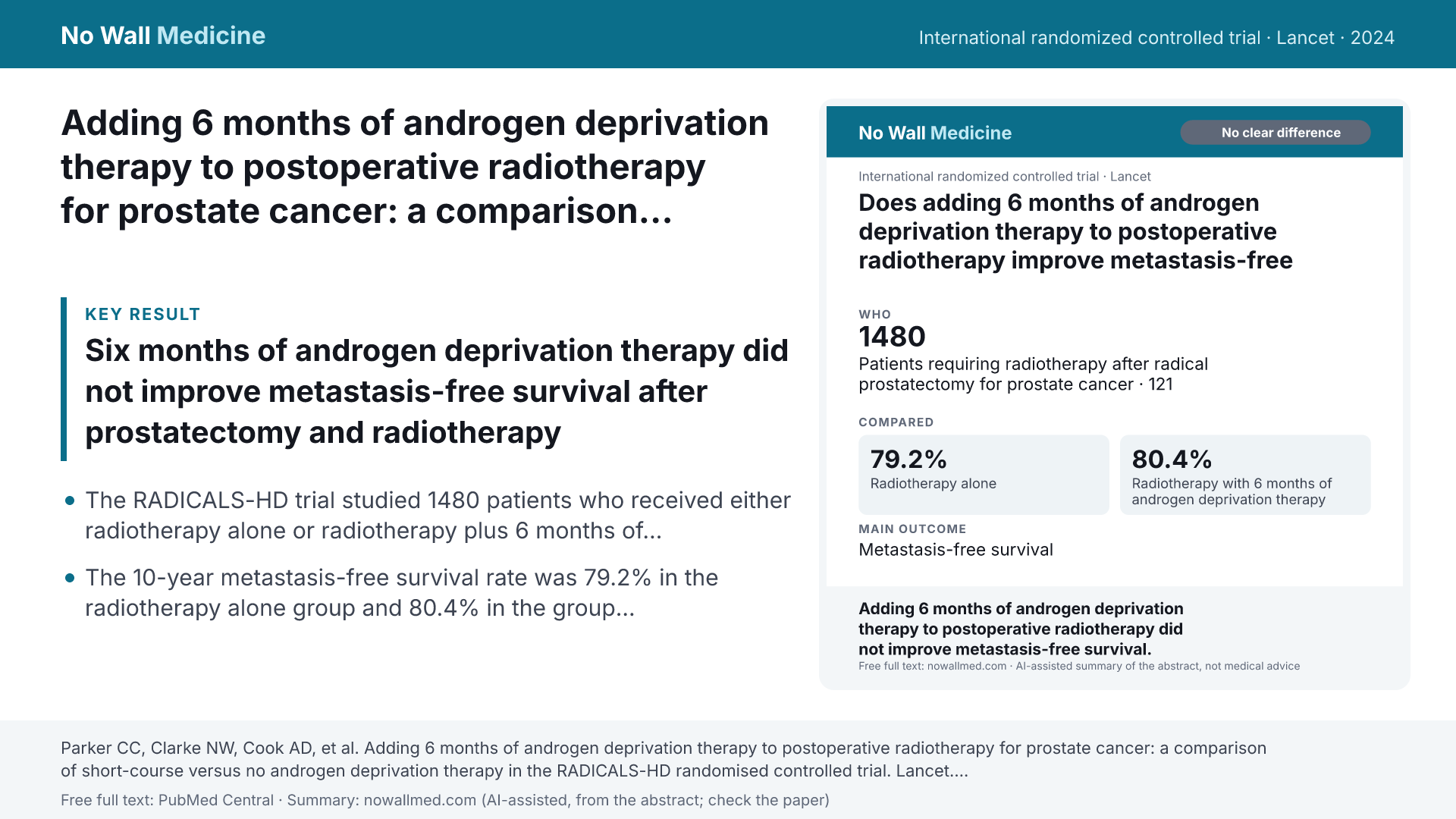
Six months of androgen deprivation therapy did not improve metastasis-free survival after prostatectomy and radiotherapy
Adding 6 months of androgen deprivation therapy to postoperative radiotherapy for prostate cancer: a comparison of short-course versus no androgen deprivation therapy in the RADICALS-HD randomised controlled trial
International randomized controlled trialNo clear difference
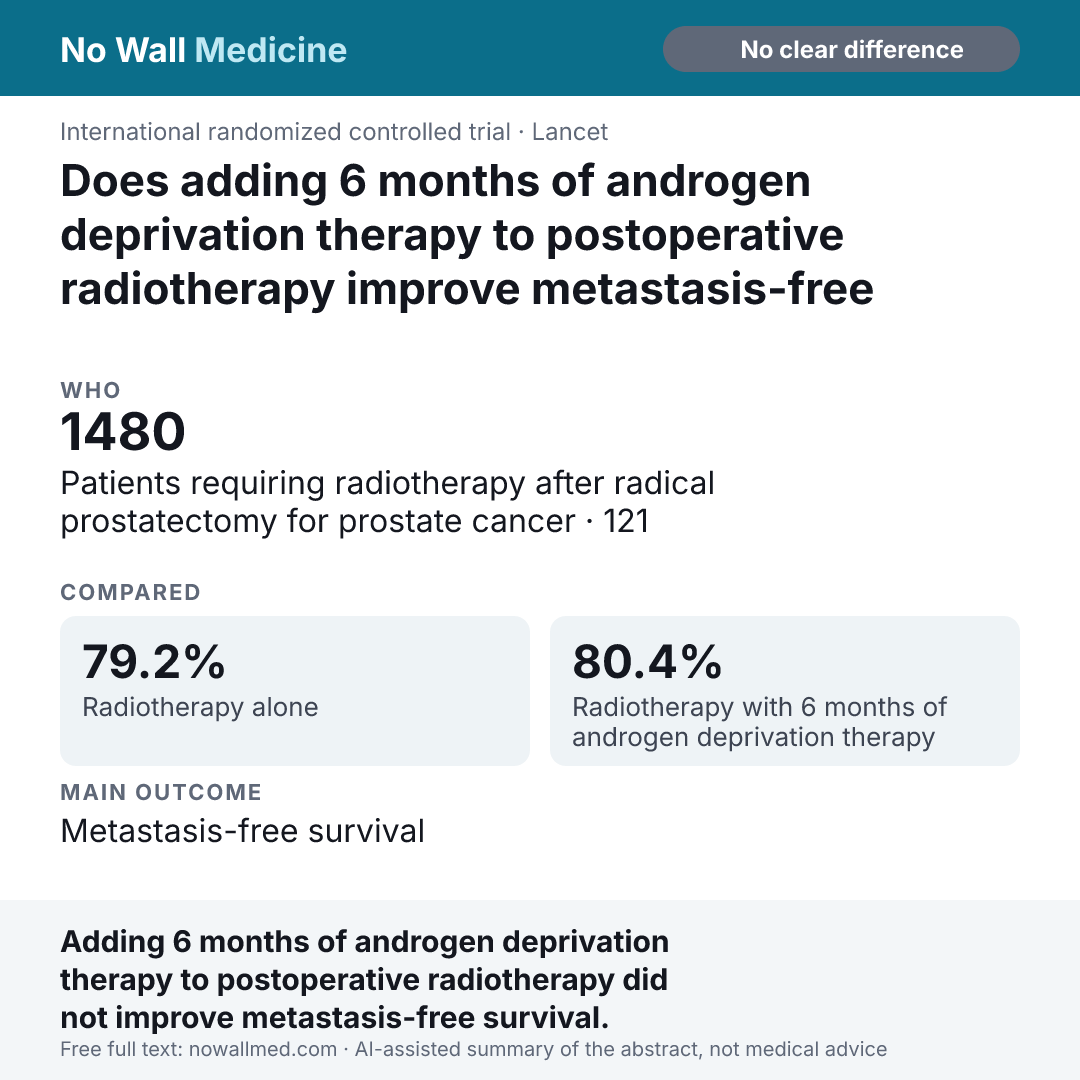
Does adding 6 months of androgen deprivation therapy to postoperative radiotherapy improve metastasis-free survival?
Who
1480
Patients requiring radiotherapy after radical prostatectomy for prostate cancer · 121 centres in Canada, Denmark, Ireland, and the UK
Compared
79.2%Radiotherapy alone (95% CI 75.4-82.5)
80.4%Radiotherapy with 6 months of androgen deprivation therapy (76.6-83.6%)
Main outcome
Metastasis-free survival
Result: hazard ratio 0.886 (95% CI 0.688-1.140)
Bottom line: Adding 6 months of androgen deprivation therapy to postoperative radiotherapy did not improve metastasis-free survival.
Funded by: Cancer Research UK, UK Research and Innovation, Canadian Cancer Society
Lancet · 2024-05-16 · Save PNG
Same trial (ISRCTN40814031, NCT00541047)
Papers we list that report this registered trial, oldest first. Read a secondary analysis alongside the main results.
- Longer follow-up No clear difference
Early radiation after prostate removal did not improve distant metastasis rates compared to salvage radiation Ann Oncol 2024-04 - Main results No clear difference
This paper Lancet 2024-05 - Related analysis Benefit found
24 months of androgen deprivation therapy improved metastasis-free survival over 6 months Lancet 2024-05
Clinical question: Does adding 6 months of androgen deprivation therapy to postoperative radiotherapy improve metastasis-free survival?
Key points
- The RADICALS-HD trial studied 1480 patients who received either radiotherapy alone or radiotherapy plus 6 months of androgen deprivation therapy, which is hormone therapy to lower testosterone.
- The 10-year metastasis-free survival rate was 79.2% in the radiotherapy alone group and 80.4% in the group receiving hormone therapy.
- Grade 3 or higher toxicity occurred in 17% of the radiotherapy alone group and 14% of the hormone therapy group.
Headline and key points written with AI from the paper’s abstract, with every number checked against it. Read the paper before relying on them.
Was this summary helpful?
Abstract
Background
Previous evidence indicates that adjuvant, short-course androgen deprivation therapy (ADT) improves metastasis-free survival when given with primary radiotherapy for intermediate-risk and high-risk localised prostate cancer. However, the value of ADT with postoperative radiotherapy after radical prostatectomy is unclear. Methods
RADICALS-HD was an international randomised controlled trial to test the efficacy of ADT used in combination with postoperative radiotherapy for prostate cancer. Key eligibility criteria were indication for radiotherapy after radical prostatectomy for prostate cancer, prostate-specific antigen less than 5 ng/mL, absence of metastatic disease, and written consent. Participants were randomly assigned (1:1) to radiotherapy alone (no ADT) or radiotherapy with 6 months of ADT (short-course ADT), using monthly subcutaneous gonadotropin-releasing hormone analogue injections, daily oral bicalutamide monotherapy 150 mg, or monthly subcutaneous degarelix. Randomisation was done centrally through minimisation with a random element, stratified by Gleason score, positive margins, radiotherapy timing, planned radiotherapy schedule, and planned type of ADT, in a computerised system. The allocated treatment was not masked. The primary outcome measure was metastasis-free survival, defined as distant metastasis arising from prostate cancer or death from any cause. Standard survival analysis methods were used, accounting for randomisation stratification factors. The trial had 80% power with two-sided α of 5% to detect an absolute increase in 10-year metastasis-free survival from 80% to 86% (hazard ratio [HR] 0·67). Analyses followed the intention-to-treat principle. The trial is registered with the ISRCTN registry, ISRCTN40814031, and ClinicalTrials.gov, NCT00541047. Findings
Between Nov 22, 2007, and June 29, 2015, 1480 patients (median age 66 years [IQR 61-69]) were randomly assigned to receive no ADT (n=737) or short-course ADT (n=743) in addition to postoperative radiotherapy at 121 centres in Canada, Denmark, Ireland, and the UK. With a median follow-up of 9·0 years (IQR 7·1-10·1), metastasis-free survival events were reported for 268 participants (142 in the no ADT group and 126 in the short-course ADT group; HR 0·886 [95% CI 0·688-1·140], p=0·35). 10-year metastasis-free survival was 79·2% (95% CI 75·4-82·5) in the no ADT group and 80·4% (76·6-83·6) in the short-course ADT group. Toxicity of grade 3 or higher was reported for 121 (17%) of 737 participants in the no ADT group and 100 (14%) of 743 in the short-course ADT group (p=0·15), with no treatment-related deaths. Interpretation
Metastatic disease is uncommon following postoperative bed radiotherapy after radical prostatectomy. Adding 6 months of ADT to this radiotherapy did not improve metastasis-free survival compared with no ADT. These findings do not support the use of short-course ADT with postoperative radiotherapy in this patient population. Funding
Cancer Research UK, UK Research and Innovation (formerly Medical Research Council), and Canadian Cancer Society.
Abstract reproduced under the article’s CC BY licence.
Subject terms
Headline, design, result, key points, caveat and citation as plain text.
Cite this article
Parker CC, Clarke NW, Cook AD, et al. Adding 6 months of androgen deprivation therapy to postoperative radiotherapy for prostate cancer: a comparison of short-course versus no androgen deprivation therapy in the RADICALS-HD randomised controlled trial. Lancet. 2024;403(10442):2405-2415. doi:10.1016/S0140-6736(24)00548-8
Spotted a mistake? Suggest a correction