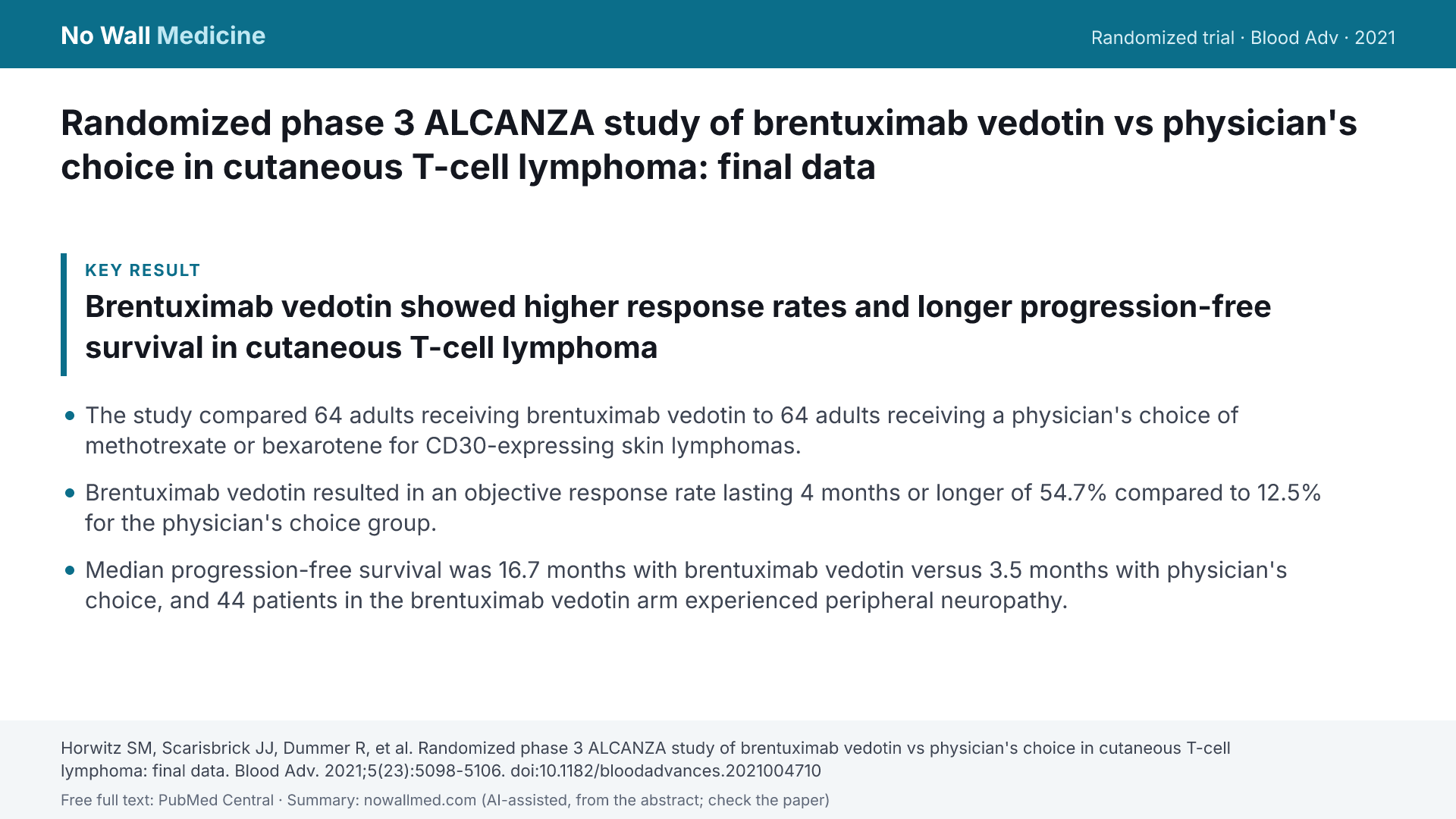
Brentuximab vedotin showed higher response rates and longer progression-free survival in cutaneous T-cell lymphoma
Randomized phase 3 ALCANZA study of brentuximab vedotin vs physician's choice in cutaneous T-cell lymphoma: final data
Why it matters: The effectiveness of brentuximab vedotin compared to standard physician's choice treatments for CD30-expressing mycosis fungoides or primary cutaneous anaplastic large-cell lymphoma needed to be established.
Key points
- The study compared 64 adults receiving brentuximab vedotin to 64 adults receiving a physician's choice of methotrexate or bexarotene for CD30-expressing skin lymphomas.
- Brentuximab vedotin resulted in an objective response rate lasting 4 months or longer of 54.7% compared to 12.5% for the physician's choice group.
- Median progression-free survival was 16.7 months with brentuximab vedotin versus 3.5 months with physician's choice, and 44 patients in the brentuximab vedotin arm experienced peripheral neuropathy.
Headline and key points written with AI from the paper’s abstract, with every number checked against it. Read the paper before relying on them.
Was this summary helpful?
Abstract
The primary analysis of the phase 3 ALCANZA trial showed significantly improved objective responses lasting ≥4 months (ORR4; primary endpoint) and progression-free survival (PFS) with brentuximab vedotin vs physician's choice (methotrexate or bexarotene) in CD30-expressing mycosis fungoides (MF) or primary cutaneous anaplastic large-cell lymphoma (C-ALCL). Cutaneous T-cell lymphomas often cause pruritus and pain; brentuximab vedotin improved skin symptom burden with no negative effects on quality of life. We report final data from ALCANZA (median follow-up, 45.9 months). Adults with previously treated CD30-expressing MF/C-ALCL were randomly assigned to brentuximab vedotin (n = 64) or physician's choice (n = 64). Final data demonstrated improved responses per independent review facility with brentuximab vedotin vs physician's choice: ORR4; 54.7% vs 12.5% (P < .001); complete response, 17.2% vs 1.6% (P = .002). Median PFS with brentuximab vedotin vs physician's choice was 16.7 months vs 3.5 months (P < .001). Median time to the next treatment was significantly longer with brentuximab vedotin than with physician's choice (14.2 vs 5.6 months; hazard ratio, 0.27; 95% confidence interval, 0.17-0.42; P < .001). Of 44 patients in the brentuximab vedotin arm who experienced any-grade peripheral neuropathy, (grade 3, n = 6; grade 4, n = 0), 86% (38 of 44) had complete resolution (26 of 44) or improvement to grades 1 and 2 (12 of 44). Peripheral neuropathy was ongoing in 18 patients (all grades 1-2). These final analyses confirm improved, clinically meaningful, durable responses and longer PFS with brentuximab vedotin vs physician's choice in CD30-expressing MF or C-ALCL. This trial was registered at https://www.clinicaltrials.gov as #NCT01578499.
Abstract reproduced under the article’s CC BY NC ND licence.
Subject terms
Headline, design, result, key points, caveat and citation as plain text.
Cite this article
Horwitz SM, Scarisbrick JJ, Dummer R, et al. Randomized phase 3 ALCANZA study of brentuximab vedotin vs physician's choice in cutaneous T-cell lymphoma: final data. Blood Adv. 2021. doi:10.1182/bloodadvances.2021004710
Spotted a mistake? Suggest a correction