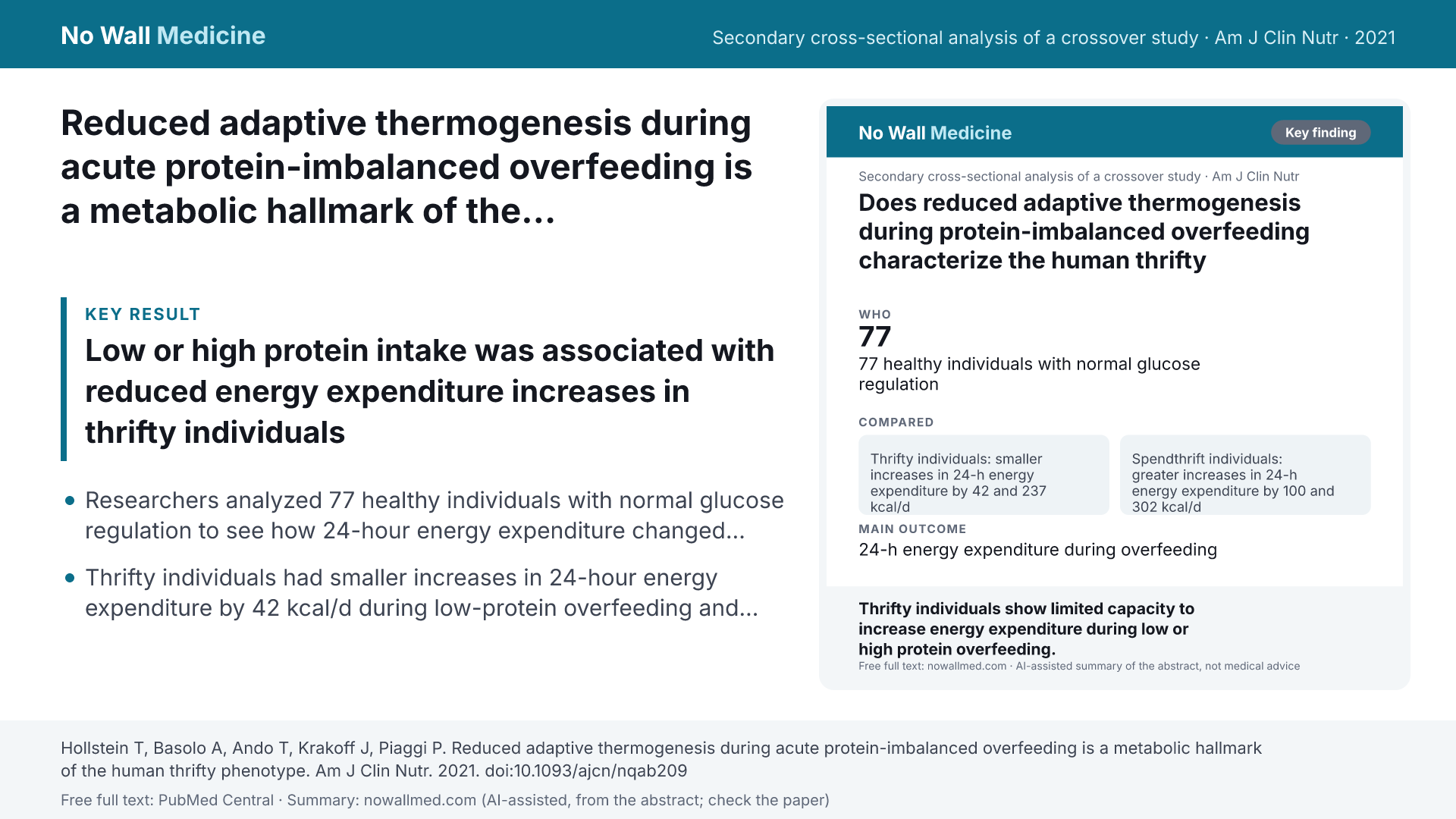
Low or high protein intake was associated with reduced energy expenditure increases in thrifty individuals
Reduced adaptive thermogenesis during acute protein-imbalanced overfeeding is a metabolic hallmark of the human thrifty phenotype
Secondary cross-sectional analysis of a crossover studyKey finding
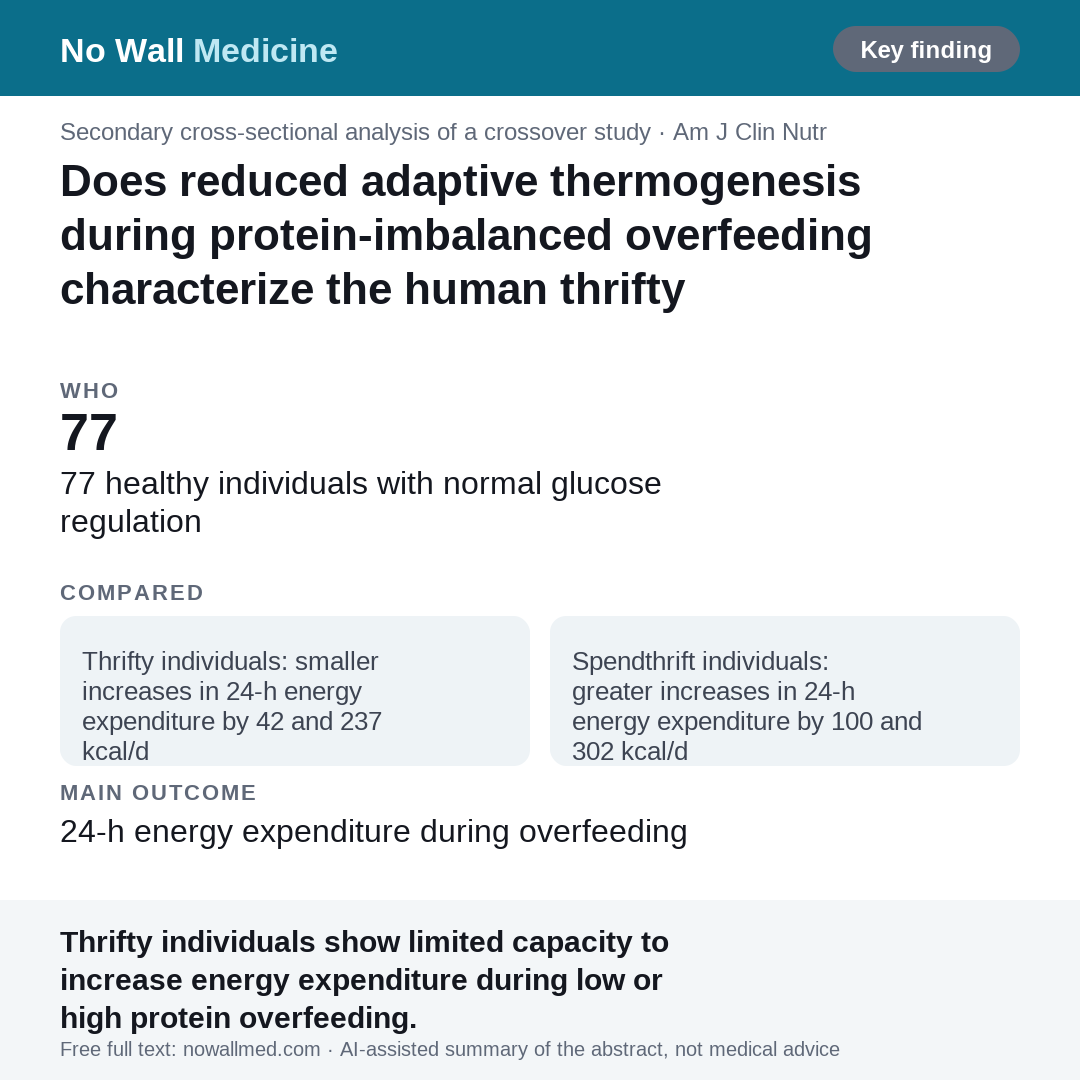
Does reduced adaptive thermogenesis during protein-imbalanced overfeeding characterize the human thrifty phenotype?
Who
77
77 healthy individuals with normal glucose regulation
Compared
Thrifty individuals: smaller increases in 24-h energy expenditure by 42 and 237 kcal/d
Spendthrift individuals: greater increases in 24-h energy expenditure by 100 and 302 kcal/d
Main outcome
24-h energy expenditure during overfeeding
Bottom line: Thrifty individuals show limited capacity to increase energy expenditure during low or high protein overfeeding.
Am J Clin Nutr · 2021-07-06Download image
Clinical question: Does reduced adaptive thermogenesis during protein-imbalanced overfeeding characterize the human thrifty phenotype?
Key points
- Researchers analyzed 77 healthy individuals with normal glucose regulation to see how 24-hour energy expenditure changed during fasting and overfeeding with different protein levels.
- Thrifty individuals had smaller increases in 24-hour energy expenditure by 42 kcal/d during low-protein overfeeding and 237 kcal/d during high-protein overfeeding compared to spendthrift individuals.
- The relationship between baseline energy expenditure and energy expenditure during overfeeding was significant for low and high protein diets but not for normal protein diets.
Limitation the authors note: This was a secondary cross-sectional analysis of a single-arm crossover study.
Headline and key points written with AI from the paper’s abstract, with every number checked against it. Read the paper before relying on them.
Was this summary helpful?
Subject terms
Cite this article
Hollstein T, Basolo A, Ando T, Krakoff J, Piaggi P. Reduced adaptive thermogenesis during acute protein-imbalanced overfeeding is a metabolic hallmark of the human thrifty phenotype. Am J Clin Nutr. 2021. doi:10.1093/ajcn/nqab209
Spotted a mistake? Suggest a correction