Relationship between cumulative silica exposure and silicosis: a systematic review and dose-response meta-analysis
Systematic review and dose-response meta-analysisBenefit found
What is the relationship between cumulative respirable crystalline silica exposure and silicosis risk?
Who
65977
Participants with over 20 years follow-up since first employment
Compared
Miners (reduction from 4 to 2 mg/m3-years): RR 0.23 (95% CI 0.18 to 0.29)
Non-miners (reduction from 4 to 2 mg/m3-years): RR 0.55 (95% CI 0.36 to 0.83)
Main outcome
Risk of silicosis
Bottom line: Reducing cumulative respirable crystalline silica exposure significantly reduces silicosis risk, especially among mining populations.
Thorax · 2024-09-18Download image
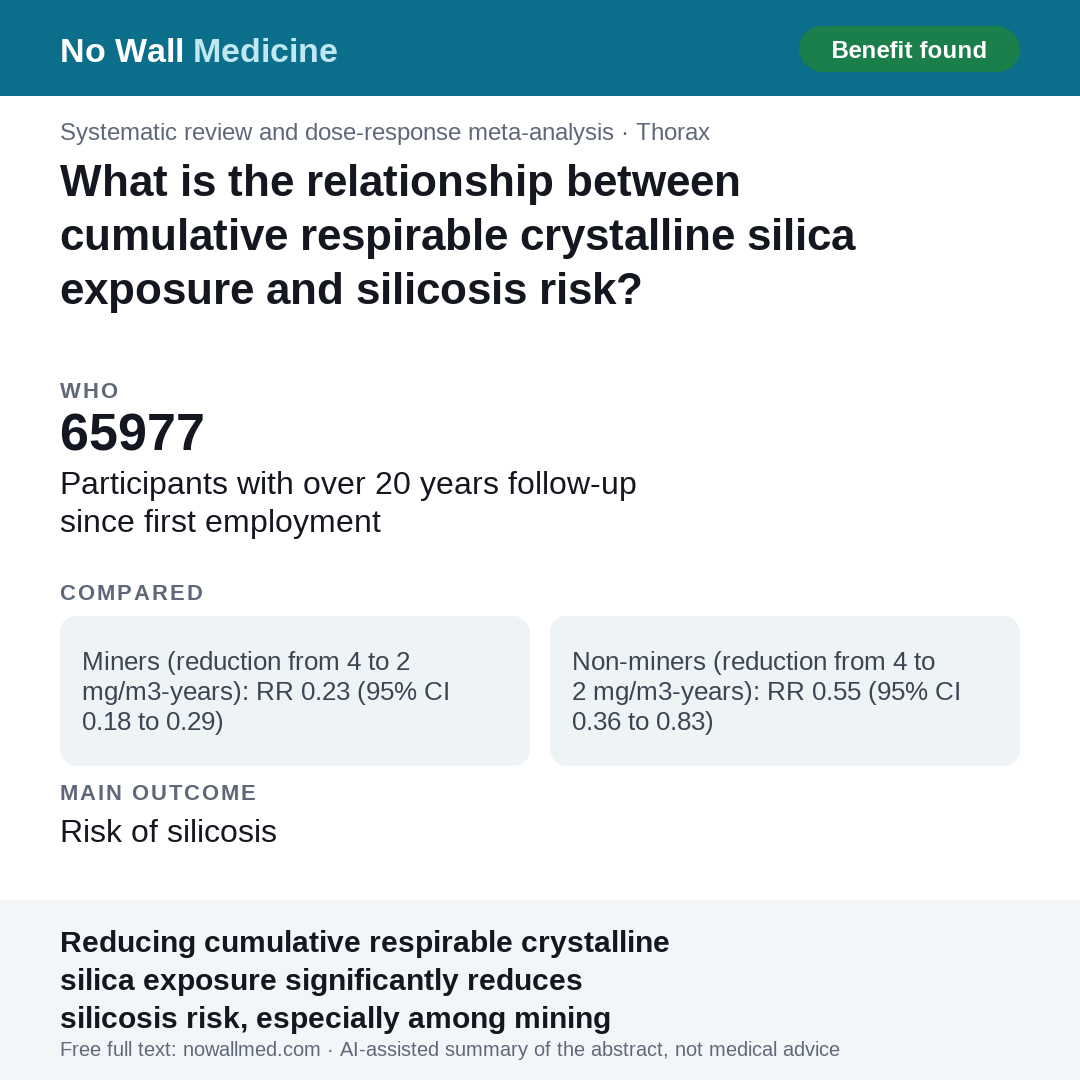
Clinical question: What is the relationship between cumulative respirable crystalline silica exposure and silicosis risk?
Abstract
Background
Silicosis, a chronic respiratory disease caused by crystalline silica exposure, is a persistent global lung health issue. No systematic review of the relationship between cumulative respirable crystalline silica (RCS) exposure and silicosis exists. UK exposure limits are currently under review. We therefore performed a systematic review and dose-response meta-analysis of this relationship. Methods
Web of Science, Medline and Embase were searched on 24 February 2023. Studies of radiographic, autopsy or death certificate silicosis, with an estimated average follow-up of over 20 years since first employment, were included. Cumulative silicosis risk methods were compared. The relative risks (RR) of silicosis at increasing cumulative exposures were calculated and used to estimate the absolute risk reduction (ARR). Results
Eight eligible studies, including 10 cohorts, contributed 8792 cases of silicosis among 65 977 participants. Substantial differences in cumulative risk estimates between methodologies exist. Using the same method, we observed higher cumulative silicosis risks among mining compared with non-mining cohorts. A reduction from 4 to 2 mg/m³-years in cumulative RCS exposure corresponded to substantial risk reductions among miners (RR 0.23 (95% CI 0.18 to 0.29, I2=92.9%) with an ARR of 323 (95% CI 298 to 344) per 1000) and non-miners (RR 0.55 (95% CI 0.36 to 0.83, I2=77.0%) with an ARR of 23 (95% CI 9 to 33) per 1000). Conclusion
Despite significant heterogeneity, our findings support a reduction in permissible exposure limits from 0.1 mg/m3 to 0.05 mg/m³, particularly among mining populations. Further research is needed among non-miners as only two studies were eligible.
Abstract reproduced under the article’s CC BY licence.
Topics
Cite this article
Howlett P, Gan J, Lesosky M, Feary J. Relationship between cumulative silica exposure and silicosis: a systematic review and dose-response meta-analysis. Thorax. 2024. doi:10.1136/thorax-2024-221447
Spotted a mistake? Suggest a correction
Top studies every Monday
The week’s key trials and guidelines in your specialties, plus any topics you follow. By email, free.
Get the weekly digest