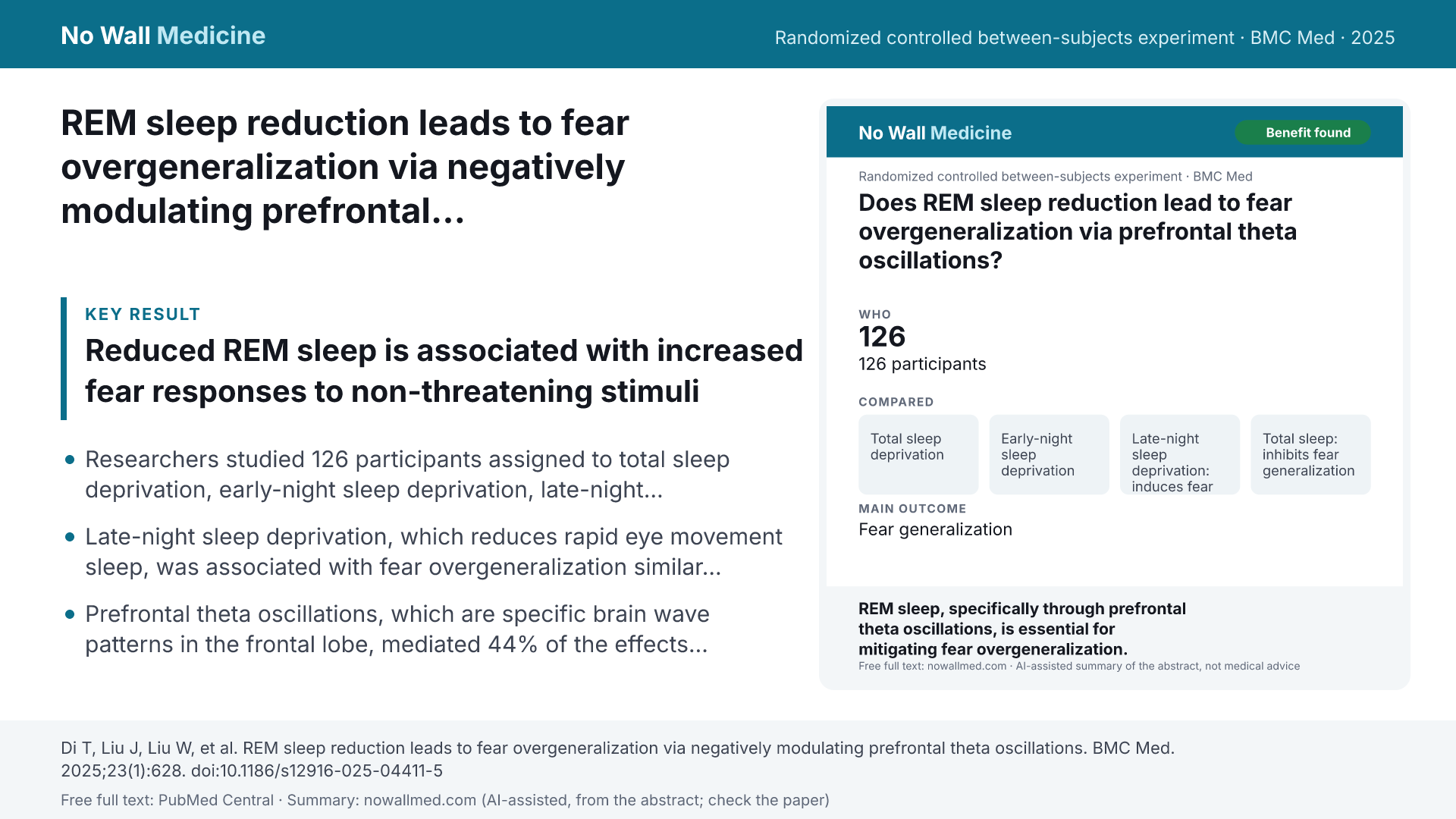
Reduced REM sleep is associated with increased fear responses to non-threatening stimuli
REM sleep reduction leads to fear overgeneralization via negatively modulating prefrontal theta oscillations
Randomized controlled between-subjects experimentBenefit found
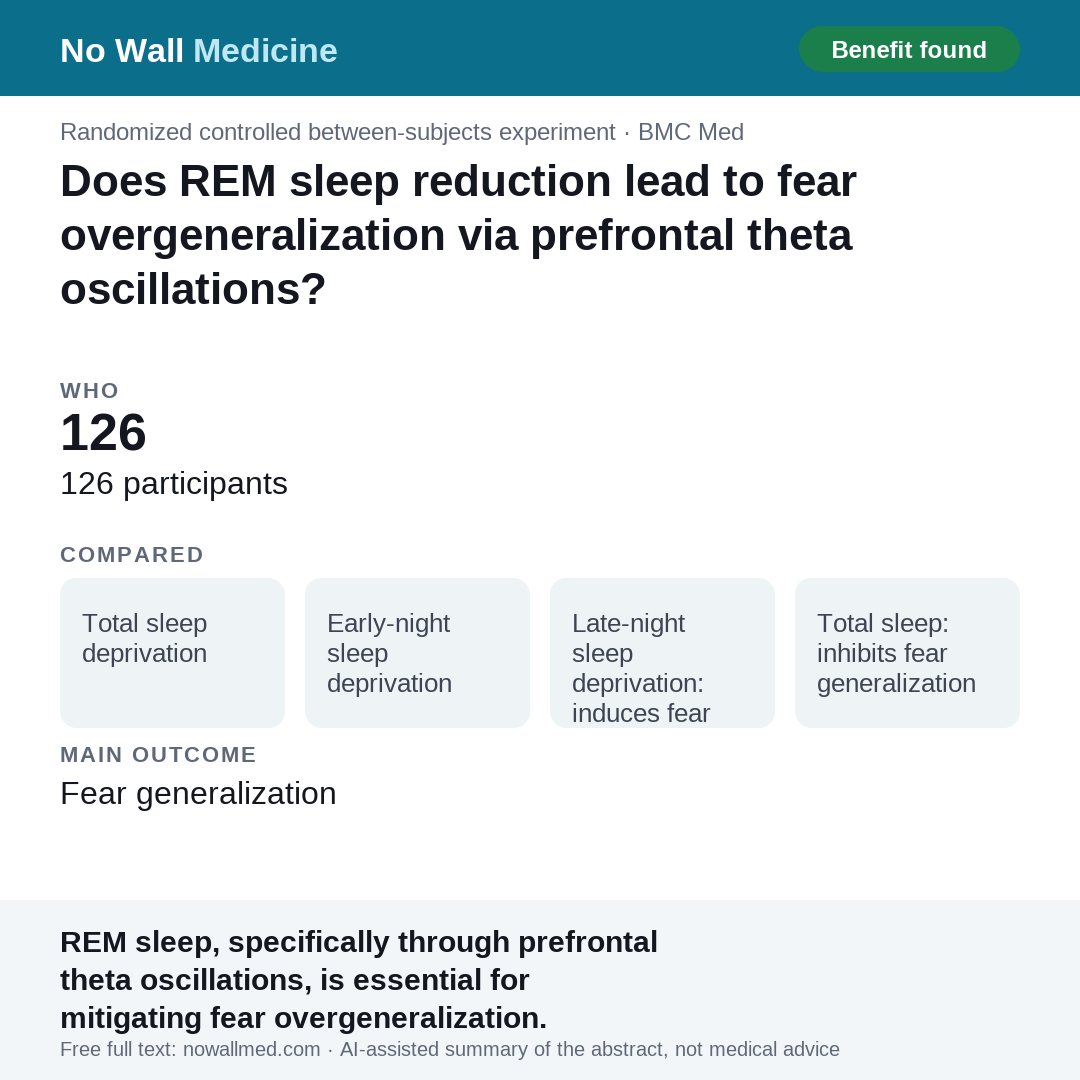
Does REM sleep reduction lead to fear overgeneralization via prefrontal theta oscillations?
Who
126
126 participants
Compared
Total sleep deprivation
Early-night sleep deprivation
Late-night sleep deprivation: induces fear overgeneralization comparable to total sleep deprivation
Total sleep: inhibits fear generalization
Main outcome
Fear generalization
Bottom line: REM sleep, specifically through prefrontal theta oscillations, is essential for mitigating fear overgeneralization.
BMC Med · 2025-11-11Download image
Clinical question: Does REM sleep reduction lead to fear overgeneralization via prefrontal theta oscillations?
Why it matters: The specific role of different sleep phases and their associated brain oscillations in influencing fear generalization remains largely unknown.
Key points
- Researchers studied 126 participants assigned to total sleep deprivation, early-night sleep deprivation, late-night sleep deprivation, or total sleep.
- Late-night sleep deprivation, which reduces rapid eye movement sleep, was associated with fear overgeneralization similar to total sleep deprivation.
- Prefrontal theta oscillations, which are specific brain wave patterns in the frontal lobe, mediated 44% of the effects of rapid eye movement sleep on fear generalization.
Headline and key points written with AI from the paper’s abstract, with every number checked against it. Read the paper before relying on them.
Was this summary helpful?
Subject terms
Cite this article
Di T, Liu J, Liu W, et al. REM sleep reduction leads to fear overgeneralization via negatively modulating prefrontal theta oscillations. BMC Med. 2025. doi:10.1186/s12916-025-04411-5
Spotted a mistake? Suggest a correction