Theta burst stimulation protocols show varying effectiveness for treating depression compared to sham treatment
Theta burst stimulation for depression: a systematic review and network and pairwise meta-analysis
Systematic review and network meta-analysisBenefit found
Which theta burst stimulation protocols provide the best risk-benefit balance for depression?
Who
960
Individuals with depression, mostly major depressive disorder
Compared
Theta burst stimulation protocols
Sham
Main outcome
Response rate
Bottom line: Continuous theta burst stimulation plus intermittent theta burst stimulation or intermittent theta burst stimulation alone show favorable risk-benefit balance.
Mol Psychiatry · 2024-06-06Download image
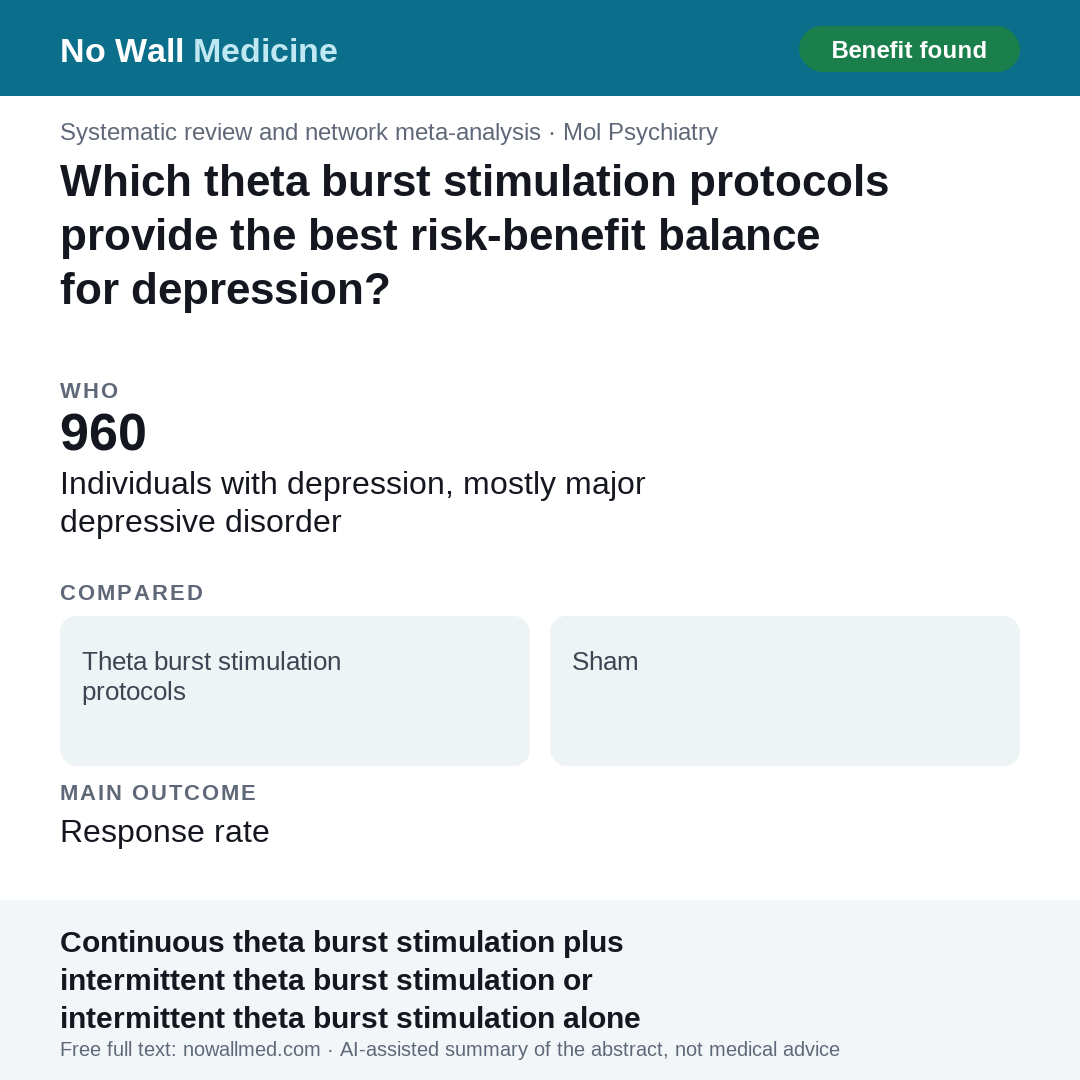
Clinical question: Which theta burst stimulation protocols provide the best risk-benefit balance for depression?
Why it matters: It is unknown which specific theta burst stimulation protocols provide the most favorable risk-benefit balance for individuals with depression.
Key points
- Researchers analyzed 23 randomized controlled trials involving 960 participants with a mean age of 41.88 years to compare different theta burst stimulation protocols.
- Compared to sham, cTBS (R-DLPFC) + iTBS (L-DLPFC), iTBS (L-DLPFC), and iTBS (occipital lobe) had higher response rates, while iTBS (L-DLPFC) had a higher remission rate.
- No significant differences were found between any theta burst stimulation protocols and sham for discontinuation rates, mania switches, or headache and discomfort.
Headline and key points written with AI from the paper’s abstract, with every number checked against it. Read the paper before relying on them.
Was this summary helpful?
Subject terms
Cite this article
Kishi T, Ikuta T, Sakuma K, Hatano M, Matsuda Y, Wilkening J. Theta burst stimulation for depression: a systematic review and network and pairwise meta-analysis. Mol Psychiatry. 2024. doi:10.1038/s41380-024-02630-5
Spotted a mistake? Suggest a correction
Top studies every Monday
The week’s key trials and guidelines in your specialties, plus any topics you follow. By email, free.
Get the weekly digest