Enucleation was associated with fewer complications and shorter hospital stays during robotic partial kidney tumor removal
Resection Techniques During Robotic Partial Nephrectomy: A Systematic Review
Systematic review and pooled analysisBenefit found
How do different resection techniques during robotic partial nephrectomy affect surgical outcomes?
Who
adult patients undergoing robotic partial nephrectomy
Compared
enucleation
resection
Main outcome
surgical outcomes including complications, length of stay, and renal function
Result: overall complications OR 0.55 (95% CI 0.34-0.87)
Bottom line: Enucleation is associated with fewer complications, shorter hospital stays, and better renal function compared to standard resection.
Eur Urol Open Sci · 2023-04-29Download image
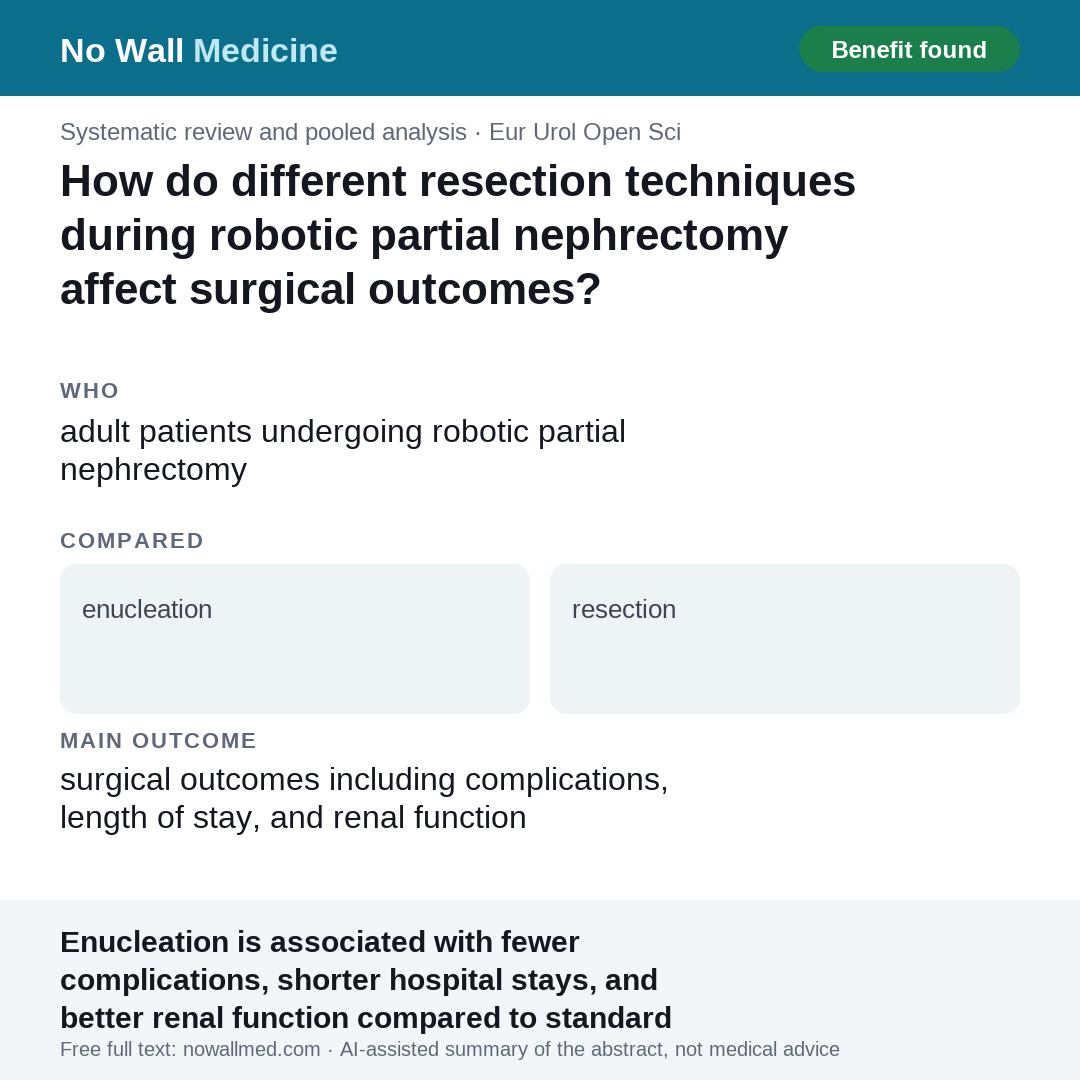
Clinical question: How do different resection techniques during robotic partial nephrectomy affect surgical outcomes?
Why it matters: A standardized definition for different resection techniques used during robotic partial nephrectomy is lacking.
Key points
- Researchers analyzed 20 studies involving adult patients undergoing robotic partial nephrectomy, comparing enucleation to enucleoresection or wedge resection.
- Enucleation was associated with lower odds of renal artery clamping (OR 3.51, 95% CI 1.13-10.88), overall complications (OR 0.55, 95% CI 0.34-0.87), and major complications (OR 0.39, 95% CI 0.19-0.79).
- Enucleation was associated with a shorter hospital stay (WMD -0.72 d, 95% CI -0.99 to -0.45) and a smaller decrease in estimated glomerular filtration rate (WMD -2.64 ml/min, 95% CI -5.15 to -0.12).
Headline and key points written with AI from the paper’s abstract, with every number checked against it. Read the paper before relying on them.
Was this summary helpful?
Cite this article
Bertolo R, Pecoraro A, Carbonara U, Amparore D, Diana P, Muselaers S. Resection Techniques During Robotic Partial Nephrectomy: A Systematic Review. Eur Urol Open Sci. 2023. doi:10.1016/j.euros.2023.03.008
Spotted a mistake? Suggest a correction
Top studies every Monday
The week’s key trials and guidelines in your specialties, plus any topics you follow. By email, free.
Get the weekly digest