Multiple factors are associated with increased surgical site infection risk after knee ligament reconstruction
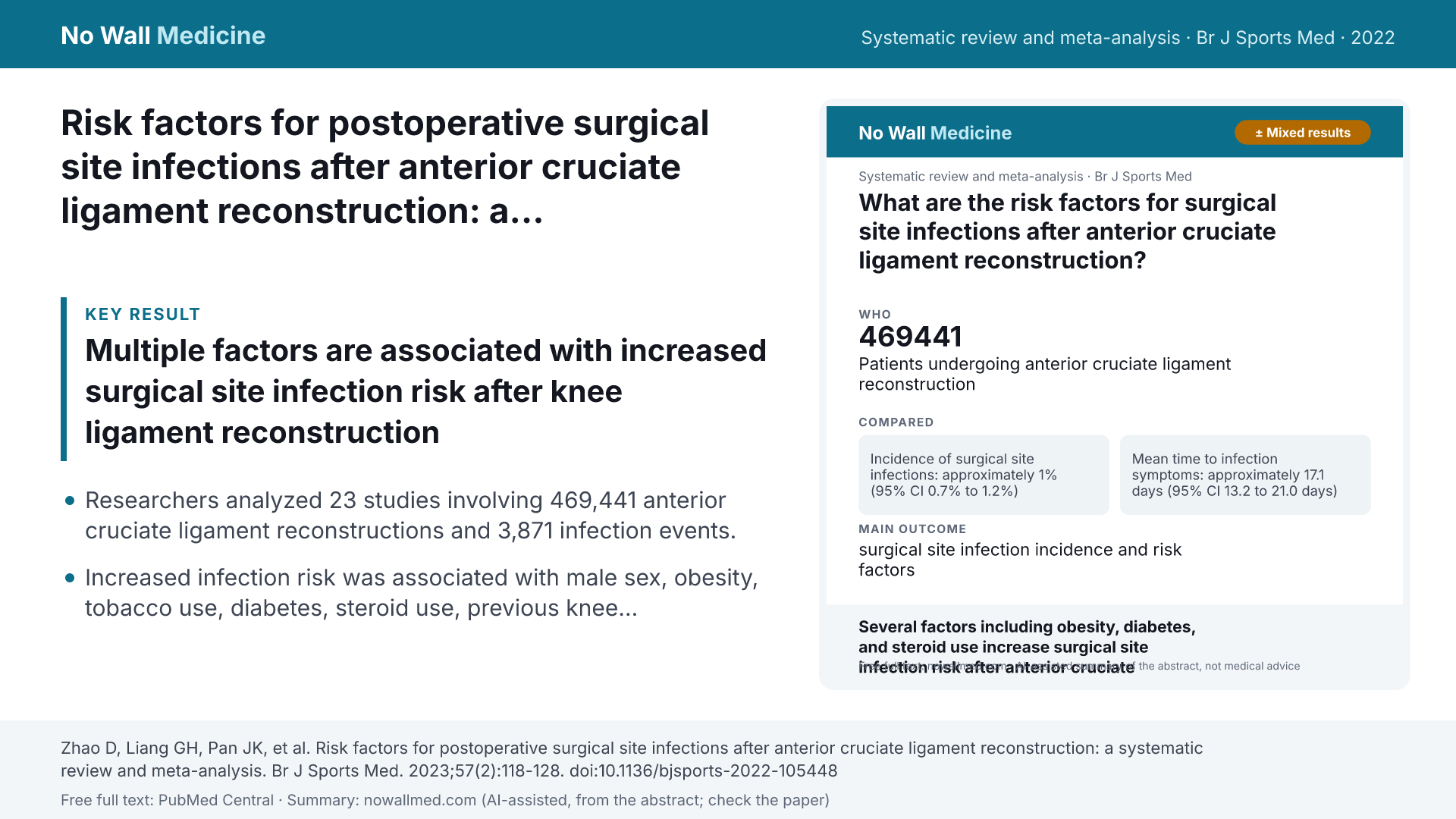
Risk factors for postoperative surgical site infections after anterior cruciate ligament reconstruction: a systematic review and meta-analysis
Systematic review and meta-analysisMixed results
What are the risk factors for surgical site infections after anterior cruciate ligament reconstruction?
Who
469441
Patients undergoing anterior cruciate ligament reconstruction
Compared
Incidence of surgical site infections: approximately 1% (95% CI 0.7% to 1.2%)
Mean time to infection symptoms: approximately 17.1 days (95% CI 13.2 to 21.0 days)
Main outcome
surgical site infection incidence and risk factors
Bottom line: Several factors including obesity, diabetes, and steroid use increase surgical site infection risk after anterior cruciate ligament reconstruction.
Br J Sports Med · 2022-12-14Download image
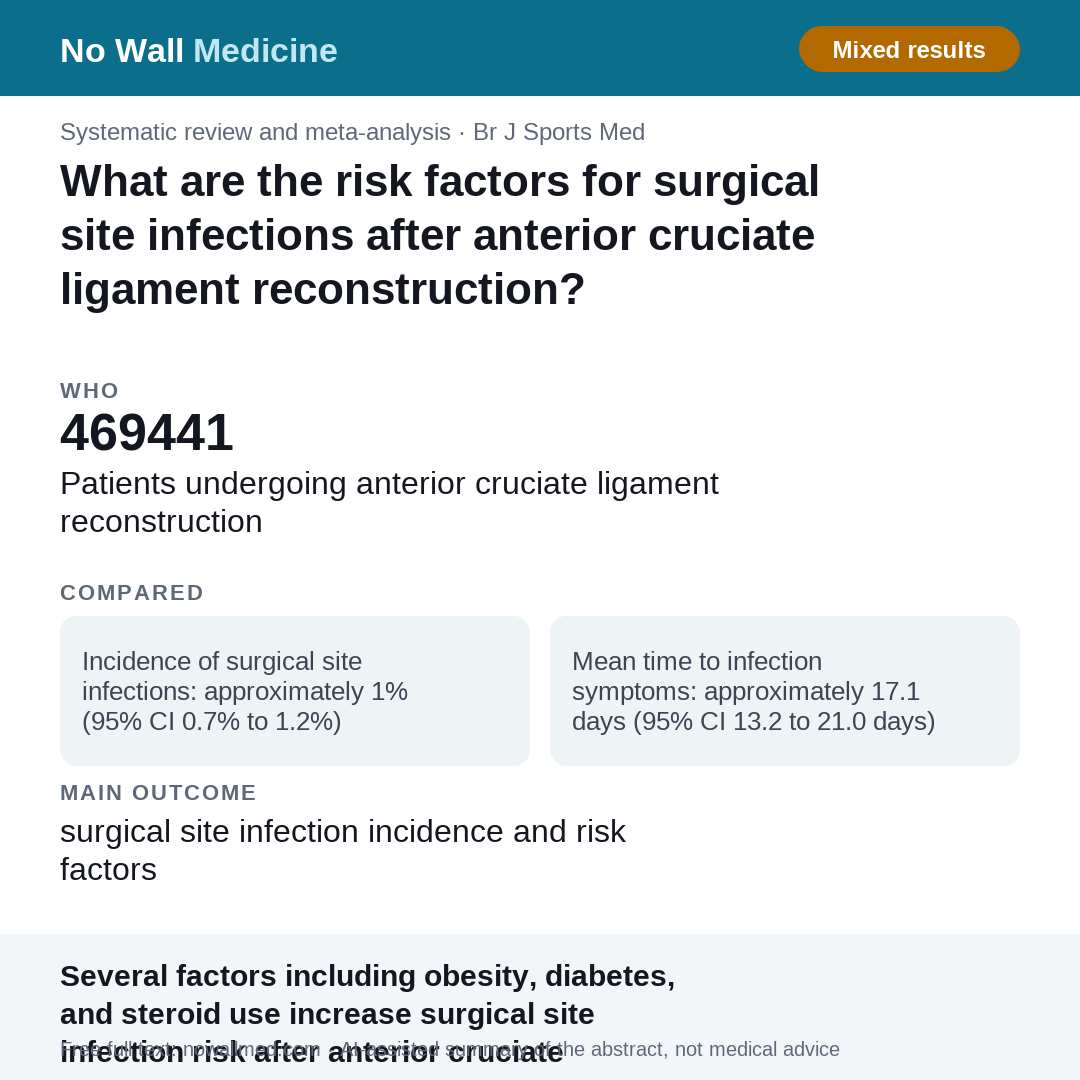
Clinical question: What are the risk factors for surgical site infections after anterior cruciate ligament reconstruction?
Why it matters: The specific risk factors that increase the likelihood of surgical site infections following anterior cruciate ligament reconstruction were not clearly identified.
Key points
- Researchers analyzed 23 studies involving 469,441 anterior cruciate ligament reconstructions and 3,871 infection events.
- Increased infection risk was associated with male sex, obesity, tobacco use, diabetes, steroid use, previous knee surgery, being a professional athlete, revision surgery, hamstring autografts, and lateral extra-articular tenodesis.
- The incidence of surgical site infections was approximately 1% (95% CI 0.7% to 1.2%) with symptoms appearing at a mean of 17.1 days (95% CI 13.2 to 21.0 days).
Headline and key points written with AI from the paper’s abstract, with every number checked against it. Read the paper before relying on them.
Was this summary helpful?
Abstract
Objectives
The primary aim was to evaluate risk factors for surgical site infections after anterior cruciate ligament reconstruction (ACLR). The secondary aim was to investigate the surgical site infection incidence rate and the mean time to postoperative surgical site infection symptoms. Design
Systematic review and meta-analysis. Data sources
PubMed, Embase and Web of Science were searched from database inception to September 2021 and updated in April 2022. Eligibility criteria
Quantitative, original studies reporting potential risk factors for surgical site infections after ACLR were included. Results
Twenty-three studies with 3871 infection events from 469 441 ACLRs met the inclusion criteria. Male sex (OR 1.78, p< 0.00001), obesity (OR 1.82, p=0.0005), tobacco use (OR 1.37, p=0.01), diabetes mellitus (OR 3.40, p=0.002), steroid use history (OR 4.80, p<0.00001), previous knee surgery history (OR 3.63, p=0.02), professional athlete (OR 4.56, p=0.02), revision surgery (OR 2.05, p=0.04), hamstring autografts (OR 2.83, p<0.00001), concomitant lateral extra-articular tenodesis (OR 3.92, p=0.0001) and a long operating time (weighted mean difference 8.12, p=0.005) were identified as factors that increased the risk of surgical site infections (superficial and deep) after ACLR. Age, outpatient or inpatient surgery, bone-patellar tendon-bone autografts or allografts and a concomitant meniscus suture did not increase the risk of surgical site infections. The incidence of surgical site infections after ACLR was approximately 1% (95% CI 0.7% to 1.2%). The mean time from surgery to the onset of surgical site infection symptoms was approximately 17.1 days (95% CI 13.2 to 21.0 days). Conclusion
Male sex, obesity, tobacco use, diabetes mellitus, steroid use history, previous knee surgery history, professional athletes, revision surgery, hamstring autografts, concomitant lateral extra-articular tenodesis and a long operation time may increase the risk of surgical site infections after ACLR. Although the risk of surgical site infections after ACLR is low, raising awareness and implementing effective preventions for risk factors are priorities for clinicians to reduce the incidence of surgical site infections due to its seriousness.
Abstract reproduced under the article’s CC BY NC licence.
Subject terms
Cite this article
Zhao D, Liang GH, Pan JK, et al. Risk factors for postoperative surgical site infections after anterior cruciate ligament reconstruction: a systematic review and meta-analysis. Br J Sports Med. 2022. doi:10.1136/bjsports-2022-105448
Spotted a mistake? Suggest a correction