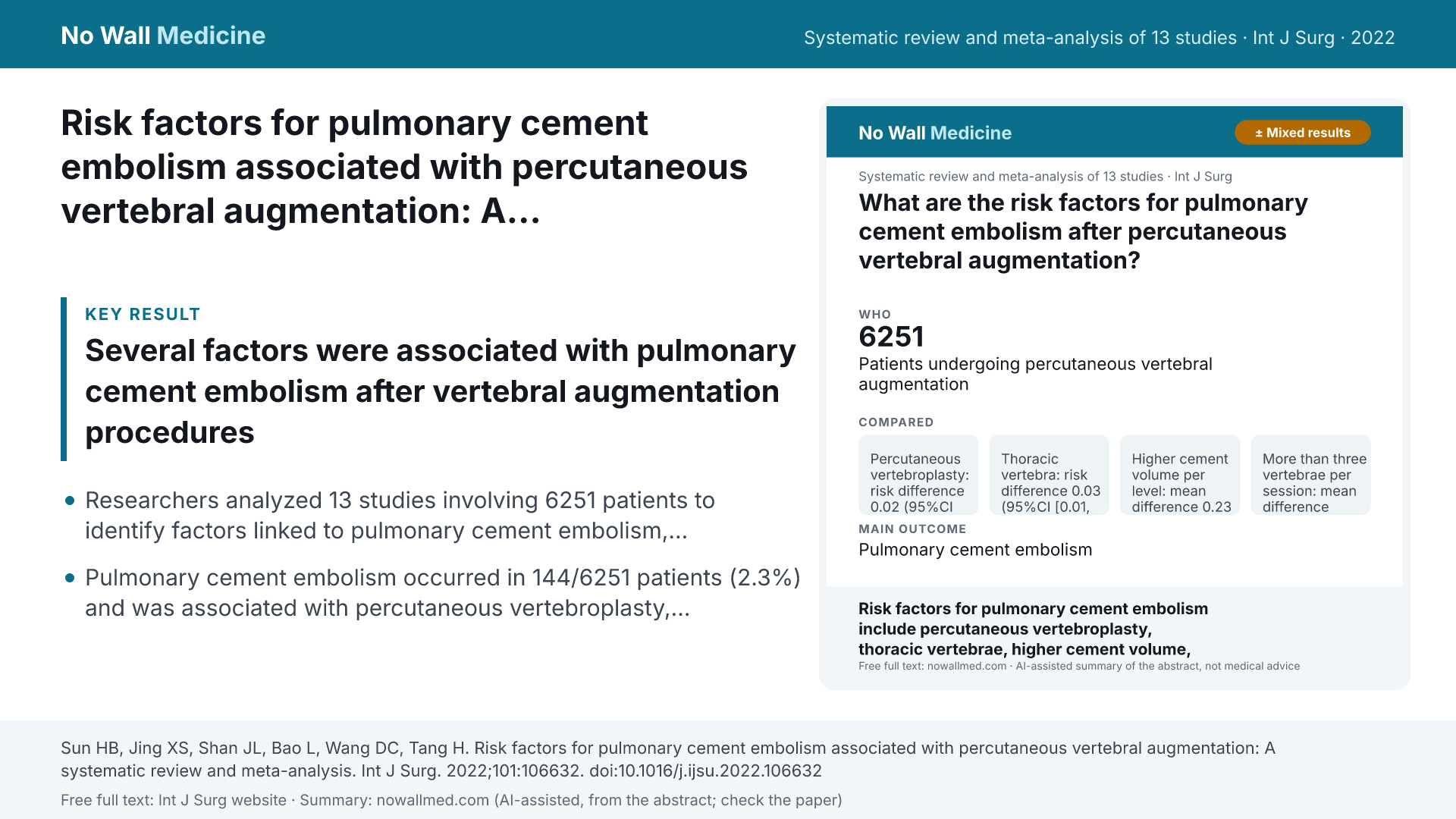
Several factors were associated with pulmonary cement embolism after vertebral augmentation procedures
Risk factors for pulmonary cement embolism associated with percutaneous vertebral augmentation: A systematic review and meta-analysis
Systematic review and meta-analysis of 13 studiesMixed results
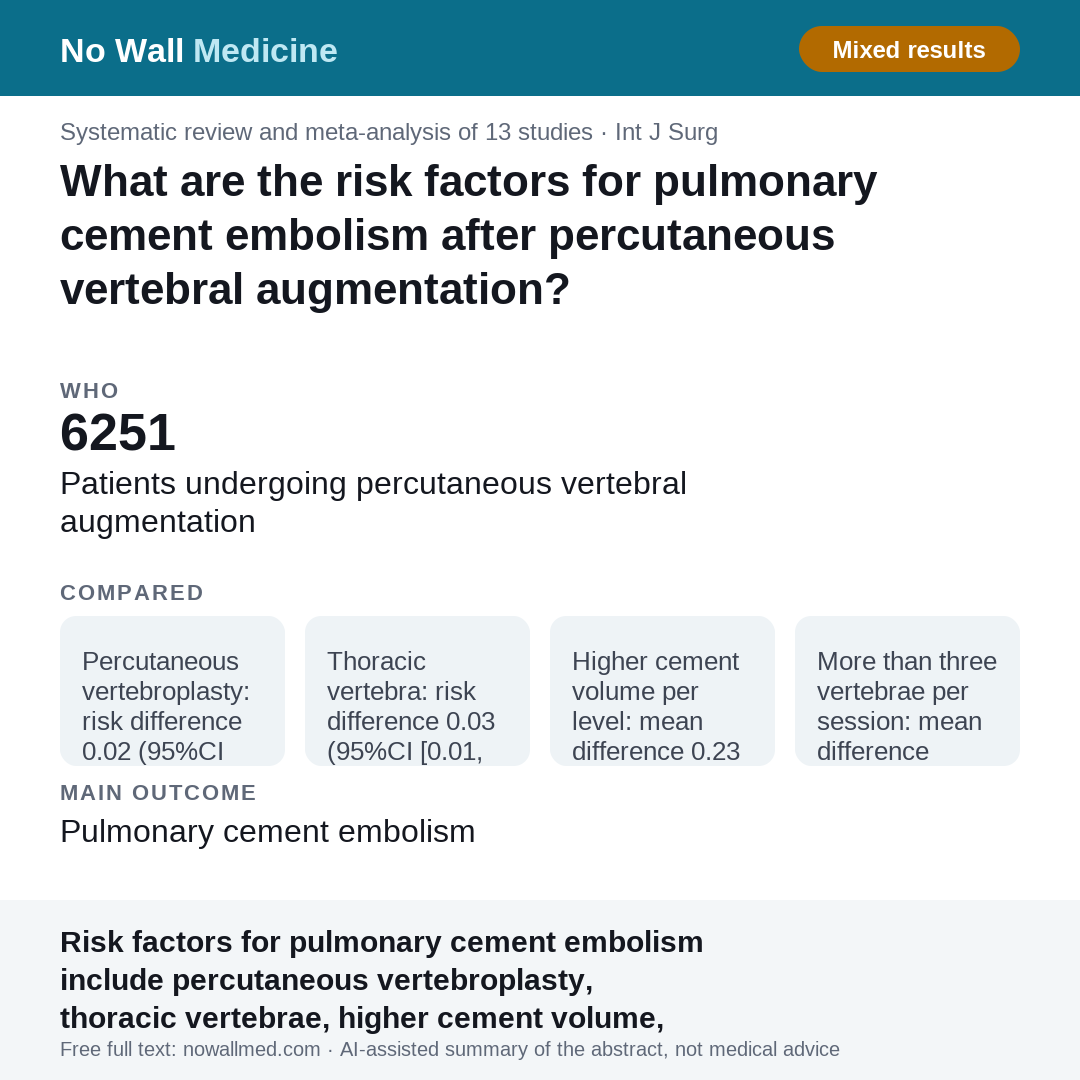
What are the risk factors for pulmonary cement embolism after percutaneous vertebral augmentation?
Who
6251
Patients undergoing percutaneous vertebral augmentation
Compared
Percutaneous vertebroplasty: risk difference 0.02 (95%CI [0.01, 0.04])
Thoracic vertebra: risk difference 0.03 (95%CI [0.01, 0.05])
Higher cement volume per level: mean difference 0.23 (95%CI [0.05, 0.42])
More than three vertebrae per session: mean difference -0.05 (95%CI [-0.08, -0.02])
Main outcome
Pulmonary cement embolism
Bottom line: Risk factors for pulmonary cement embolism include percutaneous vertebroplasty, thoracic vertebrae, higher cement volume, multiple vertebrae treated, and venous leakage.
Limitation: 7 studies were considered low quality according to the Newcastle-Ottawa Scale
Int J Surg · 2022-04-20Download image
Clinical question: What are the risk factors for pulmonary cement embolism after percutaneous vertebral augmentation?
Why it matters: The specific risk factors that increase the likelihood of pulmonary cement embolism during percutaneous vertebral augmentation were not clearly identified.
Key points
- Researchers analyzed 13 studies involving 6251 patients to identify factors linked to pulmonary cement embolism, a complication where bone cement enters the lungs.
- Pulmonary cement embolism occurred in 144/6251 patients (2.3%) and was associated with percutaneous vertebroplasty, thoracic vertebrae, higher cement volume, treating more than three vertebrae, and venous cement leakage.
- The risk difference for venous cement leakage was 0.07 (95%CI: [0.03, 0.11]) and for thoracic vertebrae was 0.03 (95%CI: [0.01, 0.05]).
Limitation the authors note: Seven of the included studies were considered low quality according to the Newcastle-Ottawa Scale.
Headline and key points written with AI from the paper’s abstract, with every number checked against it. Read the paper before relying on them.
Was this summary helpful?
Subject terms
Cite this article
Sun HB, Jing XS, Shan JL, Bao L, Wang DC, Tang H. Risk factors for pulmonary cement embolism associated with percutaneous vertebral augmentation: A systematic review and meta-analysis. Int J Surg. 2022. doi:10.1016/j.ijsu.2022.106632
Spotted a mistake? Suggest a correction
Top studies every Monday
The week’s key trials and guidelines in your specialties, plus any topics you follow. By email, free.
Get the weekly digest