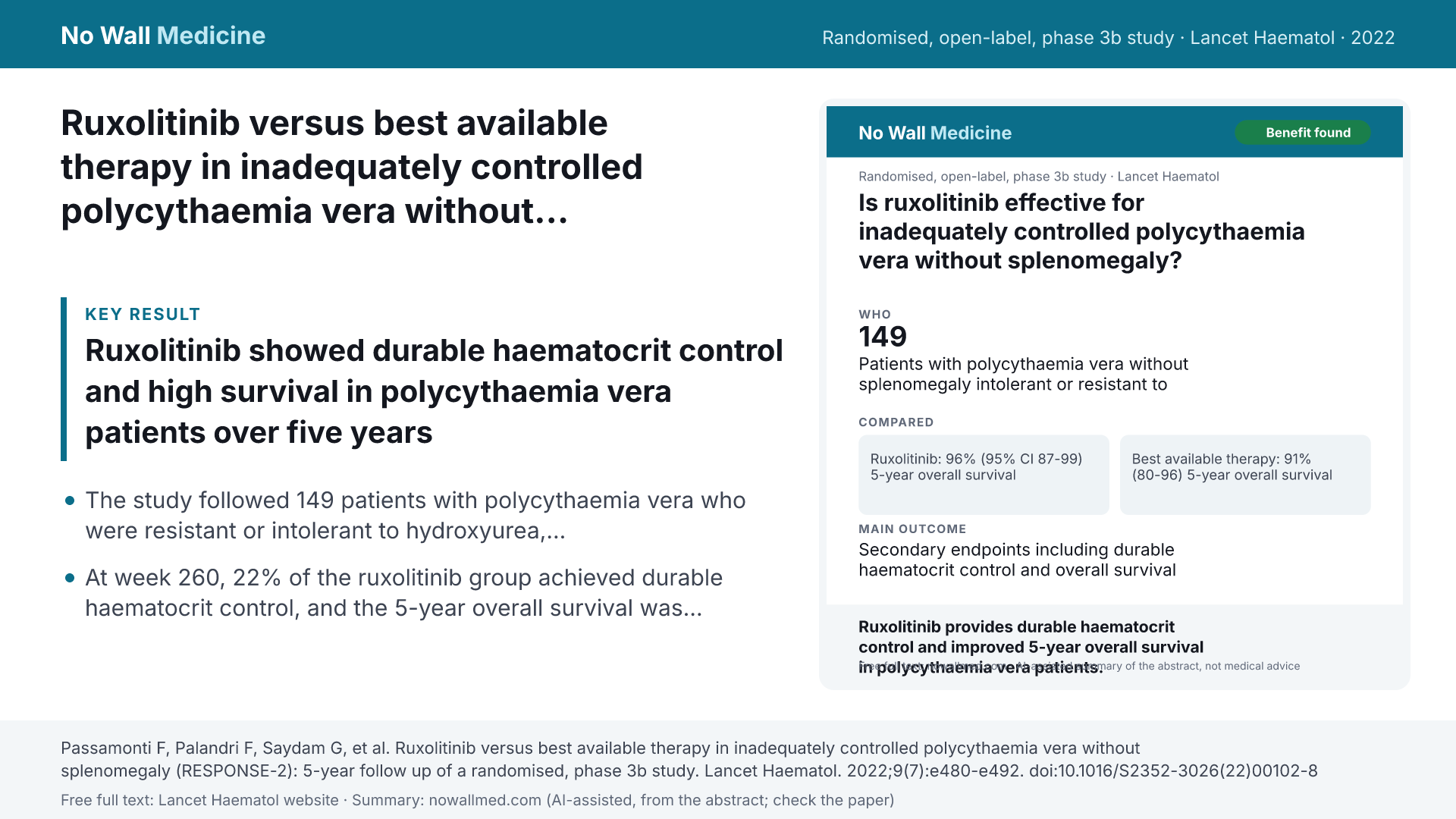
Ruxolitinib showed durable haematocrit control and high survival in polycythaemia vera patients over five years
Ruxolitinib versus best available therapy in inadequately controlled polycythaemia vera without splenomegaly (RESPONSE-2): 5-year follow up of a randomised, phase 3b study
Randomised, open-label, phase 3b studyBenefit found
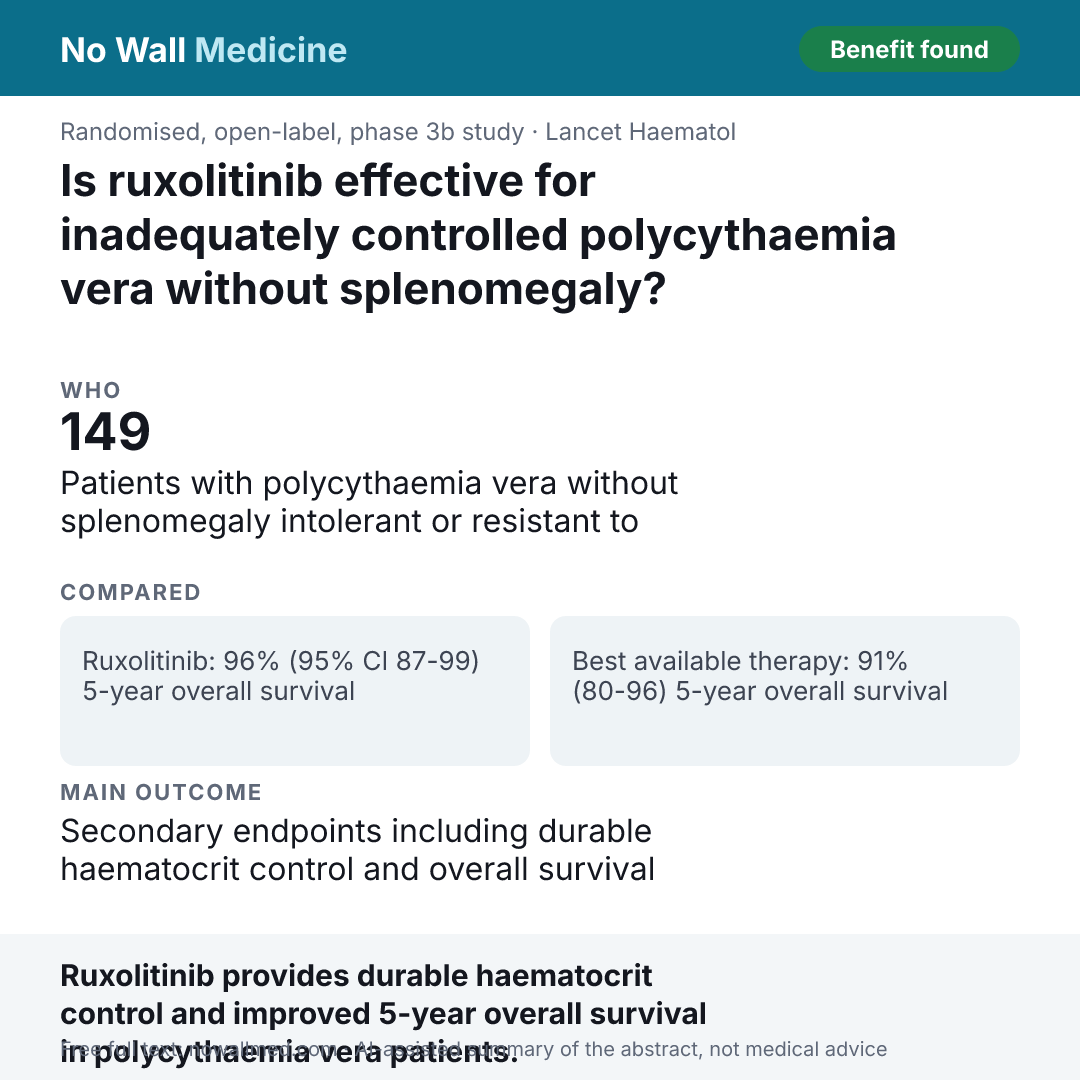
Is ruxolitinib effective for inadequately controlled polycythaemia vera without splenomegaly?
Who
149
Patients with polycythaemia vera without splenomegaly intolerant or resistant to hydroxyurea · 48 hospitals or clinics across 12 countries
Compared
Ruxolitinib: 96% (95% CI 87-99) 5-year overall survival
Best available therapy: 91% (80-96) 5-year overall survival
Main outcome
Secondary endpoints including durable haematocrit control and overall survival
Bottom line: Ruxolitinib provides durable haematocrit control and improved 5-year overall survival in polycythaemia vera patients.
Funded by: Novartis
Lancet Haematol · 2022-05-18 · Save PNG
Clinical question: Is ruxolitinib effective for inadequately controlled polycythaemia vera without splenomegaly?
Key points
- The study followed 149 patients with polycythaemia vera who were resistant or intolerant to hydroxyurea, comparing ruxolitinib to best available therapy.
- At week 260, 22% of the ruxolitinib group achieved durable haematocrit control, and the 5-year overall survival was 96% compared to 91% for best available therapy.
- The ruxolitinib group required 60 phlebotomies, which are bloodletting procedures, among 74 patients over 260 weeks, while the best available therapy group required 106 phlebotomies among 75 patients over 80 weeks.
Headline and key points written with AI from the paper’s abstract, with every number checked against it. Read the paper before relying on them.
Was this summary helpful?
Subject terms
Headline, design, result, key points, caveat and citation as plain text.
Cite this article
Passamonti F, Palandri F, Saydam G, et al. Ruxolitinib versus best available therapy in inadequately controlled polycythaemia vera without splenomegaly (RESPONSE-2): 5-year follow up of a randomised, phase 3b study. Lancet Haematol. 2022. doi:10.1016/S2352-3026(22)00102-8
Spotted a mistake? Suggest a correction