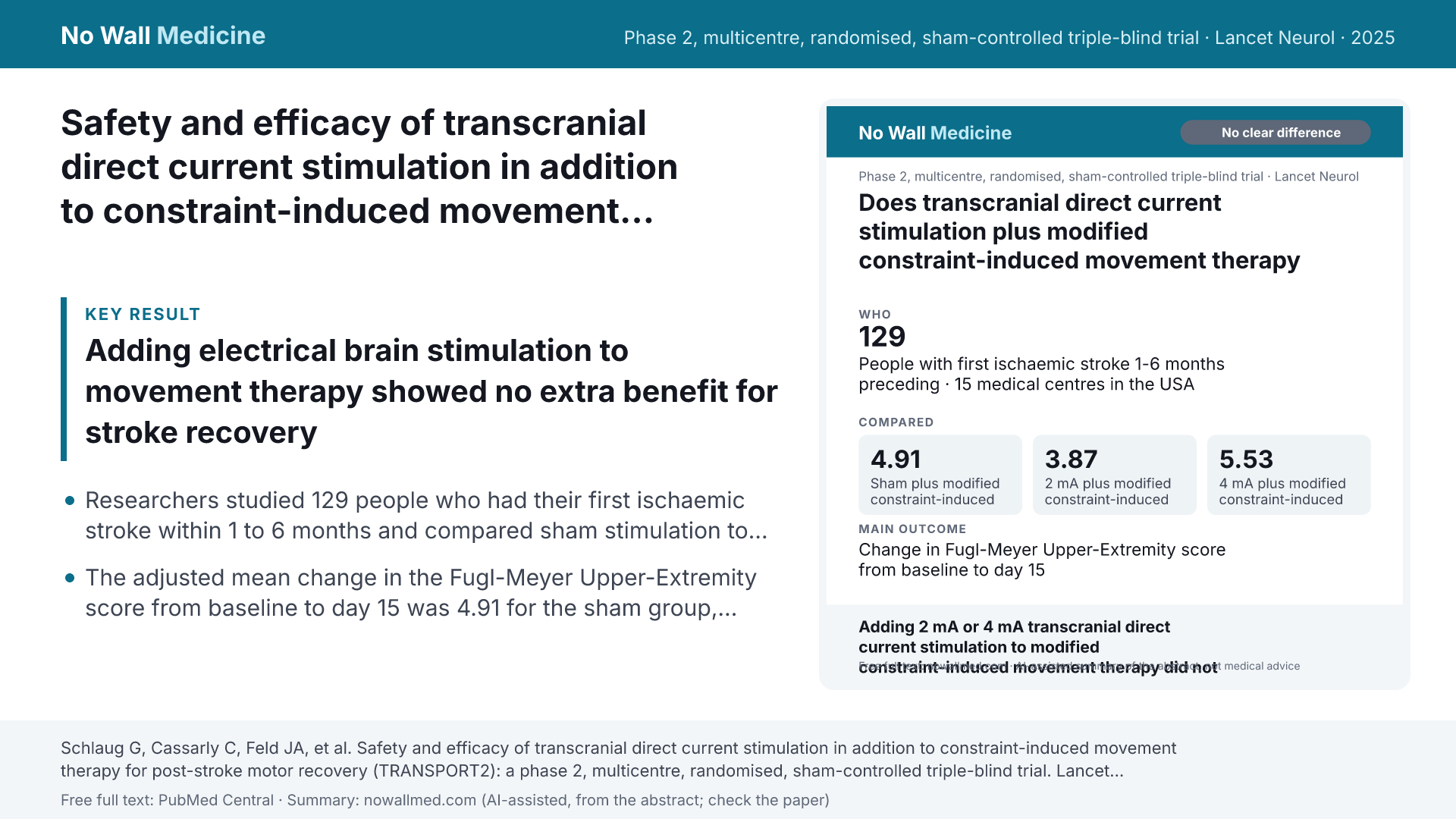
Adding electrical brain stimulation to movement therapy showed no extra benefit for stroke recovery
Safety and efficacy of transcranial direct current stimulation in addition to constraint-induced movement therapy for post-stroke motor recovery (TRANSPORT2): a phase 2, multicentre, randomised, sham-controlled triple-blind trial
Phase 2, multicentre, randomised, sham-controlled triple-blind trialNo clear difference
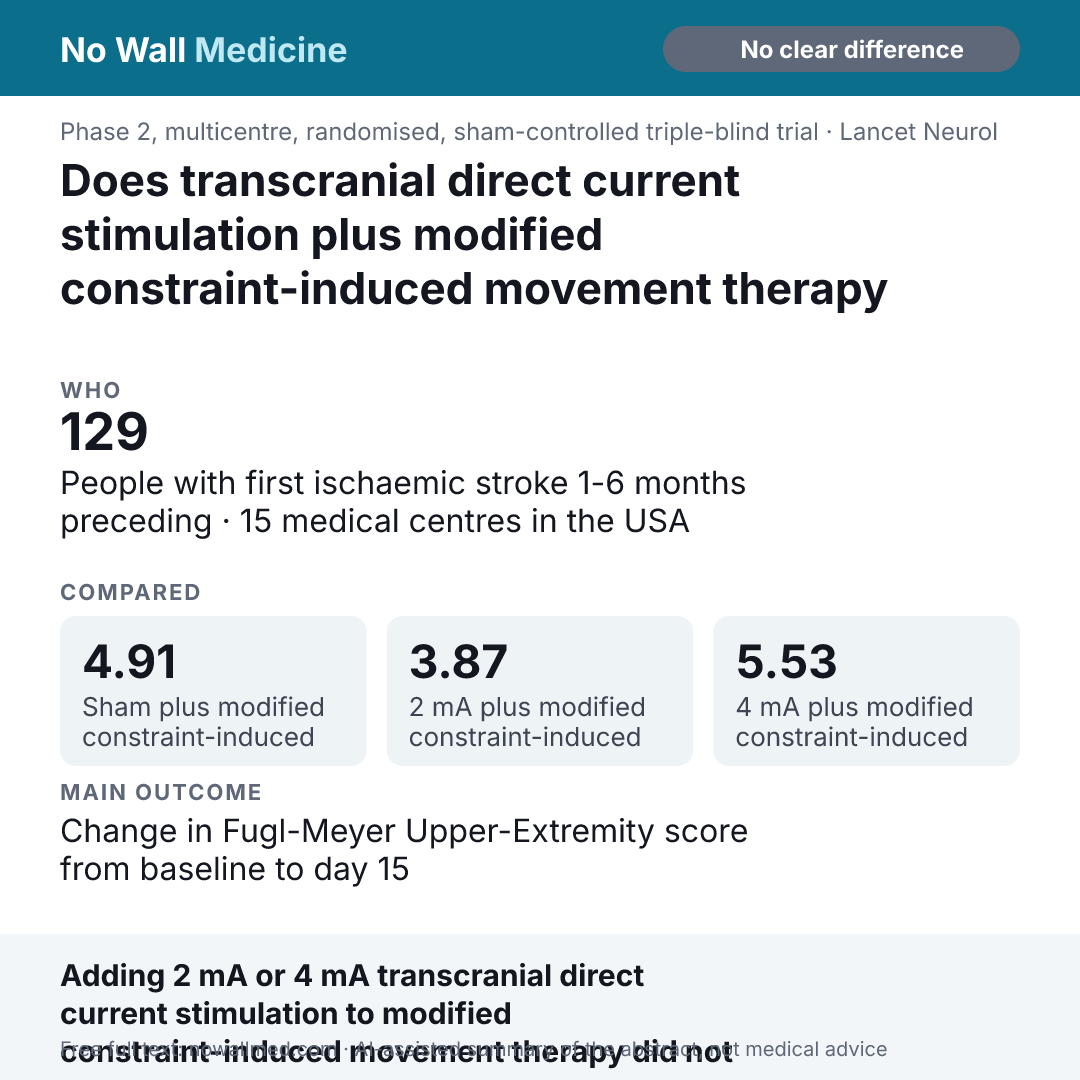
Does transcranial direct current stimulation plus modified constraint-induced movement therapy improve motor recovery after stroke?
Who
129
People with first ischaemic stroke 1-6 months preceding · 15 medical centres in the USA
Compared
4.91Sham plus modified constraint-induced movement therapy (3.00-6.82)
3.872 mA plus modified constraint-induced movement therapy (2.00-5.74)
5.534 mA plus modified constraint-induced movement therapy (3.64-7.42)
Main outcome
Change in Fugl-Meyer Upper-Extremity score from baseline to day 15
Result: p=0.39
Bottom line: Adding 2 mA or 4 mA transcranial direct current stimulation to modified constraint-induced movement therapy did not further reduce motor impairment.
Lancet Neurol · 2025-03-26 · Funded by National Institute of Neurological Disorders and Stroke · NCT03826030
Headline and visual abstract written with AI from the paper’s abstract, with every number checked against it. Read the paper before relying on them.
Was this summary helpful?
Subject terms
Cite this article
Schlaug G, Cassarly C, Feld JA, et al. Safety and efficacy of transcranial direct current stimulation in addition to constraint-induced movement therapy for post-stroke motor recovery (TRANSPORT2): a phase 2, multicentre, randomised, sham-controlled triple-blind trial. Lancet Neurol. 2025;24(5):400-412. doi:10.1016/S1474-4422(25)00044-4
Spotted a mistake? Suggest a correction