Fascial plane blocks did not improve pain scores or opioid use after mitral valve repair
Serratus anterior and pectoralis plane blocks for robotically assisted mitral valve repair: a randomised clinical trial
Randomized clinical trialNo clear difference
Do fascial plane blocks improve analgesia after robotically assisted mitral valve repair?
Who
194
Adults scheduled for robotically assisted mitral valve repairs
Compared
combined pectoralis II and serratus anterior plane blocks
routine analgesic management
Main outcome
overall benefit analgesia score during the initial 3 days
Result: median difference 0.08 (95% CI -0.50 to 0.67)
Bottom line: Fascial plane blocks did not improve analgesia, opioid consumption, or respiratory mechanics after robotically assisted mitral valve repair.
Br J Anaesth · 2023-04-11Download image
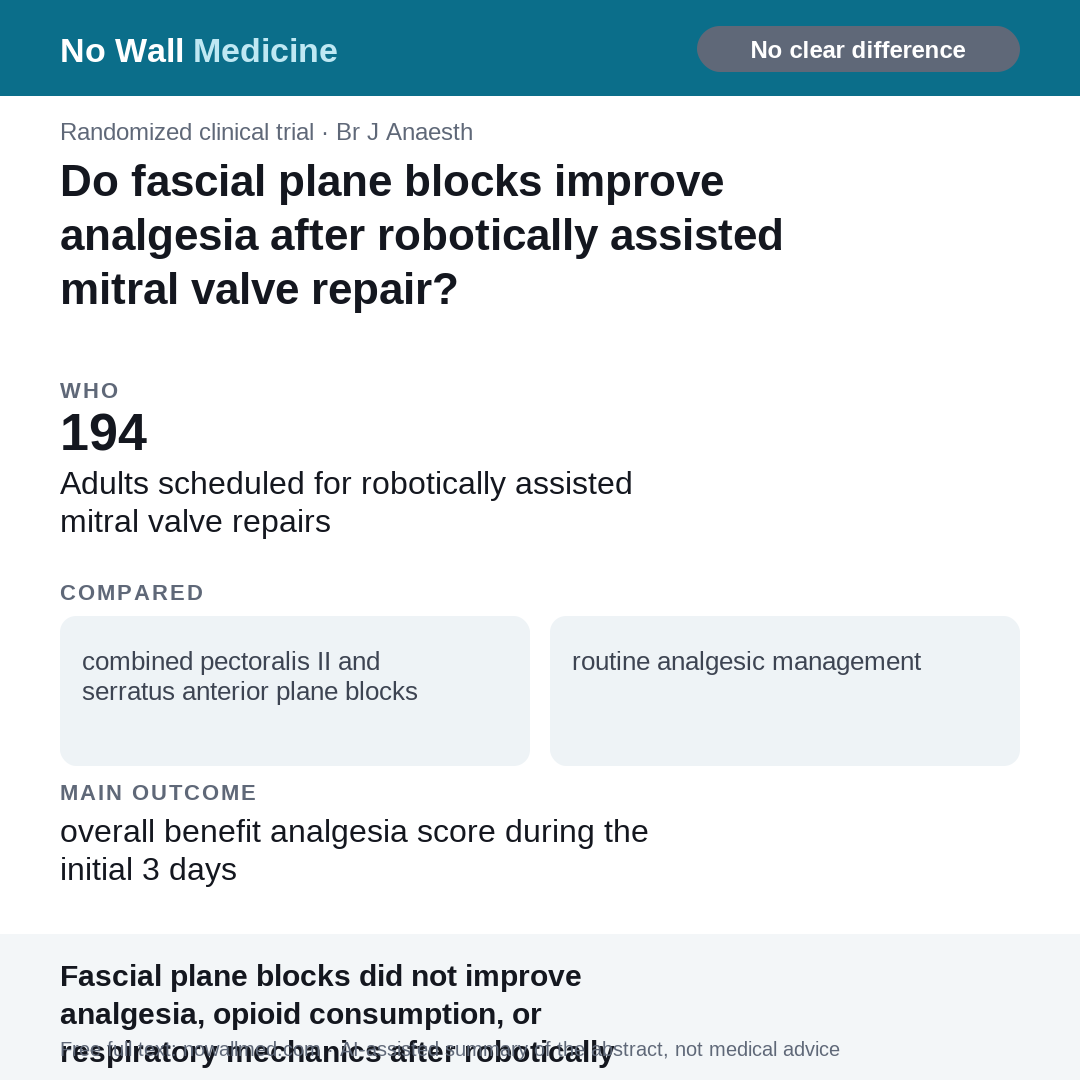
Clinical question: Do fascial plane blocks improve analgesia after robotically assisted mitral valve repair?
Why it matters: It is unclear if fascial plane blocks, which are injections into the layers of tissue, improve pain relief, reduce opioid use, or help lung function after robotically assisted mitral valve repair.
Key points
- Researchers randomized 194 adults undergoing robotically assisted mitral valve repair to receive combined serratus anterior and pectoralis plane blocks or routine analgesia.
- The blocks showed no significant difference in the overall benefit analgesia score over the first 3 days, with a median difference of 0.08 (95% CI: -0.50 to 0.67; P=0.69).
- There was no evidence of a treatment effect on cumulative opioid consumption or respiratory mechanics, which refers to how well the lungs function.
Headline and key points written with AI from the paper’s abstract, with every number checked against it. Read the paper before relying on them.
Topics
Cite this article
Alfirevic A, Marciniak D, Duncan AE, Kelava M, Yalcin EK, Hamadnalla H. Serratus anterior and pectoralis plane blocks for robotically assisted mitral valve repair: a randomised clinical trial. Br J Anaesth. 2023. doi:10.1016/j.bja.2023.02.038
Spotted a mistake? Suggest a correction
Top studies every Monday
The week’s key trials and guidelines in your specialties, plus any topics you follow. By email, free.
Get the weekly digest