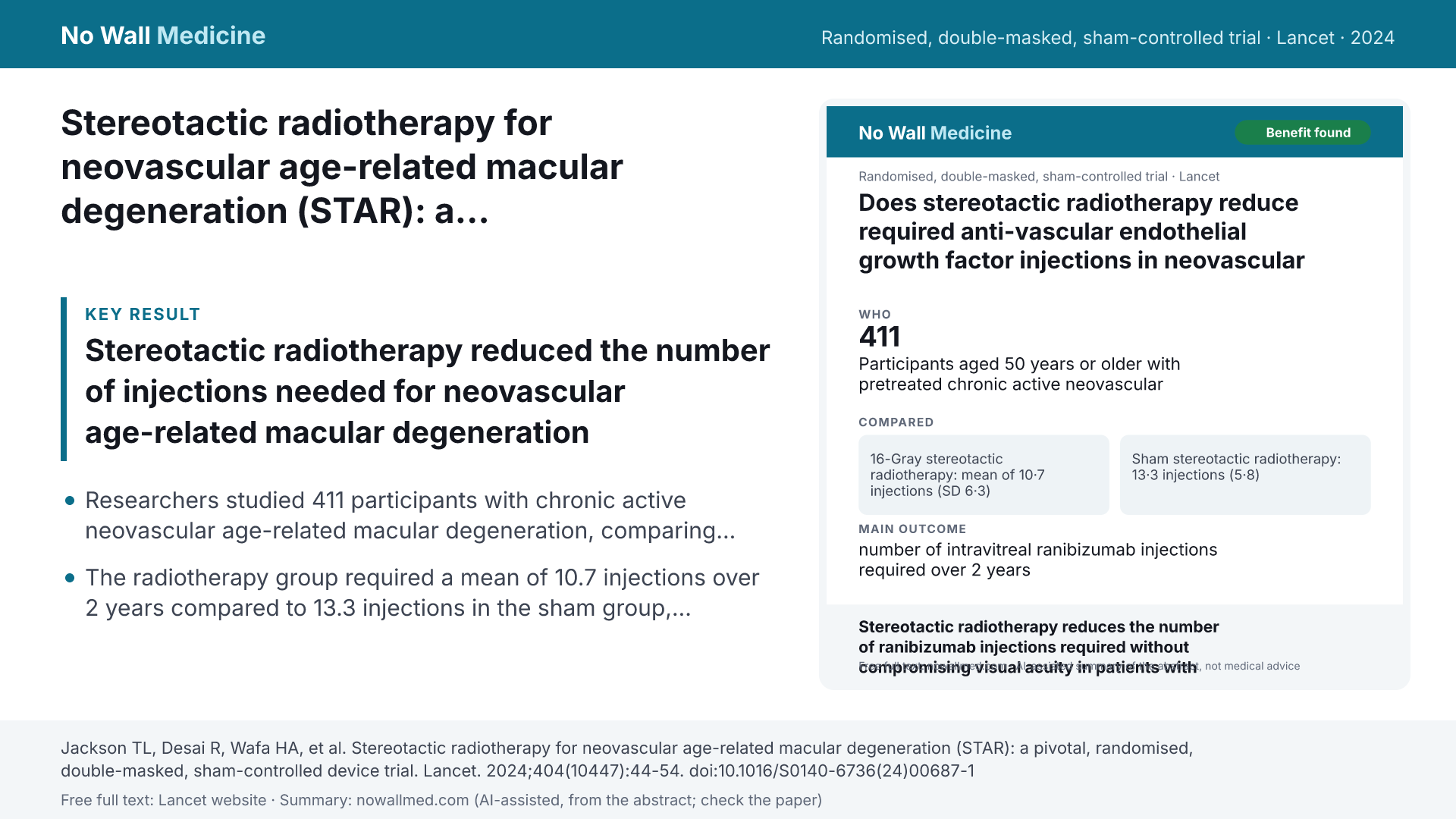
Stereotactic radiotherapy reduced the number of injections needed for neovascular age-related macular degeneration
Stereotactic radiotherapy for neovascular age-related macular degeneration (STAR): a pivotal, randomised, double-masked, sham-controlled device trial
Randomised, double-masked, sham-controlled trialBenefit found
Does stereotactic radiotherapy reduce required anti-vascular endothelial growth factor injections in neovascular age-related macular degeneration?
Who
411
Participants aged 50 years or older with pretreated chronic active neovascular age-related macular degeneration · 30 UK hospitals
Compared
16-Gray stereotactic radiotherapy: mean of 10·7 injections (SD 6·3)
Sham stereotactic radiotherapy: 13·3 injections (5·8)
Main outcome
number of intravitreal ranibizumab injections required over 2 years
Result: reduction of 2·9 injections (95% CI -4·2 to -1·6)
Bottom line: Stereotactic radiotherapy reduces the number of ranibizumab injections required without compromising visual acuity in patients with neovascular age-related macular degeneration.
Funded by: Medical Research Council and National Institute for Health and Care Research
Lancet · 2024-06-11Download image
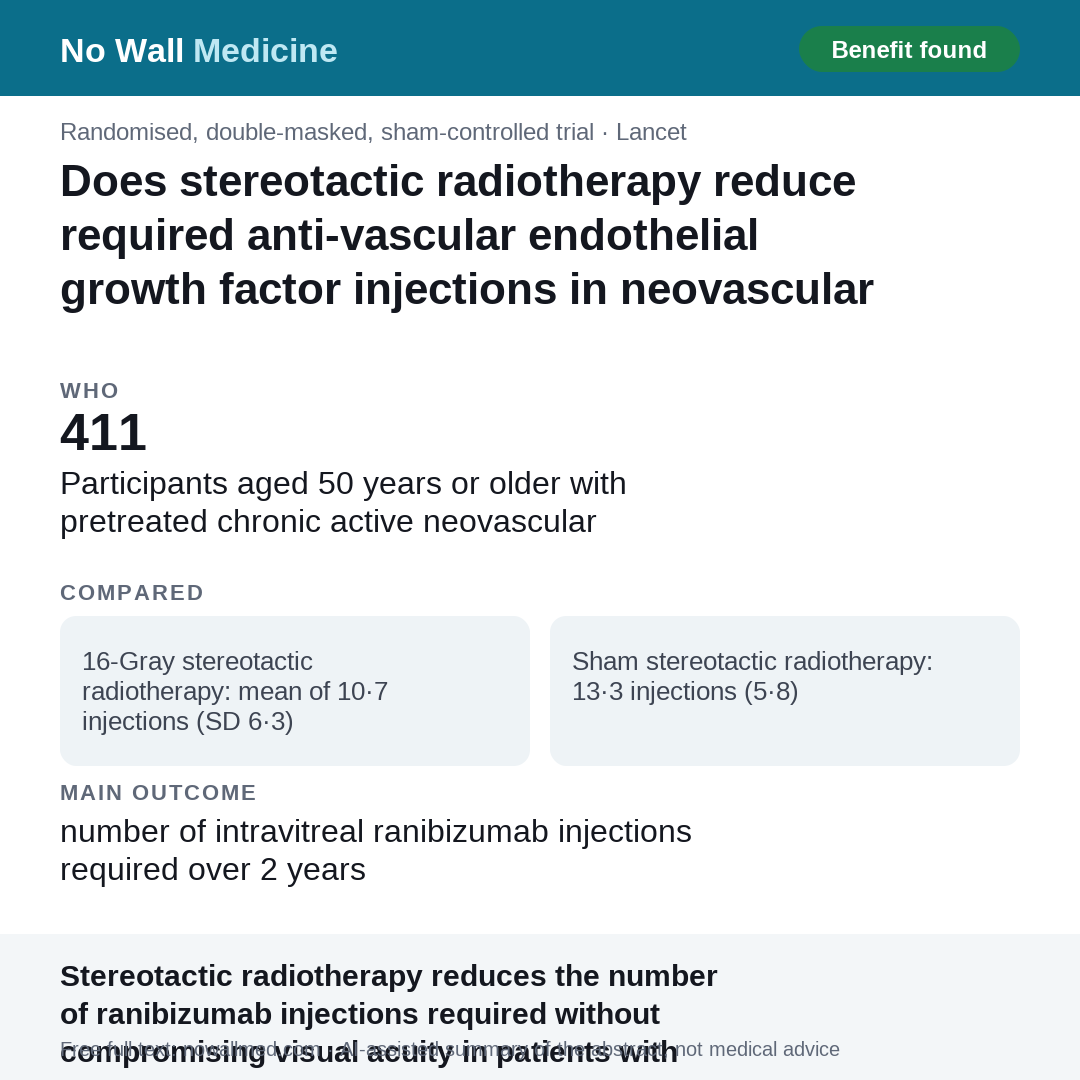
Clinical question: Does stereotactic radiotherapy reduce required anti-vascular endothelial growth factor injections in neovascular age-related macular degeneration?
Why it matters: Current first-line therapy for neovascular age-related macular degeneration requires frequent injections, and researchers wanted to see if radiotherapy could reduce this treatment burden without losing vision.
Key points
- Researchers studied 411 participants with chronic active neovascular age-related macular degeneration, comparing 16-Gray stereotactic radiotherapy to a sham treatment.
- The radiotherapy group required a mean of 10.7 injections over 2 years compared to 13.3 injections in the sham group, an adjusted reduction of 2.9 injections.
- Visual acuity changes were non-inferior between groups, though microvascular abnormalities occurred in 35% of radiotherapy eyes compared to 12% of sham eyes.
Headline and key points written with AI from the paper’s abstract, with every number checked against it. Read the paper before relying on them.
Was this summary helpful?
Abstract
Background
Neovascular age-related macular degeneration (nAMD) is a leading cause of blindness. The first-line therapy is anti-vascular endothelial growth factor (anti-VEGF) agents delivered by intravitreal injection. Ionising radiation mitigates key pathogenic processes underlying nAMD, and therefore has therapeutic potential. STAR aimed to assess whether stereotactic radiotherapy (SRT) reduces the number of anti-VEGF injections required, without sacrificing visual acuity. Methods
This pivotal, randomised, double-masked, sham-controlled trial enrolled participants with pretreated chronic active nAMD from 30 UK hospitals. Participants were randomly allocated in a 2:1 ratio to 16-Gray (Gy) SRT delivered using a robotically controlled device or sham SRT, stratified by treatment centre. Eligible participants were aged 50 years or older and had chronic active nAMD, with at least three previous anti-VEGF injections, including at least one in the last 4 months. Participants and all trial and image reading centre staff were masked to treatment allocation, except one unmasked statistician. The primary outcome was the number of intravitreal ranibizumab injections required over 2 years, tested for superiority (fewer injections). The main secondary outcome was Early Treatment Diabetic Retinopathy Study visual acuity at two years, tested for non-inferiority (five-letter margin). The primary analysis used the intention-to-treat principle, and safety was analysed per-protocol on participants with available data. The study is registered with ClinicalTrials.gov (NCT02243878) and is closed for recruitment. Findings
411 participants enrolled between Jan 1, 2015, and Dec 27, 2019, and 274 were randomly allocated to the 16-Gy SRT group and 137 to the sham SRT group. 240 (58%) of all participants were female, and 171 (42%) of all participants were male. 241 participants in the 16-Gy SRT group and 118 participants in the sham group were included in the final analysis, and 409 patients were treated and formed the safety population, of whom two patients allocated to sham treatment erroneously received 16-Gy SRT. The SRT group received a mean of 10·7 injections (SD 6·3) over 2 years versus 13·3 injections (5·8) with sham, a reduction of 2·9 injections after adjusting for treatment centre (95% CI -4·2 to -1·6, p<0·0001). The SRT group best-corrected visual acuity change was non-inferior to sham (adjusted mean letter loss difference between groups, -1·7 letters [95% CI -4·2 to 0·8]). Adverse event rates were similar across groups, but reading centre-detected microvascular abnormalities occurred in 77 SRT-treated eyes (35%) and 13 (12%) sham-treated eyes. Overall, eyes with microvascular abnormalities tended to have better best-corrected visual acuity than those without. Fewer ranibizumab injections offset the cost of SRT, saving a mean of £565 per participant (95% CI -332 to 1483). Interpretation
SRT can reduce ranibizumab treatment burden without compromising vision. Funding
Medical Research Council and National Institute for Health and Care Research Efficacy and Mechanism Evaluation Programme.
Abstract reproduced under the article’s CC BY licence.
Subject terms
Cite this article
Jackson TL, Desai R, Wafa HA, et al. Stereotactic radiotherapy for neovascular age-related macular degeneration (STAR): a pivotal, randomised, double-masked, sham-controlled device trial. Lancet. 2024. doi:10.1016/S0140-6736(24)00687-1
Spotted a mistake? Suggest a correction