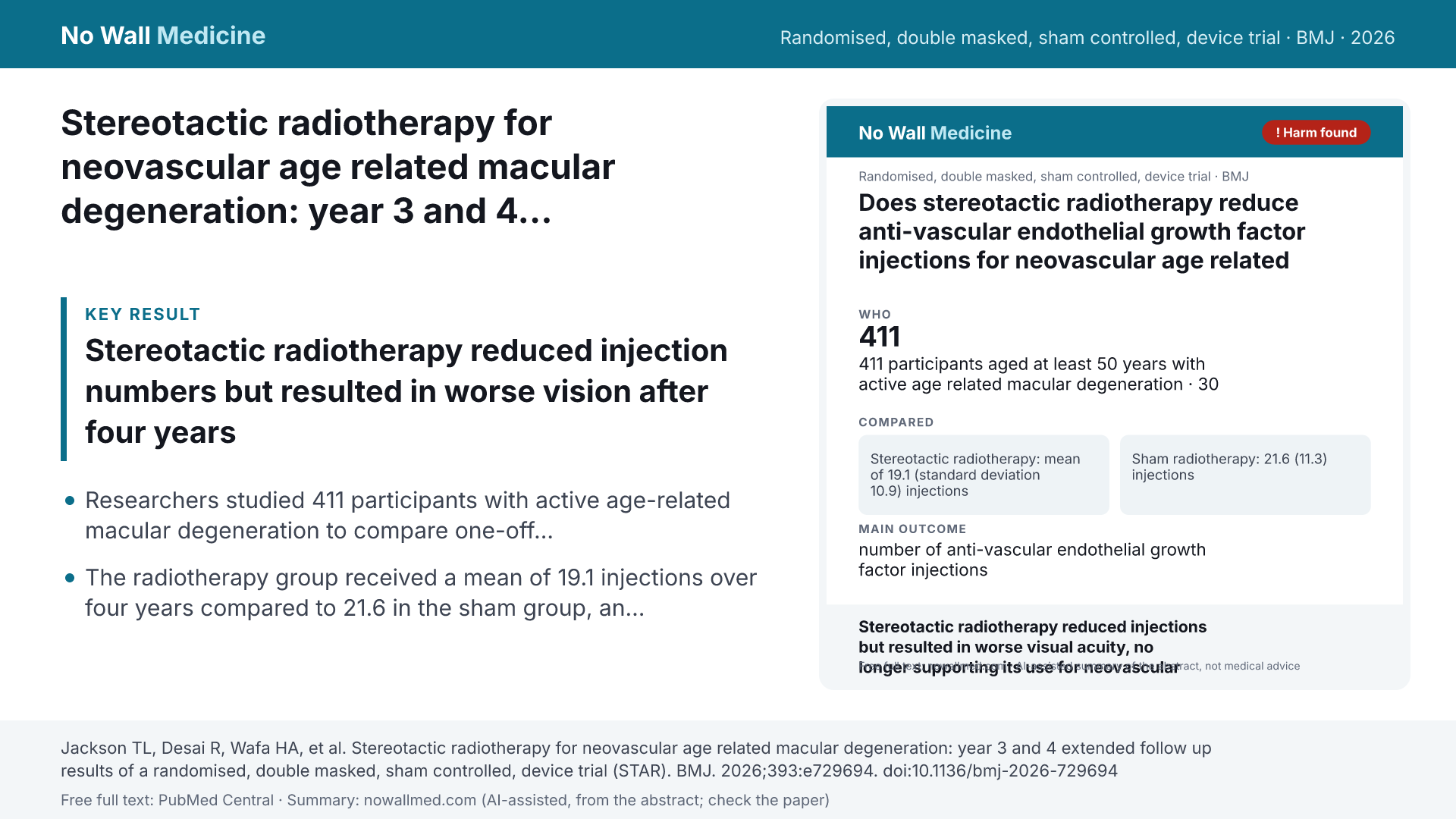
Stereotactic radiotherapy reduced injection numbers but resulted in worse vision after four years
Stereotactic radiotherapy for neovascular age related macular degeneration: year 3 and 4 extended follow up results of a randomised, double masked, sham controlled, device trial (STAR)
Randomised, double masked, sham controlled, device trialHarm found
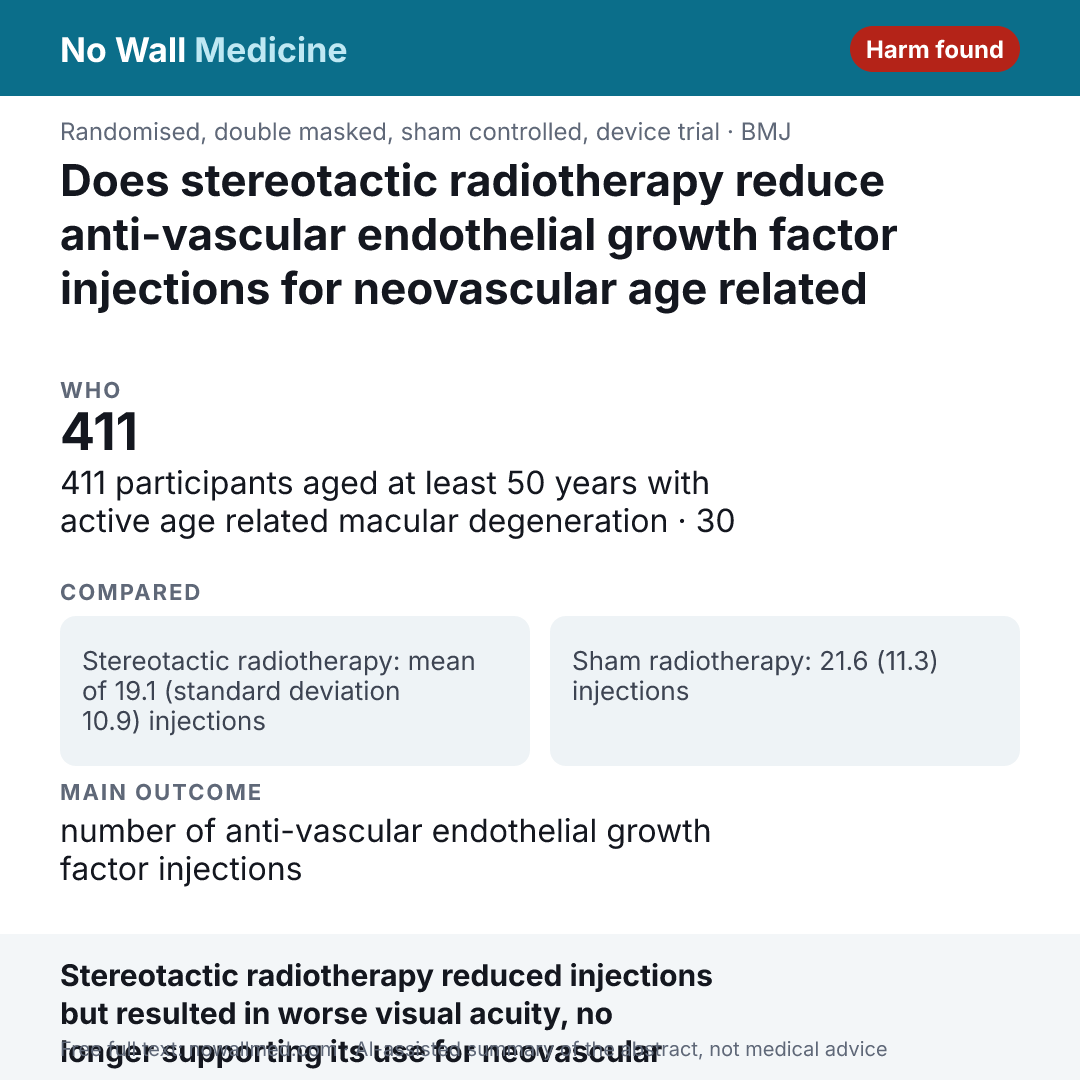
Does stereotactic radiotherapy reduce anti-vascular endothelial growth factor injections for neovascular age related macular degeneration?
Who
411
411 participants aged at least 50 years with active age related macular degeneration · 30 NHS hospitals in the UK
Compared
Stereotactic radiotherapy: mean of 19.1 (standard deviation 10.9) injections
Sham radiotherapy: 21.6 (11.3) injections
Main outcome
number of anti-vascular endothelial growth factor injections
Result: adjusted decrease of 3.2 injections (95% CI of difference -5.7 to -0.7)
Bottom line: Stereotactic radiotherapy reduced injections but resulted in worse visual acuity, no longer supporting its use for neovascular age related macular degeneration.
BMJ · 2026-06-18 · Save PNG
Same trial (NCT02243878)
Papers we list that report this registered trial, oldest first. Read a secondary analysis alongside the main results.
- Main results Benefit found
Stereotactic radiotherapy reduced the number of injections needed for neovascular age-related macular degeneration Lancet 2024-06 - Longer follow-up Harm found
This paper BMJ 2026-06
Clinical question: Does stereotactic radiotherapy reduce anti-vascular endothelial growth factor injections for neovascular age related macular degeneration?
Key points
- Researchers studied 411 participants with active age-related macular degeneration to compare one-off stereotactic radiotherapy against a sham treatment.
- The radiotherapy group received a mean of 19.1 injections over four years compared to 21.6 in the sham group, an adjusted decrease of 3.2 injections.
- Visual acuity in the radiotherapy group was 8.3 letters worse than the sham group, and microvascular abnormalities occurred in 58% of treated eyes.
Headline and key points written with AI from the paper’s abstract, with every number checked against it. Read the paper before relying on them.
Was this summary helpful?
Abstract
Objective
To assess the effects of stereotactic radiotherapy (SRT) for neovascular age related macular degeneration (AMD) beyond the two year primary outcome of the StereoTactic radiotherapy for wet Age-Related macular degeneration (STAR) trial. Design
Randomised, double masked, sham controlled, device trial involving preplanned recall from standard care. Setting
30 NHS hospitals in the UK. Participants
411 participants aged at least 50 years with chronic, pretreated, active AMD. Intervention
Participants received one-off 16 Gray SRT or sham SRT delivered using a robotically controlled device. After two years of monthly study visits, participants reverted to routine care, with anti-VEGF drug selection and dosing intervals based on local practice, but with masking maintained, and repeat data collection at years 3 and 4 study visits. Main outcome measures
The main efficacy outcome at year 4 was the number of anti-VEGF injections, tested for superiority (fewer injections). The other main outcome was visual acuity, tested for non-inferiority (five letter margin). Safety outcomes included adverse events, serious adverse events, and microvascular abnormalities. The same analyses were undertaken at years 2, 3, and 4. A within trial costing analysis was undertaken for participants with four years' follow-up. Results
Of 411 participants (204 (58%) women), 274 were allocated to SRT and 137 to sham SRT. The year 4 intention-to-treat efficacy analysis included 222 (81%) participants in the SRT group and 106 (77%) in the sham SRT group. The SRT group received a mean of 19.1 (standard deviation 10.9) injections over four years versus 21.6 (11.3) with sham SRT, an adjusted decrease of 3.2 injections (95% confidence interval (CI) of difference -5.7 to -0.7). During years 3 and 4, the SRT group received a mean cumulative 8.4 injections versus 8.3 injections in the sham SRT group. The final change in visual acuity in the SRT group was 8.3 letters worse than in the sham group (95% CI of difference -12.7 to -4.0). Adverse event rates were similar between groups, but reading centre-detected microvascular abnormalities occurred in 126/218 SRT treated eyes (58%) and 16/102 (16%) sham SRT treated eyes. Conclusion
Although the overall reduction in intravitreal therapy was maintained to year 4, the inferior vision in SRT treated eyes effectively reversed the conclusions of the year 2 primary outcome analysis and no longer supports the use of SRT to treat neovascular AMD. Including standard care, masked, extended follow-up within a clinical trial may provide useful clinical insight. Trial registration
ClinicalTrials.gov NCT02243878.
Abstract reproduced under the article’s CC BY licence.
Subject terms
Headline, design, result, key points, caveat and citation as plain text.
Cite this article
Jackson TL, Desai R, Wafa HA, et al. Stereotactic radiotherapy for neovascular age related macular degeneration: year 3 and 4 extended follow up results of a randomised, double masked, sham controlled, device trial (STAR). BMJ. 2026;393:e729694. doi:10.1136/bmj-2026-729694
Spotted a mistake? Suggest a correction