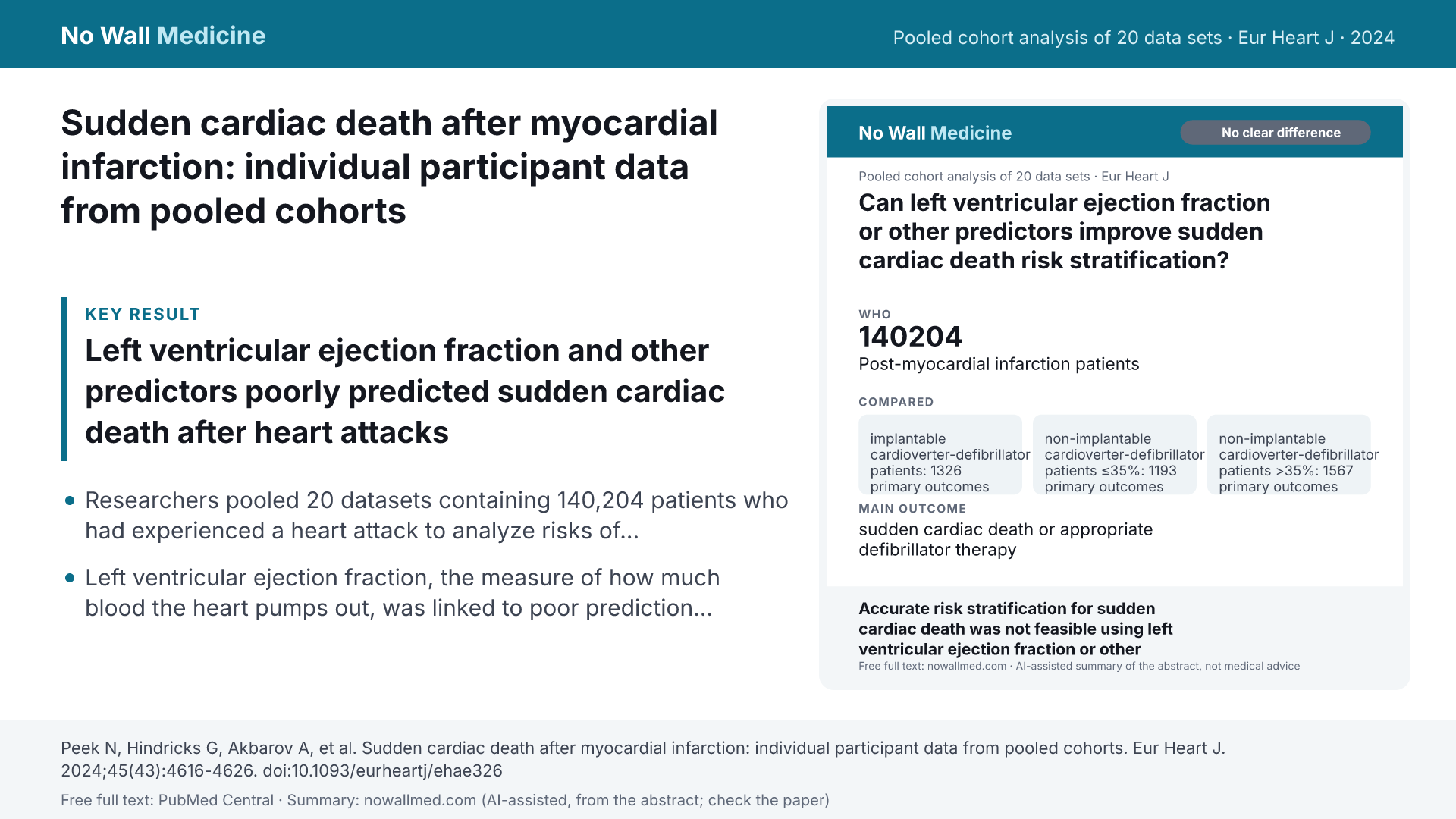
Left ventricular ejection fraction and other predictors poorly predicted sudden cardiac death after heart attacks
Sudden cardiac death after myocardial infarction: individual participant data from pooled cohorts
Pooled cohort analysis of 20 data setsNo clear difference
Can left ventricular ejection fraction or other predictors improve sudden cardiac death risk stratification?
Who
140204
Post-myocardial infarction patients
Compared
implantable cardioverter-defibrillator patients: 1326 primary outcomes
non-implantable cardioverter-defibrillator patients ≤35%: 1193 primary outcomes
non-implantable cardioverter-defibrillator patients >35%: 1567 primary outcomes
Main outcome
sudden cardiac death or appropriate defibrillator therapy
Result: c-statistics between 0.50 and 0.56
Bottom line: Accurate risk stratification for sudden cardiac death was not feasible using left ventricular ejection fraction or other predictors.
Limitation: Model generalizability was poor.
Eur Heart J · 2024-10-08 · Save PNG
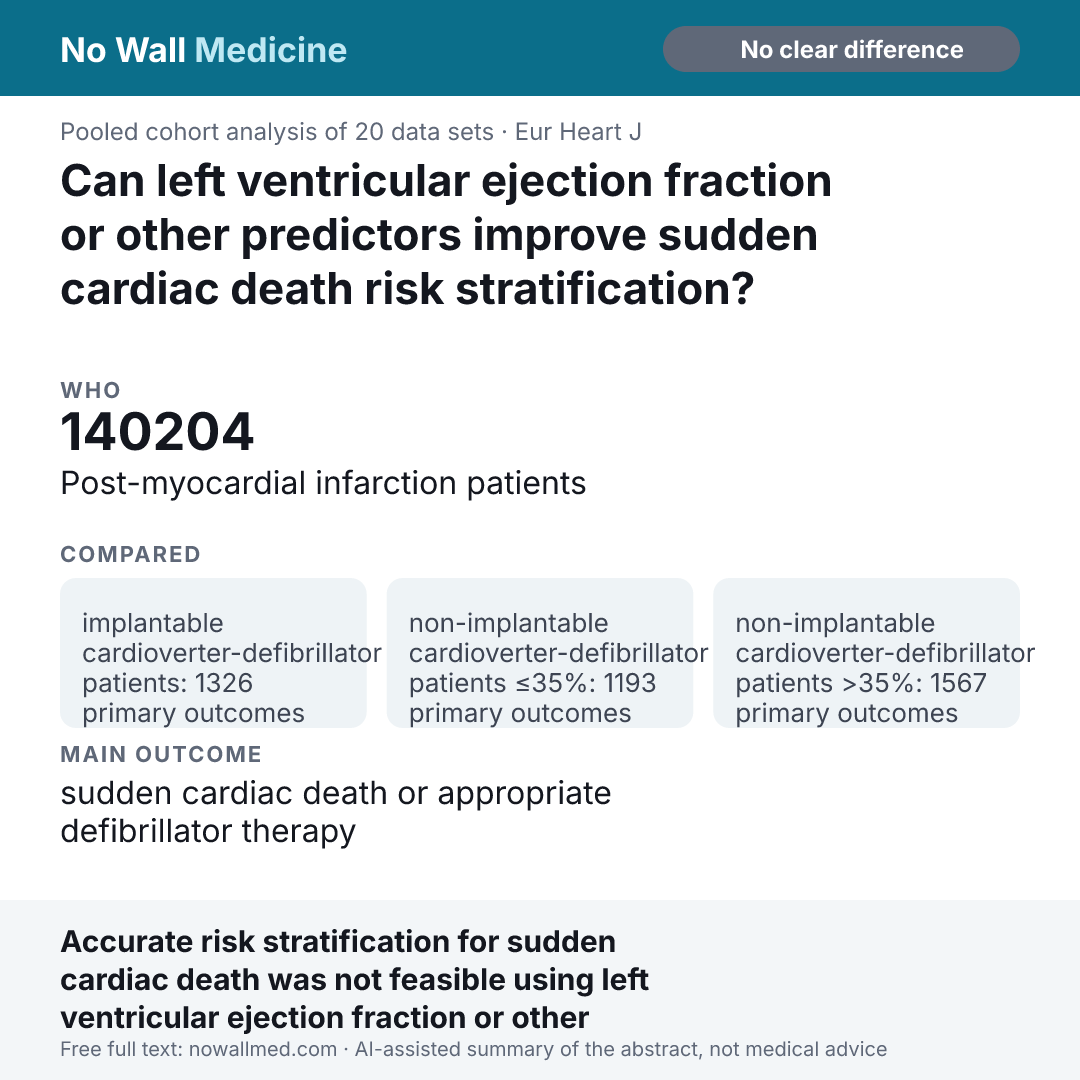
Clinical question: Can left ventricular ejection fraction or other predictors improve sudden cardiac death risk stratification?
Why it matters: Current guidelines for implanting a cardioverter-defibrillator rely on left ventricular ejection fraction, but it is unknown if this measure or other predictors can accurately identify individual risk.
Key points
- Researchers pooled 20 datasets containing 140,204 patients who had experienced a heart attack to analyze risks of sudden cardiac death.
- Left ventricular ejection fraction, the measure of how much blood the heart pumps out, was linked to poor prediction of sudden cardiac death with c-statistics between 0.50 and 0.56.
- Adding other clinical parameters did not improve the ability of models to accurately predict outcomes or generalize to different groups.
Headline and key points written with AI from the paper’s abstract, with every number checked against it. Read the paper before relying on them.
Was this summary helpful?
Subject terms
Headline, design, result, key points, caveat and citation as plain text.
Cite this article
Peek N, Hindricks G, Akbarov A, et al. Sudden cardiac death after myocardial infarction: individual participant data from pooled cohorts. Eur Heart J. 2024;45(43):4616-4626. doi:10.1093/eurheartj/ehae326
Spotted a mistake? Suggest a correction