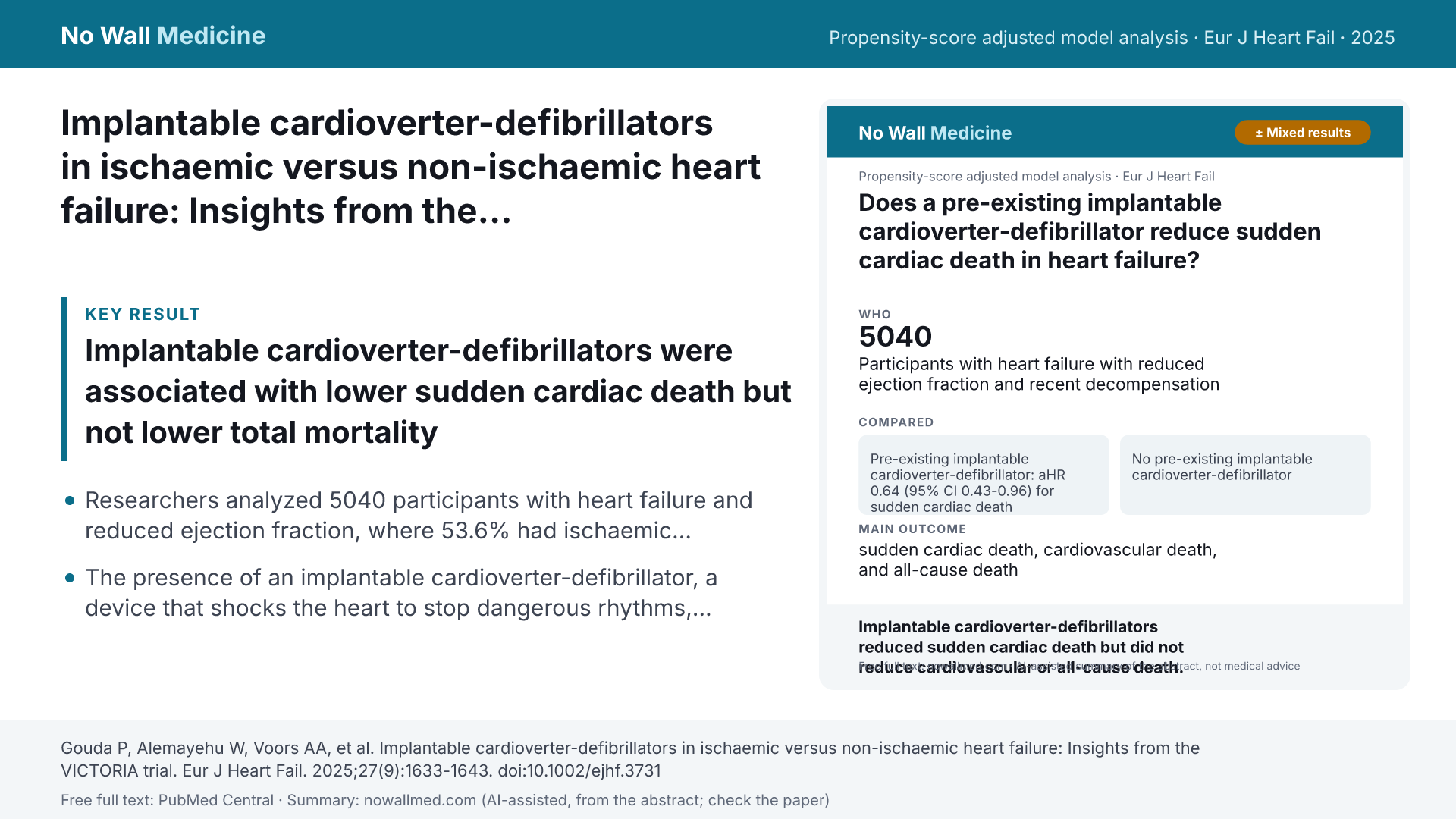
Implantable cardioverter-defibrillators were associated with lower sudden cardiac death but not lower total mortality
Implantable cardioverter-defibrillators in ischaemic versus non-ischaemic heart failure: Insights from the VICTORIA trial
Propensity-score adjusted model analysisMixed results
Does a pre-existing implantable cardioverter-defibrillator reduce sudden cardiac death in heart failure?
Who
5040
Participants with heart failure with reduced ejection fraction and recent decompensation
Compared
Pre-existing implantable cardioverter-defibrillator: aHR 0.64 (95% CI 0.43-0.96) for sudden cardiac death
No pre-existing implantable cardioverter-defibrillator
Main outcome
sudden cardiac death, cardiovascular death, and all-cause death
Result: adjusted hazard ratio 0.64 (95% CI 0.43-0.96) for sudden cardiac death
Bottom line: Implantable cardioverter-defibrillators reduced sudden cardiac death but did not reduce cardiovascular or all-cause death.
Limitation: Future research is required to evaluate which patients benefit from implantation.
Eur J Heart Fail · 2025-06-20Download image
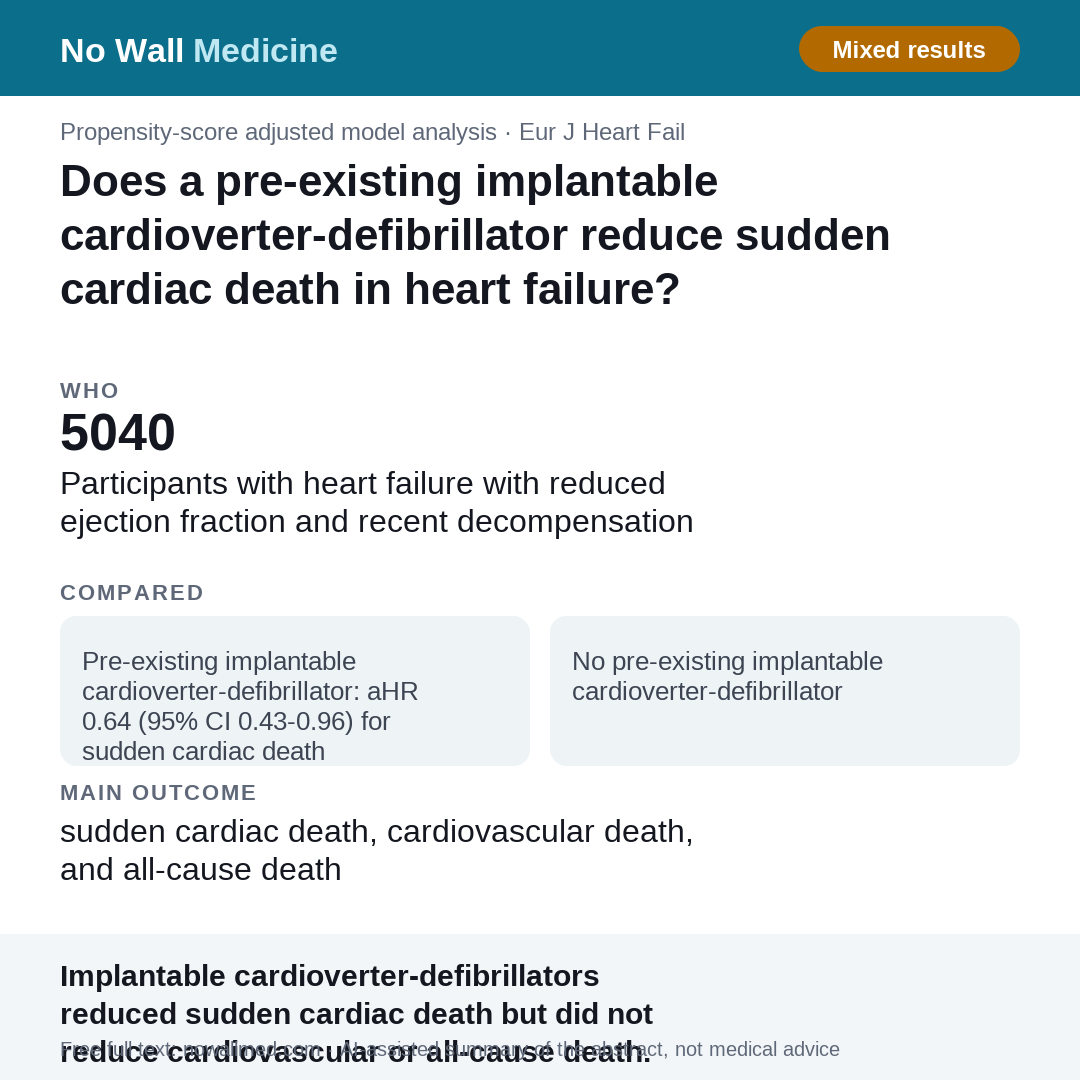
Clinical question: Does a pre-existing implantable cardioverter-defibrillator reduce sudden cardiac death in heart failure?
Why it matters: The magnitude of benefit from implantable cardioverter-defibrillator therapy remains unclear in individuals with a non-ischaemic cause of heart failure.
Key points
- Researchers analyzed 5040 participants with heart failure and reduced ejection fraction, where 53.6% had ischaemic heart disease and 46.4% had non-ischaemic heart disease.
- The presence of an implantable cardioverter-defibrillator, a device that shocks the heart to stop dangerous rhythms, was associated with a lower risk of sudden cardiac death (aHR 0.64).
- The device was not associated with a difference in cardiovascular death (aHR 0.99) or all-cause death (aHR 1.02) over a median of 10.8 months.
Headline and key points written with AI from the paper’s abstract, with every number checked against it. Read the paper before relying on them.
Was this summary helpful?
Subject terms
Headline, design, result, key points, caveat and citation as plain text.
Cite this article
Gouda P, Alemayehu W, Voors AA, et al. Implantable cardioverter-defibrillators in ischaemic versus non-ischaemic heart failure: Insights from the VICTORIA trial. Eur J Heart Fail. 2025. doi:10.1002/ejhf.3731
Spotted a mistake? Suggest a correction