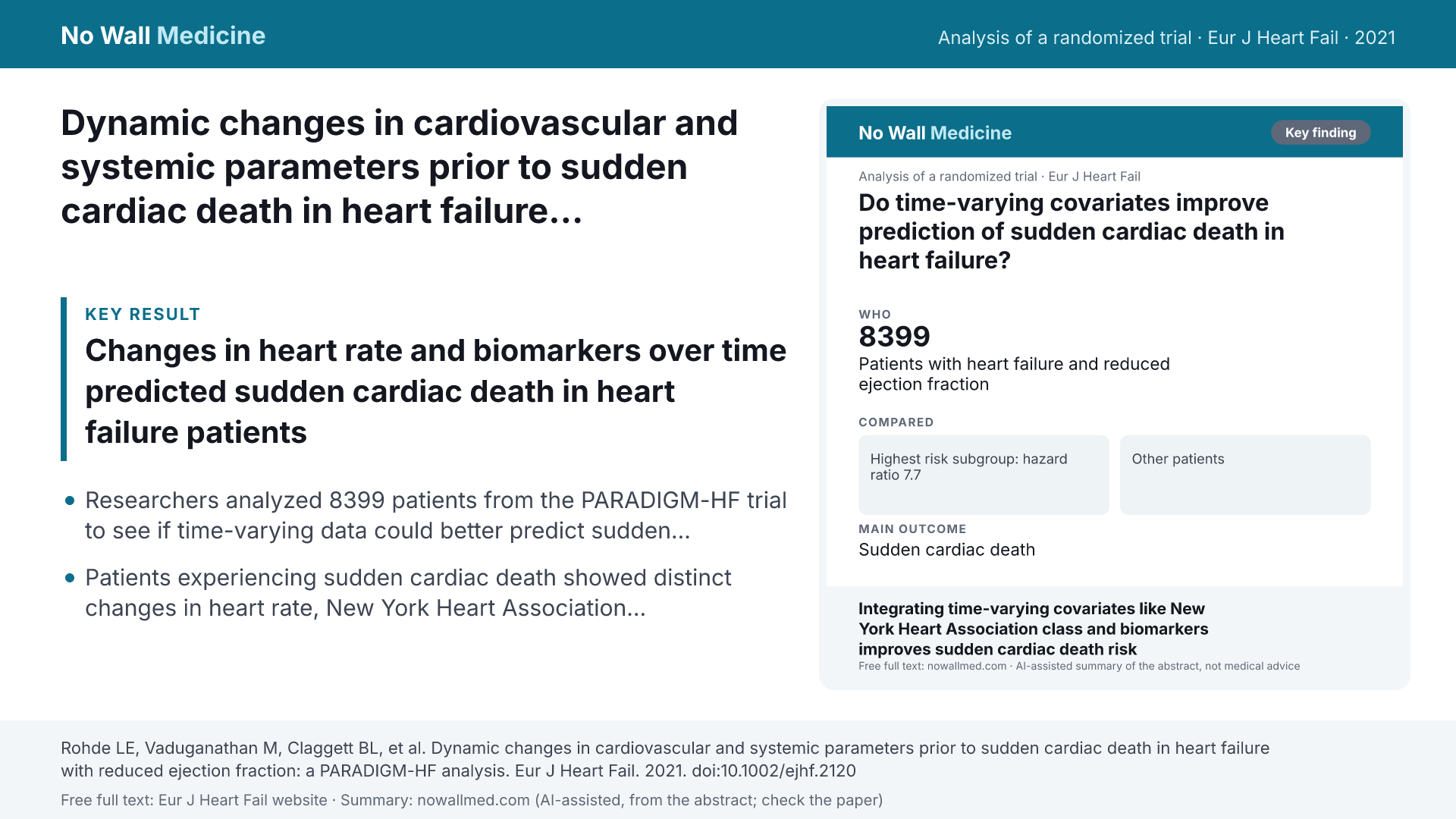
Changes in heart rate and biomarkers over time predicted sudden cardiac death in heart failure patients
Dynamic changes in cardiovascular and systemic parameters prior to sudden cardiac death in heart failure with reduced ejection fraction: a PARADIGM-HF analysis
Analysis of a randomized trialKey finding
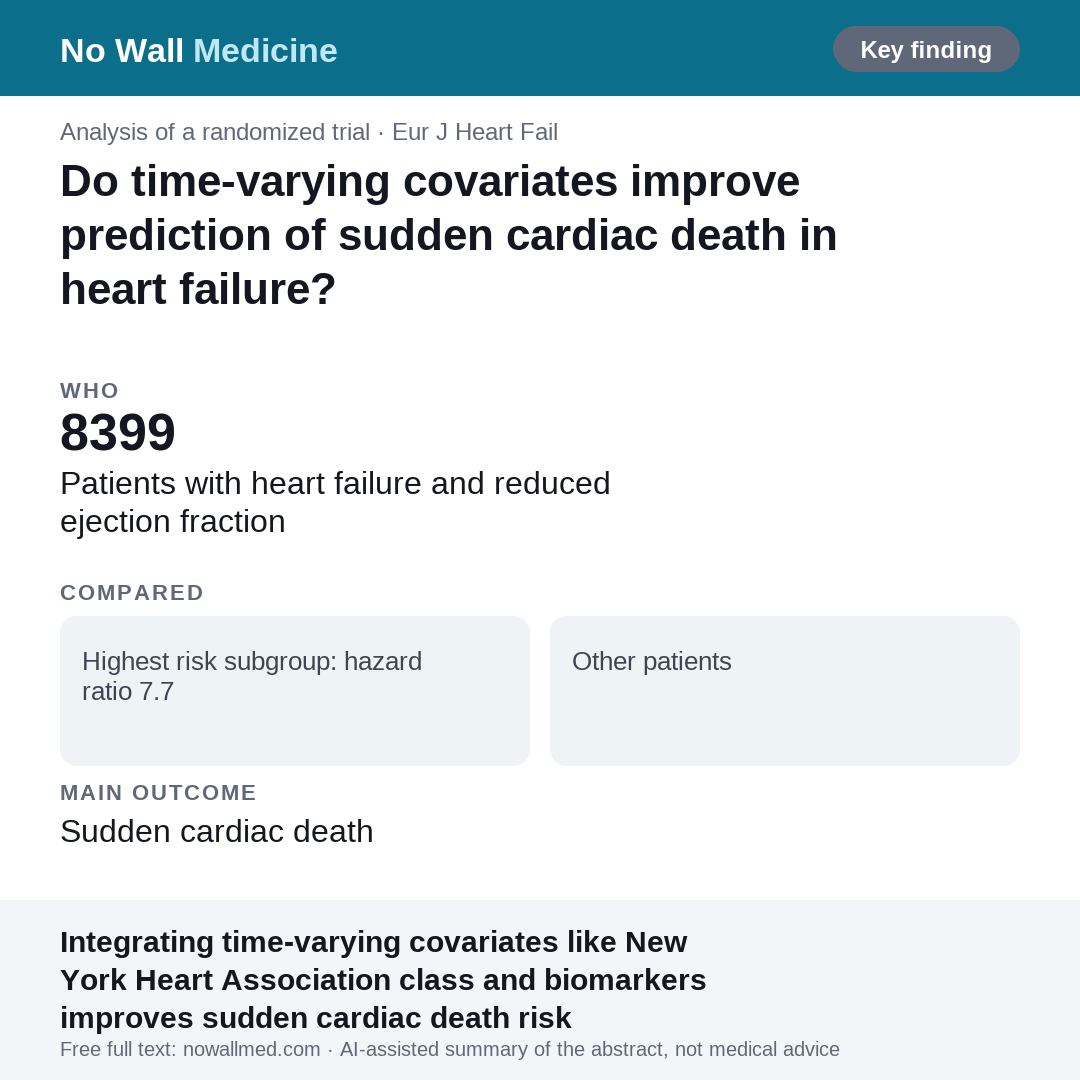
Do time-varying covariates improve prediction of sudden cardiac death in heart failure?
Who
8399
Patients with heart failure and reduced ejection fraction
Compared
Highest risk subgroup: hazard ratio 7.7
Other patients
Main outcome
Sudden cardiac death
Result: hazard ratio 7.7 (95% confidence interval 3.6-16.5)
Bottom line: Integrating time-varying covariates like New York Heart Association class and biomarkers improves sudden cardiac death risk prediction.
Eur J Heart Fail · 2021-03-09Download image
Clinical question: Do time-varying covariates improve prediction of sudden cardiac death in heart failure?
Why it matters: Prognostic models for sudden cardiac death typically use data from only a single time-point rather than tracking how health markers change over time.
Key points
- Researchers analyzed 8399 patients from the PARADIGM-HF trial to see if time-varying data could better predict sudden cardiac death, which accounted for 561 deaths.
- Patients experiencing sudden cardiac death showed distinct changes in heart rate, New York Heart Association functional class, albumin, uric acid, and total bilirubin levels more than 1 year before the event.
- A high-risk subgroup identified by classification and regression tree analysis showed a hazard ratio of 7.7 for sudden cardiac death.
Headline and key points written with AI from the paper’s abstract, with every number checked against it. Read the paper before relying on them.
Was this summary helpful?
Subject terms
Cite this article
Rohde LE, Vaduganathan M, Claggett BL, et al. Dynamic changes in cardiovascular and systemic parameters prior to sudden cardiac death in heart failure with reduced ejection fraction: a PARADIGM-HF analysis. Eur J Heart Fail. 2021. doi:10.1002/ejhf.2120
Spotted a mistake? Suggest a correction