Systematic review and meta-analysis of artificial intelligence models for strabismus screening: methodological insights and future directions
Meta-analysis of 24 trialsBenefit found
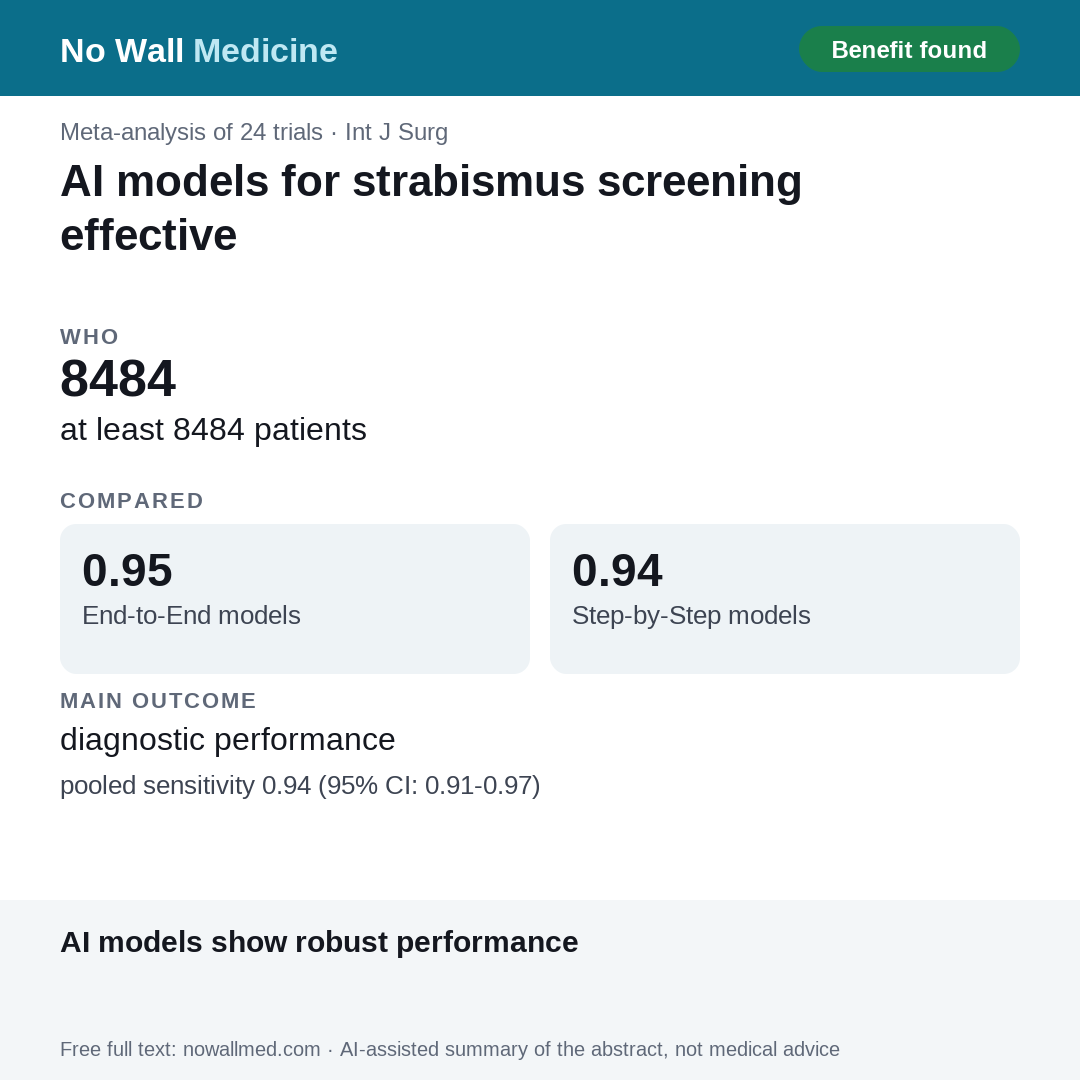
AI models for strabismus screening effective
Who
8484
at least 8484 patients
Compared
0.95End-to-End models (0.91-0.97)
0.94Step-by-Step models (0.85-0.97)
Main outcome
diagnostic performance
Result: pooled sensitivity 0.94 (95% CI: 0.91-0.97)
Bottom line: AI models show robust performance
Limitation: low risk of bias except index test
Int J Surg · 2025-07-15Download image
Abstract
Background
An increasing number of studies apply artificial intelligence (AI) techniques to strabismus detection to support clinical diagnosis. However, there is no quantitative synthesis of performance of these methods. This systematic review and meta-analysis evaluate the diagnostic performance of AI models for strabismus screening. Methods
We searched Ovid, Web of Science, PubMed, and Cochrane CENTRAL from inception to May 2025 for studies assessing AI-based strabismus screening. Eligible studies were analyzed using random-effects bivariate models. Subgroup analyses explored the influence of algorithmic architecture (End-to-End vs. Step-by-Step), validation type (internal vs. external), data augmentation, training sample size, and data modality (images, videos, eye-tracking data). Results
The 24 studies involving at least 8484 patients and 40 394 ocular measurements were included. AI models exhibited strong diagnostic performance, with a pooled sensitivity of 0.94 (95% CI: 0.91-0.97) and specificity of 0.94 (95% CI: 0.91-0.96). End-to-End models (14 studies) had comparable summary sensitivity [0.95 (0.91-0.97) vs. 0.94 (0.85-0.97); P = 0.694] and specificity [0.94 (0.91-0.97 vs. 0.93 (0.85-0.97); P = 0.627] than Step-by-Step models (10 studies). Subgroup analyses indicated that, for End-to-End models, image-based studies outperformed video-based studies, with higher sensitivity (0.96 vs. 0.85, P = 0.04) and specificity (0.95 vs. 0.91, P = 0.10). Larger training datasets and data augmentation enhanced performance, though differences were not statistically significant. Most studies demonstrated low risk of bias and applicability concerns across QUADAS-2 domains, except for the index test domain. Conclusion
AI models exhibit robust performance in strabismus screening, with End-to-End models demonstrating greater consistency. Future research should focus on integrating multimodal data and including diverse populations to enhance the precision and clinical utility of AI-driven strabismus diagnosis.
Subject terms
Cite this article
Yang Z, Wu D, Li J, Chen X, Liu L. Systematic review and meta-analysis of artificial intelligence models for strabismus screening: methodological insights and future directions. Int J Surg. 2025. doi:10.1097/JS9.0000000000002916
Spotted a mistake? Suggest a correction
Top studies every Monday
The week’s key trials and guidelines in your specialties, plus any topics you follow. By email, free.
Get the weekly digest