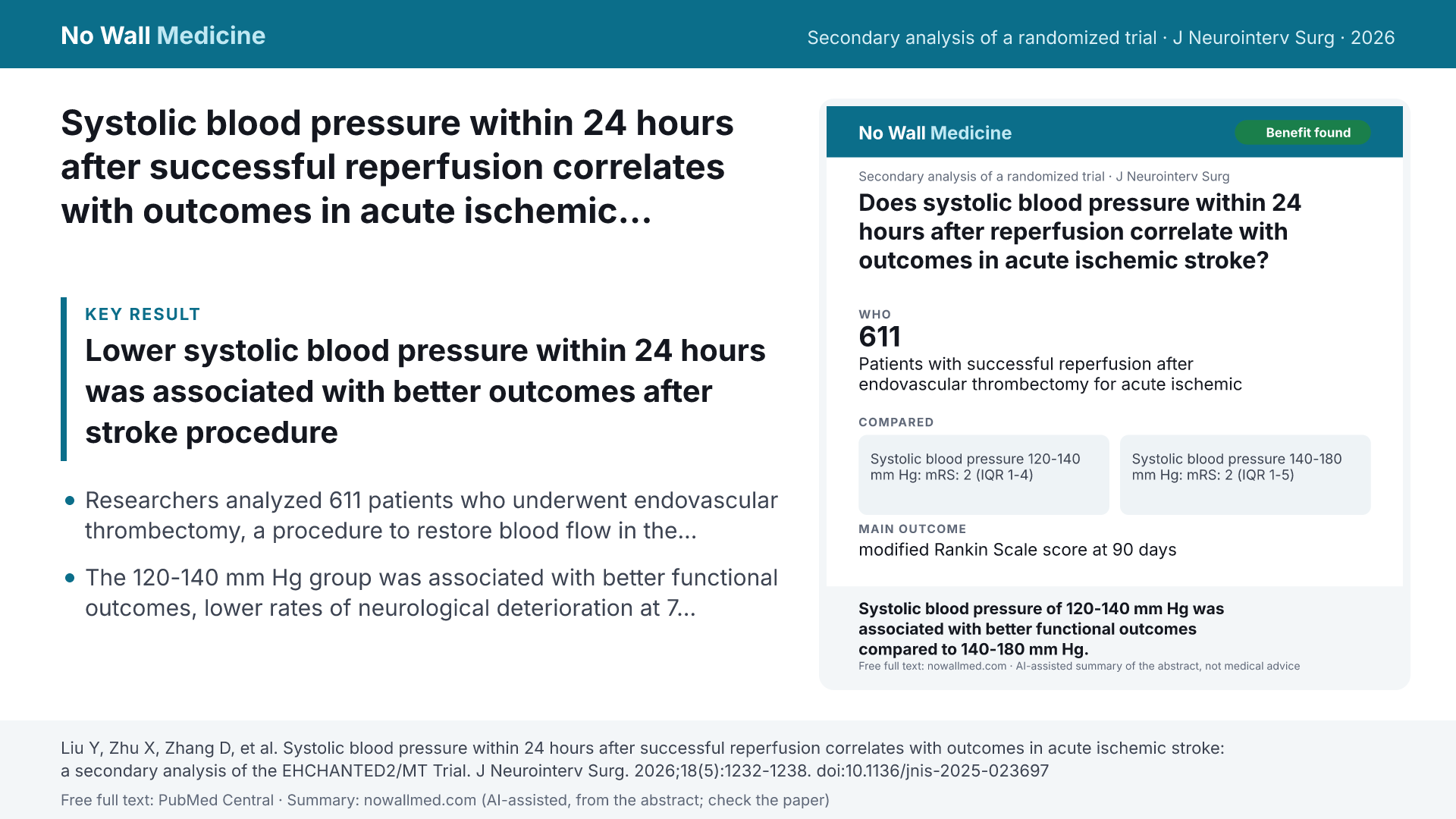
Lower systolic blood pressure within 24 hours was associated with better outcomes after stroke procedure
Systolic blood pressure within 24 hours after successful reperfusion correlates with outcomes in acute ischemic stroke: a secondary analysis of the EHCHANTED2/MT Trial
Secondary analysis of a randomized trialBenefit found
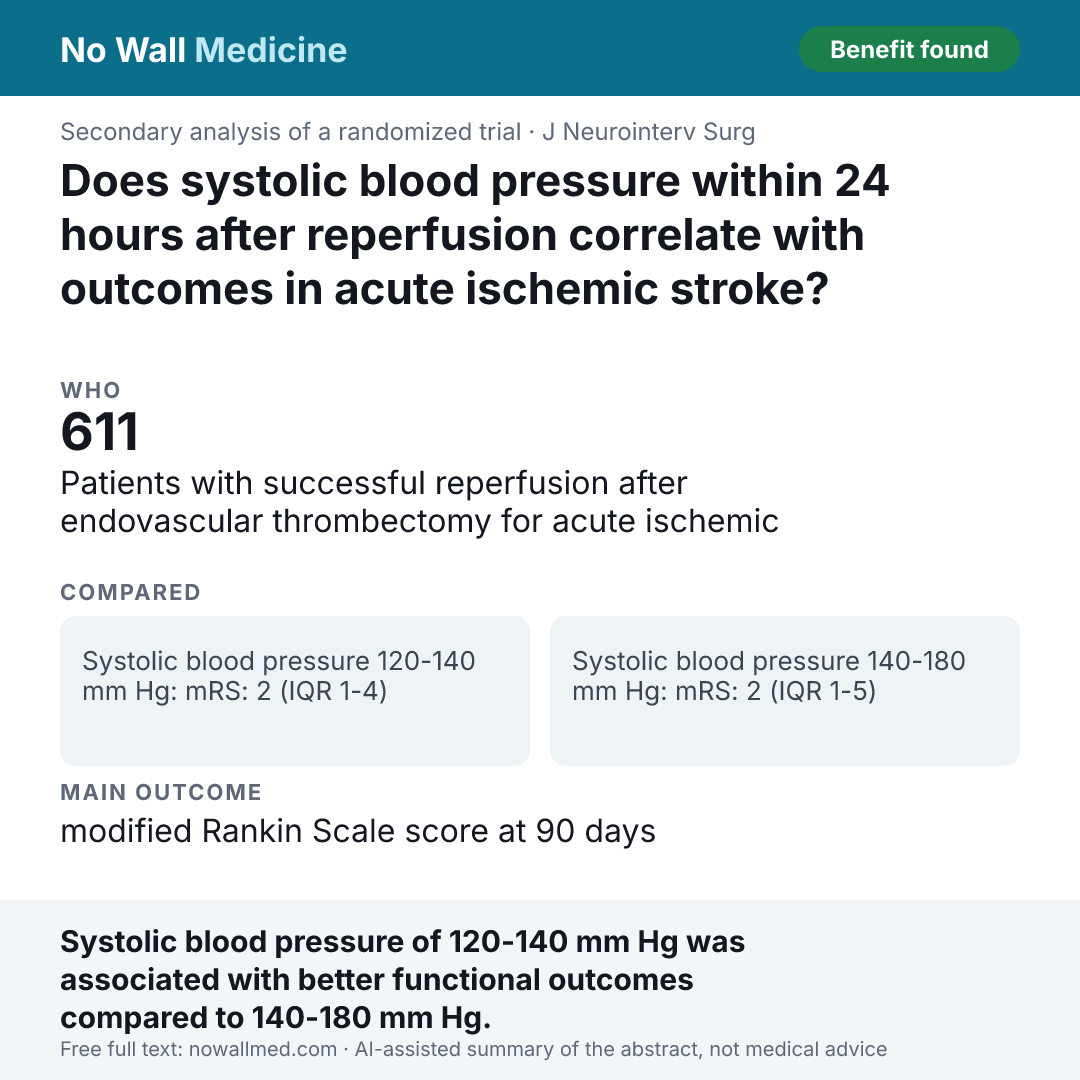
Does systolic blood pressure within 24 hours after reperfusion correlate with outcomes in acute ischemic stroke?
Who
611
Patients with successful reperfusion after endovascular thrombectomy for acute ischemic stroke
Compared
Systolic blood pressure 120-140 mm Hg: mRS: 2 (IQR 1-4)
Systolic blood pressure 140-180 mm Hg: mRS: 2 (IQR 1-5)
Main outcome
modified Rankin Scale score at 90 days
Result: adjusted OR 1.54 (95% CI 1.10 to 2.17)
Bottom line: Systolic blood pressure of 120-140 mm Hg was associated with better functional outcomes compared to 140-180 mm Hg.
J Neurointerv Surg · 2026-04-16 · Save PNG
Clinical question: Does systolic blood pressure within 24 hours after reperfusion correlate with outcomes in acute ischemic stroke?
Why it matters: The optimal threshold or range for controlling systolic blood pressure after successful reperfusion in acute ischemic stroke patients remains undefined.
Key points
- Researchers analyzed 611 patients who underwent endovascular thrombectomy, a procedure to restore blood flow in the brain, comparing those with systolic blood pressure between 120-140 mm Hg and 140-180 mm Hg.
- The 120-140 mm Hg group was associated with better functional outcomes, lower rates of neurological deterioration at 7 days, and lower 90-day mortality of 13.0% compared to 21.4% in the higher group.
- No significant differences were found between the two groups regarding major disability at 90 days, length of hospital stay, or intracranial hemorrhage, which is bleeding inside the skull.
Headline and key points written with AI from the paper’s abstract, with every number checked against it. Read the paper before relying on them.
Was this summary helpful?
Abstract
Background
The optimal threshold or range for systolic blood pressure (SBP) control in patients with successful reperfusion after endovascular thrombectomy for acute ischemic stroke (AIS) remains undefined. This study investigated whether SBP within the first 24 hours after successful reperfusion correlates with functional outcomes in AIS. Methods
In this secondary analysis of the ENCHANTED2/MT trial, patients were categorized into two groups (120-140 mm Hg and 140-180 mm Hg, respectively) based on achieved SBP within 24 hours after randomization. The primary outcome was the modified Rankin Scale (mRS) score at 90 days. Secondary outcomes included neurological deterioration at 7 days, major disability (mRS score of 3-5 at 90 days), hospitalization duration, and health-related quality of life assessed by the three-level EuroQoL 5-Dimension Self-Report Questionnaire (EQ-5D-3L) at 90 days. Safety outcomes included early neurological decline (END), 90-day mortality, symptomatic intracranial hemorrhage (sICH), and any intracranial hemorrhage (ICH). Treatment effects were expressed as ORs with 95% confidence intervals (CIs). Results
A total of 611 patients (363 in the 120-140 mm Hg group and 248 in the 140-180 mm Hg group) were included. The mean (SD) age was 67 (12) years and 37.8% were female. After adjusting for confounders, the 120-140 mm Hg group was significantly associated with better functional outcomes (mRS: 2 (IQR 1-4) vs 2 (IQR 1-5); adjusted OR 1.54 (95% CI 1.10 to 2.17), P=0.013). Compared with the 140-180 mm Hg group, the 120-140 mm Hg group had lower rates of neurological deterioration at 7 days (adjusted OR 0.68 (95% CI 0.47 to 0.98), P=0.037) and 90-day mortality (47 (13.0%) vs 53 (21.4%); adjusted OR 0.48 (95% CI 0.27 to 0.86), P=0.013). There were no significant differences between groups in END, major disability at 90 days, hospitalization duration, EQ-5D-3L score, sICH, or ICH (all P>0.05). Conclusions
In patients with successful reperfusion after endovascular thrombectomy, an average SBP within 24 hours of 120-140 mm Hg was associated with a greater likelihood of functional independence compared with 140-180 mm Hg.
Abstract reproduced under the article’s CC BY NC licence.
Subject terms
Headline, design, result, key points, caveat and citation as plain text.
Cite this article
Liu Y, Zhu X, Zhang D, et al. Systolic blood pressure within 24 hours after successful reperfusion correlates with outcomes in acute ischemic stroke: a secondary analysis of the EHCHANTED2/MT Trial. J Neurointerv Surg. 2026;18(5):1232-1238. doi:10.1136/jnis-2025-023697
Spotted a mistake? Suggest a correction