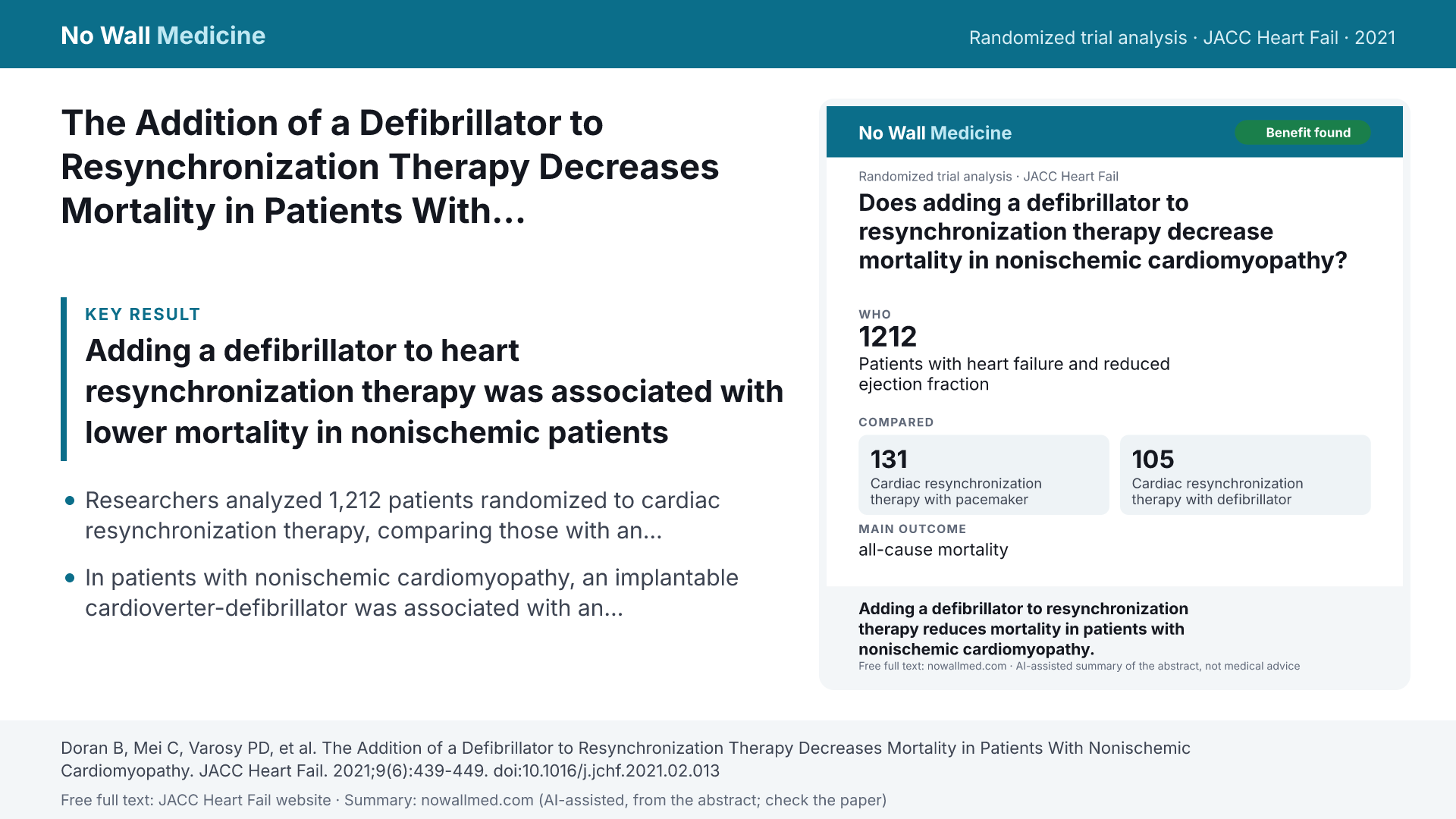
Adding a defibrillator to heart resynchronization therapy was associated with lower mortality in nonischemic patients
The Addition of a Defibrillator to Resynchronization Therapy Decreases Mortality in Patients With Nonischemic Cardiomyopathy
Randomized trial analysisBenefit found
Does adding a defibrillator to resynchronization therapy decrease mortality in nonischemic cardiomyopathy?
Who
1212
Patients with heart failure and reduced ejection fraction
Compared
131Cardiac resynchronization therapy with pacemaker
105Cardiac resynchronization therapy with defibrillator
Main outcome
all-cause mortality
Result: adjusted hazard ratio 0.54 (95% CI 0.34 to 0.86) for nonischemic cardiomyopathy
Bottom line: Adding a defibrillator to resynchronization therapy reduces mortality in patients with nonischemic cardiomyopathy.
JACC Heart Fail · 2021-05-12Download image
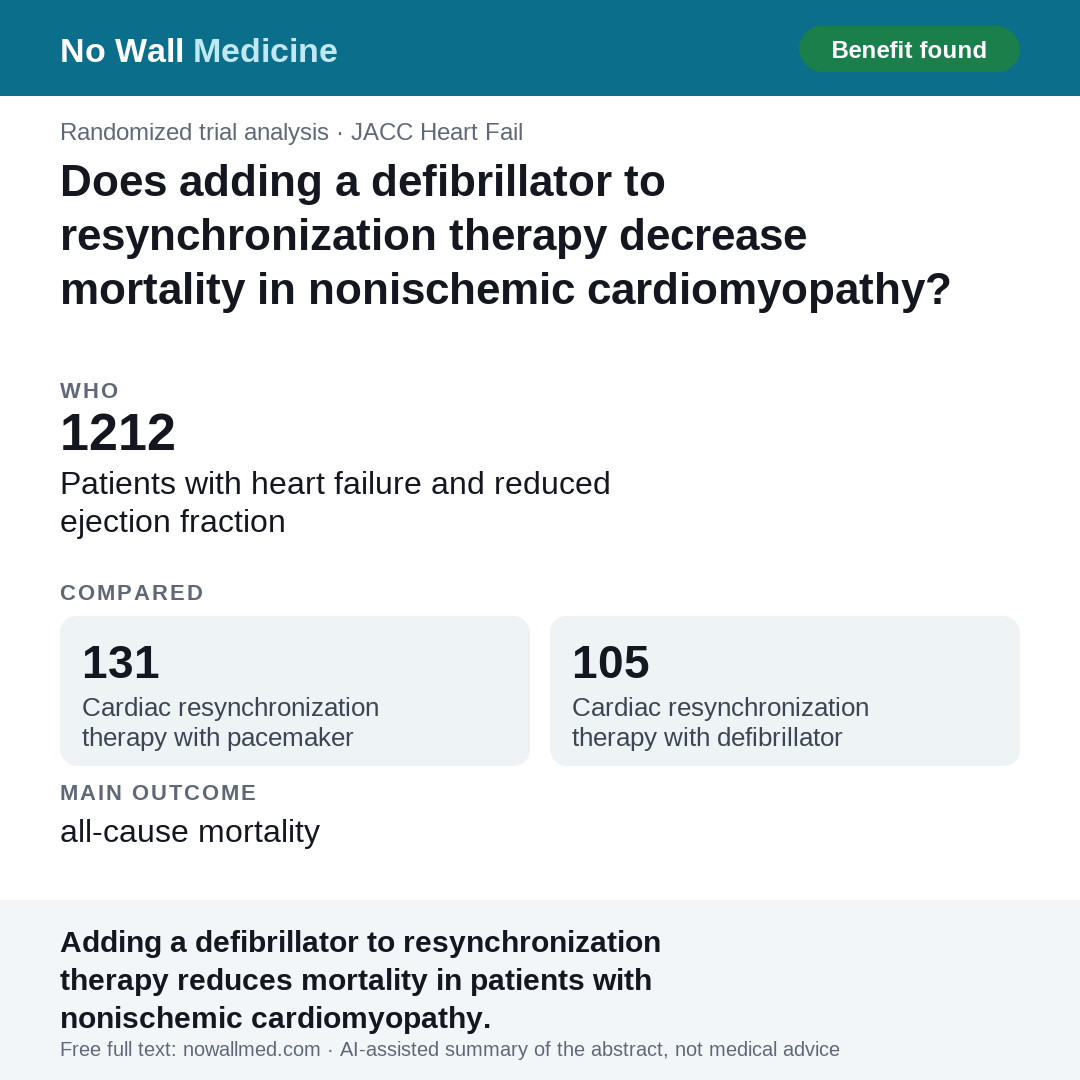
Clinical question: Does adding a defibrillator to resynchronization therapy decrease mortality in nonischemic cardiomyopathy?
Why it matters: It is uncertain if adding an implantable cardioverter-defibrillator to cardiac resynchronization therapy provides a survival benefit for patients with heart failure caused by nonischemic etiologies.
Key points
- Researchers analyzed 1,212 patients randomized to cardiac resynchronization therapy, comparing those with an implantable cardioverter-defibrillator to those with only a pacemaker.
- In patients with nonischemic cardiomyopathy, an implantable cardioverter-defibrillator was associated with an adjusted hazard ratio for all-cause mortality of 0.54.
- Patients with ischemic cardiomyopathy did not show a difference in all-cause mortality between the two device types, with an adjusted hazard ratio of 1.05.
Headline and key points written with AI from the paper’s abstract, with every number checked against it. Read the paper before relying on them.
Was this summary helpful?
Subject terms
Cite this article
Doran B, Mei C, Varosy PD, Kao DP, Saxon LA, Feldman AM. The Addition of a Defibrillator to Resynchronization Therapy Decreases Mortality in Patients With Nonischemic Cardiomyopathy. JACC Heart Fail. 2021. doi:10.1016/j.jchf.2021.02.013
Spotted a mistake? Suggest a correction