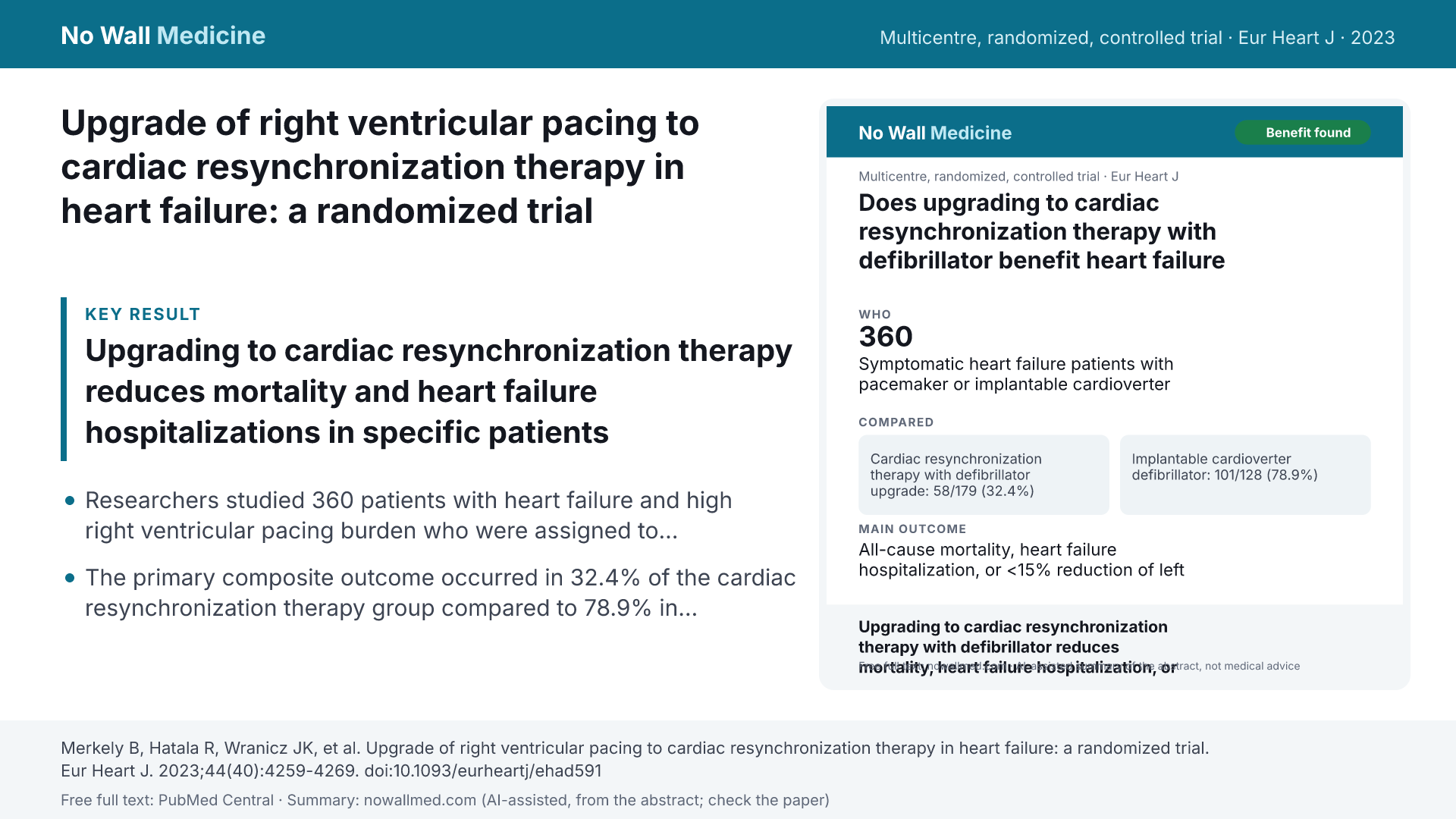
Upgrading to cardiac resynchronization therapy reduces mortality and heart failure hospitalizations in specific patients
Upgrade of right ventricular pacing to cardiac resynchronization therapy in heart failure: a randomized trial
Multicentre, randomized, controlled trialBenefit found
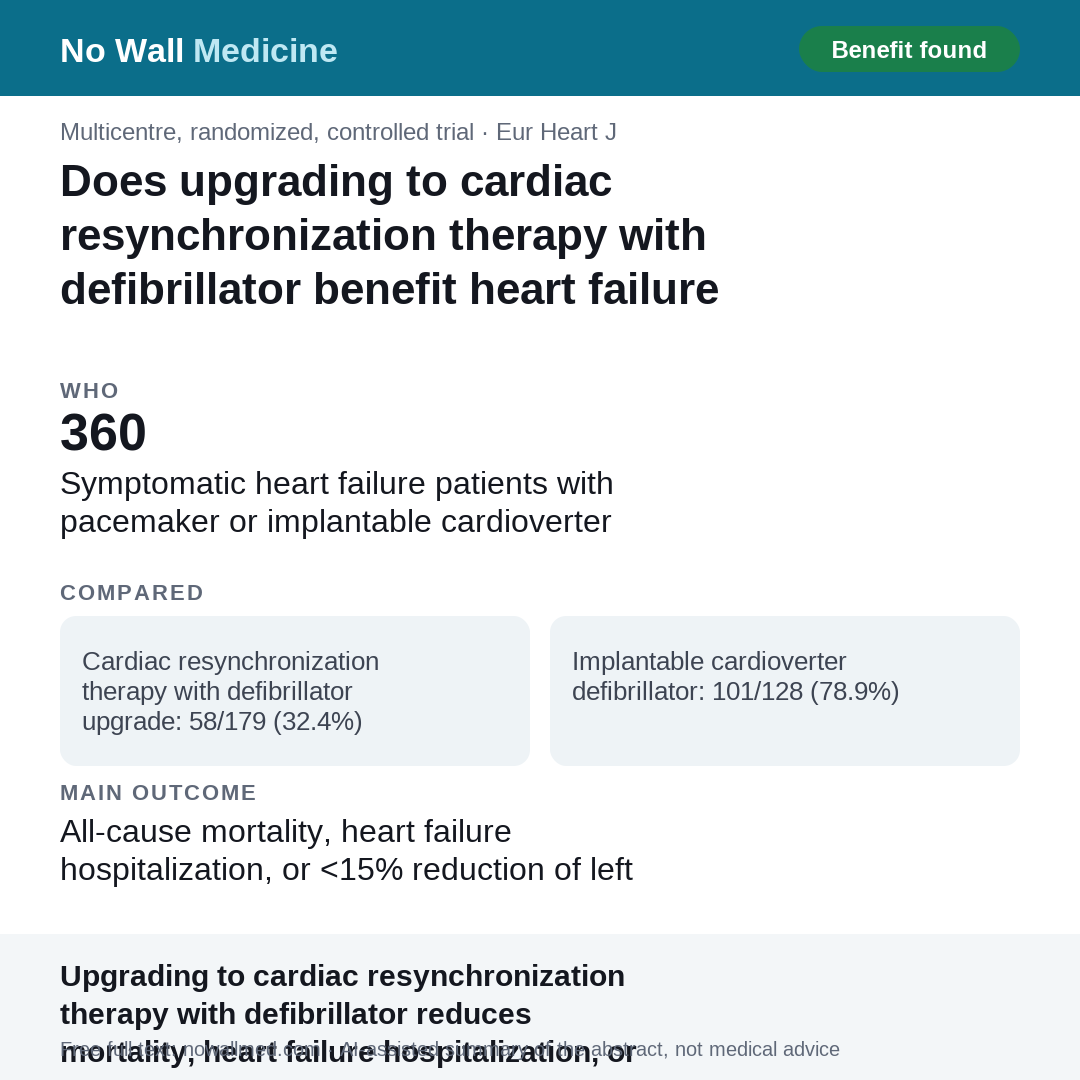
Does upgrading to cardiac resynchronization therapy with defibrillator benefit heart failure patients with high right ventricular pacing?
Who
360
Symptomatic heart failure patients with pacemaker or implantable cardioverter defibrillator and high right ventricular pacing · Multicentre
Compared
Cardiac resynchronization therapy with defibrillator upgrade: 58/179 (32.4%)
Implantable cardioverter defibrillator: 101/128 (78.9%)
Main outcome
All-cause mortality, heart failure hospitalization, or <15% reduction of left ventricular end-systolic volume
Result: odds ratio 0.11 (95% confidence interval 0.06-0.19)
Bottom line: Upgrading to cardiac resynchronization therapy with defibrillator reduces mortality, heart failure hospitalization, or lack of reverse remodeling.
Eur Heart J · 2023-08-27Download image
Clinical question: Does upgrading to cardiac resynchronization therapy with defibrillator benefit heart failure patients with high right ventricular pacing?
Why it matters: The efficacy of upgrading to cardiac resynchronization therapy with a defibrillator is uncertain for patients with heart failure who already have high right ventricular pacing burden.
Key points
- Researchers studied 360 patients with heart failure and high right ventricular pacing burden who were assigned to receive either cardiac resynchronization therapy with a defibrillator or an implantable cardioverter defibrillator.
- The primary composite outcome occurred in 32.4% of the cardiac resynchronization therapy group compared to 78.9% in the implantable cardioverter defibrillator group over a median of 12.4 months.
- All-cause mortality or heart failure hospitalization occurred in 10% of the cardiac resynchronization therapy group versus 32% in the implantable cardioverter defibrillator group.
Headline and key points written with AI from the paper’s abstract, with every number checked against it. Read the paper before relying on them.
Was this summary helpful?
Subject terms
Cite this article
Merkely B, Hatala R, Wranicz JK, et al. Upgrade of right ventricular pacing to cardiac resynchronization therapy in heart failure: a randomized trial. Eur Heart J. 2023. doi:10.1093/eurheartj/ehad591
Spotted a mistake? Suggest a correction