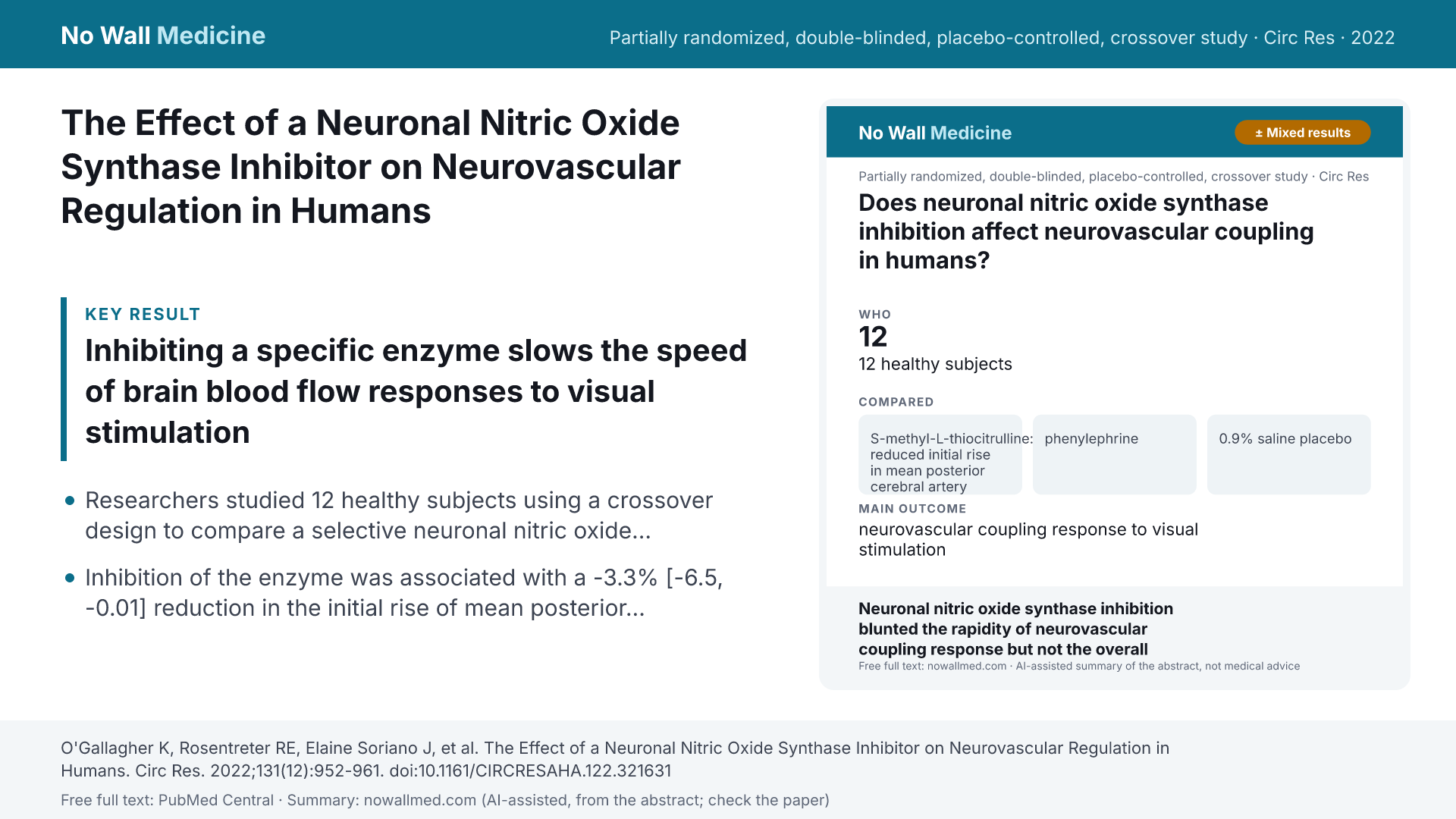
Inhibiting a specific enzyme slows the speed of brain blood flow responses to visual stimulation
The Effect of a Neuronal Nitric Oxide Synthase Inhibitor on Neurovascular Regulation in Humans
Partially randomized, double-blinded, placebo-controlled, crossover studyMixed results
Does neuronal nitric oxide synthase inhibition affect neurovascular coupling in humans?
Who
12
12 healthy subjects
Compared
S-methyl-L-thiocitrulline: reduced initial rise in mean posterior cerebral artery velocity -3.3% [-6.5, -0.01]
phenylephrine
0.9% saline placebo
Main outcome
neurovascular coupling response to visual stimulation
Result: slope reduced -4.3% [-8.5, -0.1]
Bottom line: Neuronal nitric oxide synthase inhibition blunted the rapidity of neurovascular coupling response but not the overall magnitude.
Circ Res · 2022-11-09 · Save PNG
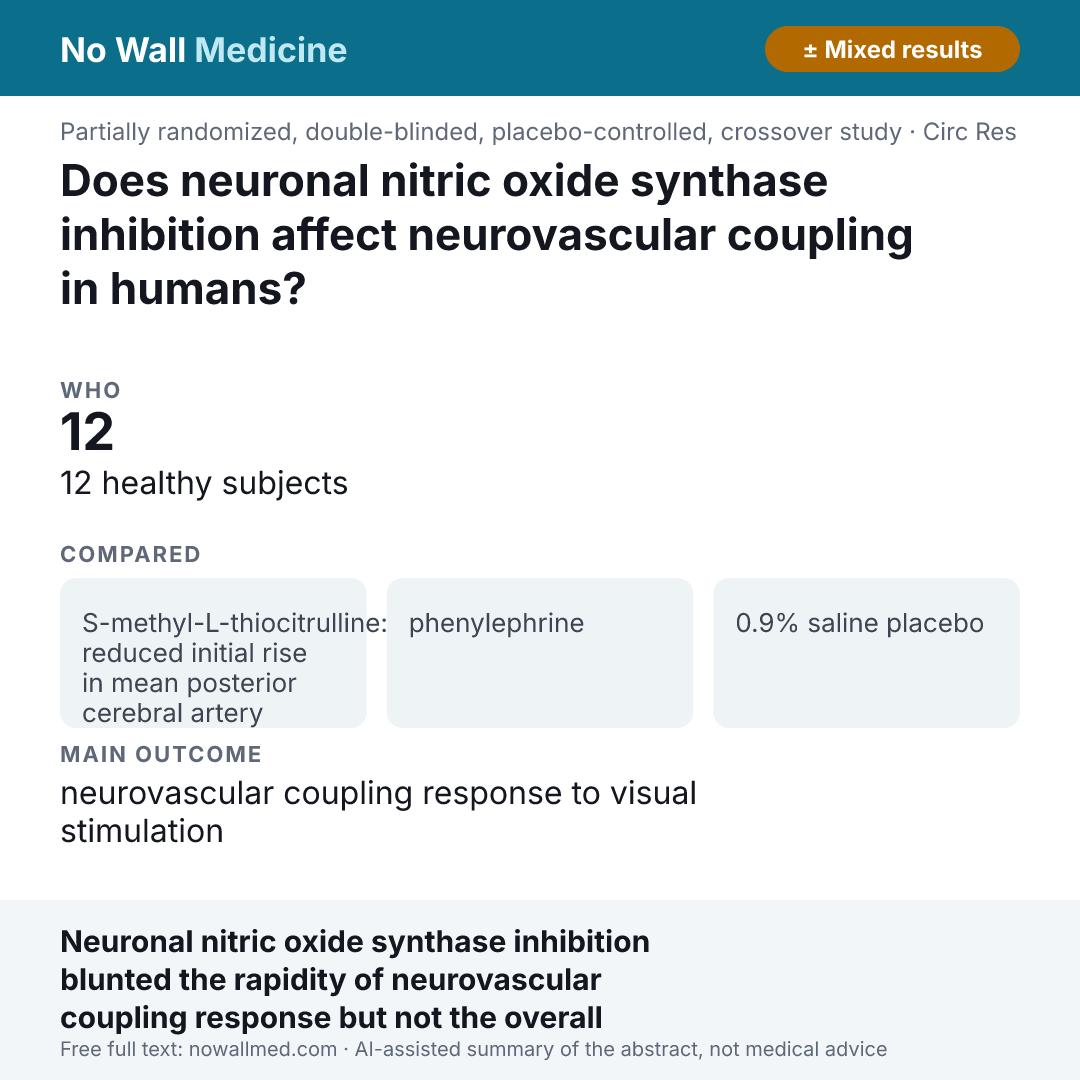
Clinical question: Does neuronal nitric oxide synthase inhibition affect neurovascular coupling in humans?
Key points
- Researchers studied 12 healthy subjects using a crossover design to compare a selective neuronal nitric oxide synthase inhibitor, a placebo, and a blood pressure control.
- Inhibition of the enzyme was associated with a -3.3% [-6.5, -0.01] reduction in the initial rise of mean posterior cerebral artery velocity and a -4.3% [-8.5, -0.1] reduction in the rate of velocity increase.
- The overall magnitude of the blood flow response in the posterior cerebral artery was not affected by the inhibitor compared to the placebo or pressor control.
Headline and key points written with AI from the paper’s abstract, with every number checked against it. Read the paper before relying on them.
Was this summary helpful?
Subject terms
Headline, design, result, key points, caveat and citation as plain text.
Cite this article
O'Gallagher K, Rosentreter RE, Elaine Soriano J, et al. The Effect of a Neuronal Nitric Oxide Synthase Inhibitor on Neurovascular Regulation in Humans. Circ Res. 2022;131(12):952-961. doi:10.1161/CIRCRESAHA.122.321631
Spotted a mistake? Suggest a correction